Majdanek this and that

A revisionist safe space
W
Wetzelrad
Posts: 534
Joined: Wed Feb 26, 2025 6:35 am

Re: Majdanek this and that

Post by Wetzelrad »

Fred Ziffel wrote: Fri Jan 16, 2026 6:53 am If you go on Google Earth (Not Google Maps), someone called Surgey Rudavin, bless his heart, took a 360 of the room.
Always appreciate those. In case you haven't seen it, Wikipedia hosts a 15,000 pixel-wide panoramic photo of chamber A/III interior.
https://commons.wikimedia.org/wiki/File ... r_Pano.jpg
Fred Ziffel wrote: Fri Jan 16, 2026 6:53 am You can see some blue staining on the B1 side, more than the “A” side [...]
I hadn't noticed it before, but you're right that there might be a faint blue patch under the viewport. Funny how there's more physical evidence for a Zyklon gassing there than on the opposite side of the wall.
Fred Ziffel wrote: Fri Jan 16, 2026 6:53 am Therefore, I say empty cans of Zyklon B stained the walls on the inside, and on the outside wall, “Stain 14” was due to HCN gas coming out of the “A” Chamber and because of that, “Stain A” was also a result of HCN gas escaping out the doorway of “A” Chamber.
An empty can or cans might do it. They may have had a bad procedure or someone not following the procedure once.

But the hypothetical person who backed out of the chamber with the empty cans could have left them outside next to the door as easily as anywhere else. I would still suggest that this is a more likely cause for the exterior stains (A and 14).

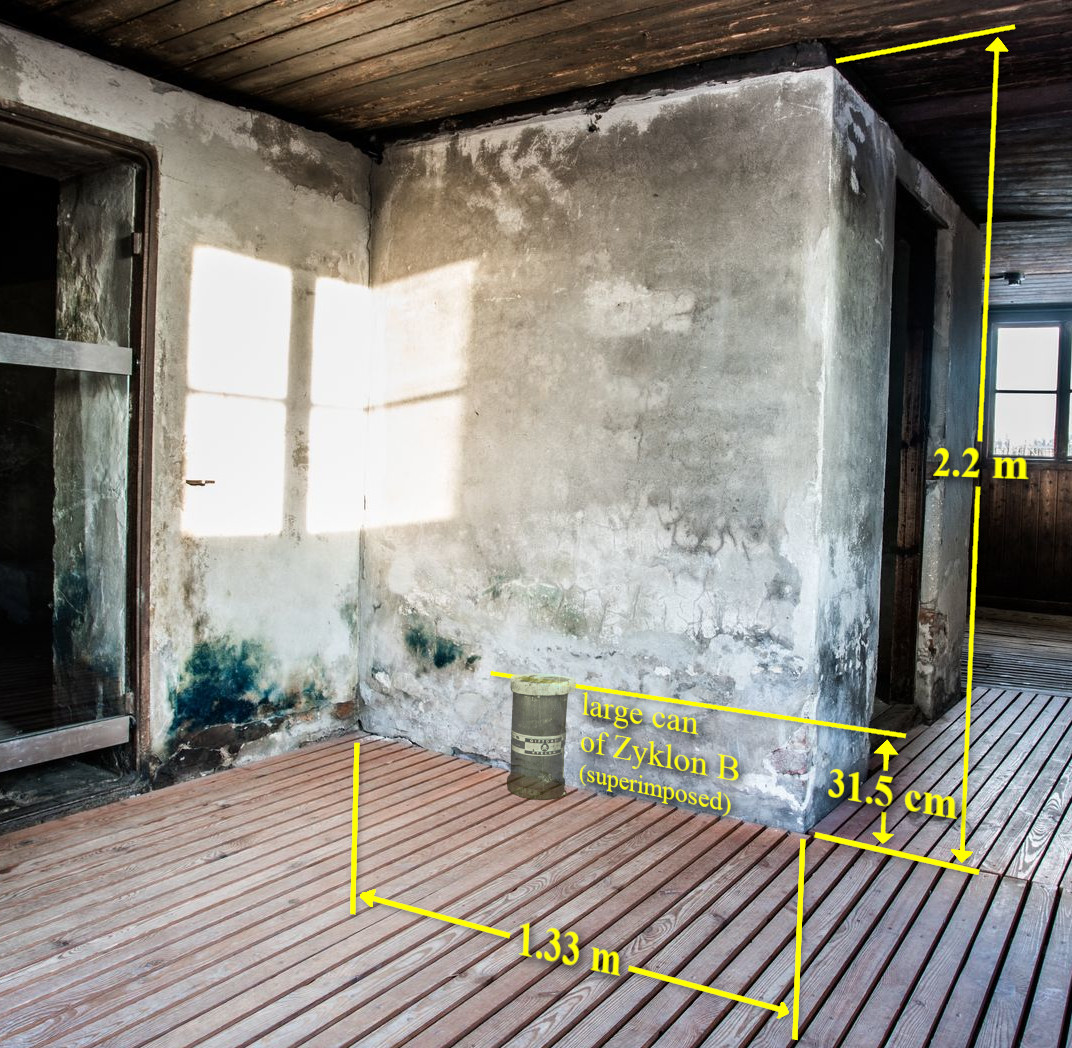
The Soviet report gives us some measurements that we can use. The height of a tall can of Zyklon B was 31.5 cm, the width of this wall was 1.13 m on the inside, and the height of one room on the inside was 2.2 m. Making some rough assumptions, we can visualize approximately how a can would look there.

Image

The stain appears to line up perfectly at 31.5 cm.
W
Wetzelrad
Posts: 534
Joined: Wed Feb 26, 2025 6:35 am

Re: Majdanek this and that

Post by Wetzelrad »

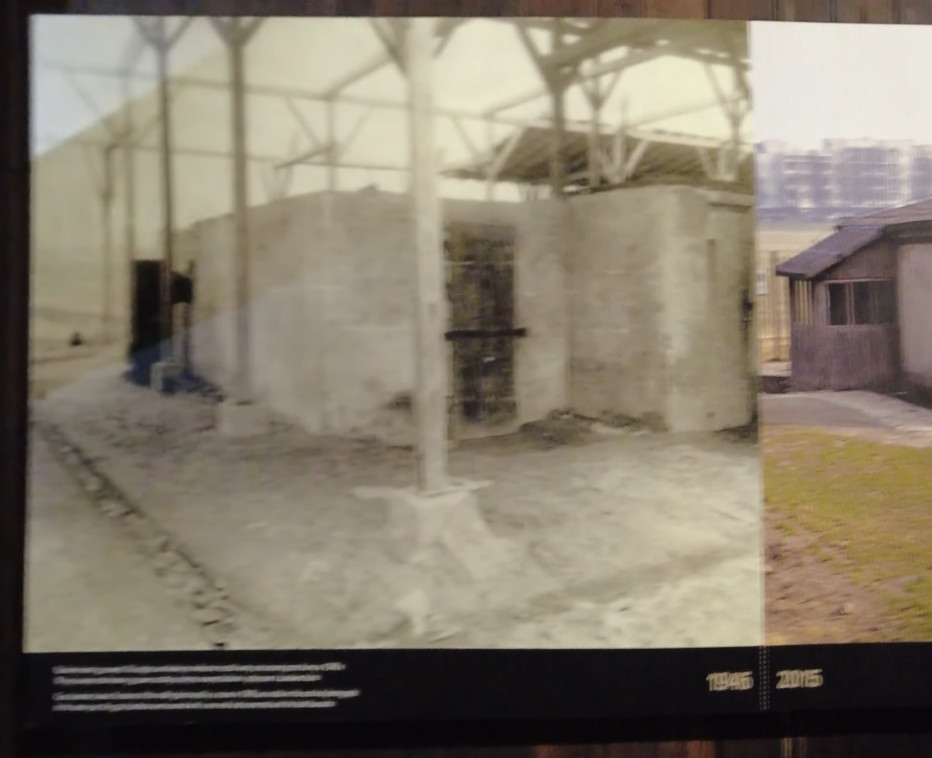
Have you noticed this? This photo from 1946, found in B43's "Past and Present" display, seems to be missing both exterior stains. It's a blurry capture and it's black-and-white, yet there's enough detail to see and match up fainter wall details, so why don't the intense dark splotches show?

Image
F
Fred Ziffel
Posts: 260
Joined: Sun Dec 01, 2024 11:02 am

Re: Majdanek this and that

Post by Fred Ziffel »

I am thinking yours is a 1500gm size. 500gm size was also used

Good point on the stains not visible. I have seen it many times and wondered. Germar perhaps would be a better source than me to figure out why this is. I have no answer for you.

The only thing I can say in my defense is the Majdanek camp has been in the hands of the Pols and Soviets since July 22,1944 till today. So, if any funny business occurred, they are the ones to point to, not the Germans. That photo was taken in 1946
Last edited by Fred Ziffel on Fri Jan 16, 2026 4:12 pm, edited 2 times in total.
I do not believe anything one is not allowed to question
F
Fred Ziffel
Posts: 260
Joined: Sun Dec 01, 2024 11:02 am

Re: Majdanek this and that

Post by Fred Ziffel »

True the height of the can does match. thanks for posting, Looks good
We have:
1. No other stains, no other cans were left in this area to stain the wall?
2. This location is outside in the open air. Excellent ventilation, Parts of the stain is quite intense
3. What caused the Stain "A"? Diffusion? HCN exposure? We at least now know it did not diffuse through the wall of Cell 14.
4. what was the cause of blue staining inside Cell 14? Cell 14 is enclosed and has blue stains, whereas your placement area was not enclosed. (I am not saying what you argue is not plausible. However, these are the conditions we have here)
Interesting for sure!
I wish I could have been a fly on the wall. but the Zyklon might kill me. LOL
I do not believe anything one is not allowed to question
W
Wetzelrad
Posts: 534
Joined: Wed Feb 26, 2025 6:35 am

Re: Majdanek this and that

Post by Wetzelrad »

Fred Ziffel wrote: Fri Jan 16, 2026 3:49 pm Good point on the stains not visible. I have seen it many times and wondered. Germar perhaps would be a better source than me to figure out why this is. I have no answer for you.

The only thing I can say in my defense is the Majdanek camp has been in the hands of the Pols and Soviets since July 22,1944 till today. So, if any funny business occurred, they are the ones to point to, not the Germans. That photo was taken in 1946
We also have Soviet liberation footage of the front of the bunker in 1944. See timestamp 05:36 of reel 5 here. Again the stains are missing. Here is a side-by-side comparison.

photo comparison of missing blue stains on exterior of chamber III and cell 14, Majdanek.jpg
photo comparison of missing blue stains on exterior of chamber III and cell 14, Majdanek.jpg (214.78 KiB) Viewed 423 times

This allows us to say confidently that someone used Zyklon at the Majdanek gas chambers well after the camp was liberated. For what reason? How many other stains were created postwar?
F
Fred Ziffel
Posts: 260
Joined: Sun Dec 01, 2024 11:02 am

Re: Majdanek this and that

Post by Fred Ziffel »

plausible argument, I point my feeble finger at the Pols first and or the Soviets.
Maybe to use up all that Zyklon they found in B52
I do not believe anything one is not allowed to question
W
Wetzelrad
Posts: 534
Joined: Wed Feb 26, 2025 6:35 am

Re: Majdanek this and that

Post by Wetzelrad »

I'm really skeptical of any legitimate usage, though.

Is it really believable that the Soviets occupied Majdanek, investigated it, determined that 1.5-2 million people died there, declared it was a "vernichtungslager", turned it into a museum, and then decided to use the ostensible "gas chambers" for delousing rather than treating the place with the respect that would normally be allotted to a site of mass murder?

I won't say it's impossible. Since at that time the Soviets were interring a few prisoners in Majdanek they might have had a genuine need for delousing there. But if so this allows us to say:

The Soviets overtook a "death camp" and continued to use its prisoner housing facilities for housing and its delousing facilities for delousing, exactly as they were designed for. This severely limits the plausibility that they believed it was a death camp where the gas chambers were used on humans.

On the other hand, maybe they didn't use the Zyklon for delousing but for some other exploratory use. A small part of me still wonders if the stains in chamber A/III are not evidence of an attempt to try to force HCN through the pipe system. Pressac once suggested something like that. Maybe he knew more than he was letting on. Rudolf also thought the stains around the pipes in chamber A/III were consistent with piped gaseous HCN. It seems possible that many stains were created by some clumsy postwar experiment. This is as far as I'll speculate for now.

Another possibility is that flooding caused the exterior stains to form, but this seems improbable on the whole.

One other curiosity about this is what it tells us about alkalinity. Since these two stains were made four or more years after construction (1942), then it means the concrete was still suitably alkaline for that long. Four years is a long time. Rudolf wrote in TCOA: "cement mortars and concretes [...] are noticeably alkaline for many weeks, months, or even years". This example shows he is correct and in no way exaggerating.

One last thing. A third stain, the one inside the gas chamber doorway, also might be missing in the Soviet film, but it's too dark to say for certain.
User avatar
HansHill
Posts: 1346
Joined: Sun Oct 06, 2024 3:06 pm
Location: Arlen, TX

Re: Majdanek this and that

Post by HansHill »

I hadn't been following along here before replying to you in the debate forum Wetzelrad. It seems you gents have covered alot of ground here! Just one point i wanted to address, i'm not sure if this:
Fred Ziffel wrote: Fri Jan 16, 2026 4:08 pm 3. What caused the Stain "A"? Diffusion? HCN exposure? We at least now know it did not diffuse through the wall of Cell 14.
is a safe assumption. We know that the formation of PB is predictable and regular, however it requires very specific variables such as iron content, moisture and temperature. There is one other instance of aggressive blue staining to appear on the exterior of a wall where we know the interior had been exposed to HCN, yet the interior wall remains unstained, example below - disinfestation room BW 5b from Birkenau:

Image

Here is the same southern wall from BW 5b displaying very obvious and aggressive PB on the exterior!

Image

The line of reasoning here will be that the plaster on the interior of BW 5b was poor in iron content, yet the brickwork underneath obviously was much more accommodating to PB formation. Its probably extremely unlikely that anyone has a measurement of the iron content of the plaster in cell 14, but unless this is measured I don't think diffusion can be ruled out entirely!
W
Wetzelrad
Posts: 534
Joined: Wed Feb 26, 2025 6:35 am

Re: Majdanek this and that

Post by Wetzelrad »

HansHill wrote: Sun Jan 18, 2026 9:40 pmThere is one other instance of aggressive blue staining to appear on the exterior of a wall where we know the interior had been exposed to HCN, yet the interior wall remains unstained, example below - disinfestation room BW 5b from Birkenau:
I see your point, but this is less a comparison of interior to exterior than of iron-poor plaster to brick and mortar. I expect that if both sides had been plastered at the time of construction, or if the plaster were tore up today, the blue would appear similar on both sides, if not more intense on the interior side.

For Majdanek, I might accept that diffusion could still be a possible explanation for the stain on the front of chamber III/A, but diffusion looks impossible for cell 14 judging by the unmatched locations of the stains and their distances from where gassing was done. Also, the wall seems relatively thin for this room, so I might guess it lacks underlying brickwork.

By the way, I didn't mean to turn Fred's thread into another Prussian Blue deep dive, lol. I'll be moving on to other matters soon.
User avatar
HansHill
Posts: 1346
Joined: Sun Oct 06, 2024 3:06 pm
Location: Arlen, TX

Re: Majdanek this and that

Post by HansHill »

Either way it's still a fascinating discussion point. This is the exact kind of thing that the experts should be investigating openly, honestly, and transparently, and strikes me as what Rudolf refers to in TCOA where he says more work is needed to be done, leaving his theory in a falsifiable state.

Were the Holocaust to be an actual historical event like any other, you could quite easily imagine two experts live on CNN or MSNBC, one arguing the case for Soviet gassings post war, one countering and arguing for legitimate usage, and ultimately what it means for our understanding of 1) the Majdanek timeline and narrative, and 2) the implications for Birkenau absence of stains.

I was in the middle of writing Richard Green and Germar Rudolf live on CNN, but in this scenario, it wouldn't even need to be Rudolf, it would be any number of other experts who are not terrified for their livelihood and freedom.

Anyway sorry Mr Ziffel for disturbing your Majdanek megathread!
W
Wetzelrad
Posts: 534
Joined: Wed Feb 26, 2025 6:35 am

Re: Majdanek this and that

Post by Wetzelrad »

Fred, what do you know about the barbed wire fences in the gas chamber area? The Soviet report describes it as surrounding the entire canopy and separating the bathhouses from the bunker. From Concentration Camp Majdanek, pp.119-123:
The pole-support roof is surrounded by a 3-m-high barbed wire barrier with two gates to admit vehicles. The pole-support roof is only accessible through said gate or through the immediately adjacent Undressing Room of Barrack No. 42 and the gas chamber of Barrack No. 41 / see Diagram 1 /.
Chamber No. III [...] is not connected to the Shower; it is a detached building and is separated from the Shower by a barbed wire barrier.
The distance between B41 and the bunker is actually quite short. Was there really a fence between them? This is a pretty important detail for how it was used. Knowing where all the gates were is also critically important.

I also see in two photos that there was a fence between B41 and B42, actually circling B42. What was its purpose?
F
Fred Ziffel
Posts: 260
Joined: Sun Dec 01, 2024 11:02 am

Re: Majdanek this and that

Post by Fred Ziffel »

I do not have much more than you on this subject, The one you see that encloses B42 has a gate in back of the photo and that jives with the drawing. People that were first entering the camp conceivably entered through this gate.
2nd photo (greenish) shows fence with gate towards the front that runs between B41 and B42. completely disregard the red arrows. that has nothing to do with subject at hand
for all that may not know "X" on the fence is a gate
But I will leave you with a few photos and a drawing of the seeable fence arrangements
Attachments
drawing of 3 buildings at maj.JPG
drawing of 3 buildings at maj.JPG (62.38 KiB) Viewed 246 times
good photo of Majdanek B41.JPG
good photo of Majdanek B41.JPG (115.35 KiB) Viewed 246 times
41 maj.jpg
41 maj.jpg (229.97 KiB) Viewed 246 times
Last edited by Fred Ziffel on Mon Jan 26, 2026 8:51 am, edited 5 times in total.
I do not believe anything one is not allowed to question
F
Fred Ziffel
Posts: 260
Joined: Sun Dec 01, 2024 11:02 am

Re: Majdanek this and that

Post by Fred Ziffel »

Here is another stain in the area that may be of interest to you all

It is a small stain located on the other side of the "A" Chamber door near the bottom
I wager this was due to diffusion since there is a stain on the other side inside
Attachments
gfdhlk;h.JPG
gfdhlk;h.JPG (202.54 KiB) Viewed 246 times
777.JPG
777.JPG (102.79 KiB) Viewed 246 times
I do not believe anything one is not allowed to question
W
Wetzelrad
Posts: 534
Joined: Wed Feb 26, 2025 6:35 am

Re: Majdanek this and that

Post by Wetzelrad »

Yes, that definitely looks like diffusion and it makes sense. Good photos.
W
Wetzelrad
Posts: 534
Joined: Wed Feb 26, 2025 6:35 am

Re: Majdanek this and that

Post by Wetzelrad »

Fred Ziffel wrote: Sun Jan 25, 2026 9:48 am I do not have much more than you on this subject, The one you see that encloses B42 has a gate in back of the photo and that jives with the drawing. People that were first entering the camp conceivably entered through this gate.
2nd photo (greenish) shows fence with gate towards the front that runs between B1 and B42. completely disregard the red arrows. that has nothing to do with subject at hand
for all that may not know "X" on the fence is a gate
But I will leave you with a few photos and a drawing of the seeable fence arrangements
Ok. Given that the Soviet drawing seems to indicate the line of the barbed wire fence, plus gates, I will assume it is correct and the description in the report is mistaken or mistranslated. Thanks.

My goal is to figure out the flow of the prisoners. I intend to map this out later, but for now consider my text description and this photo:
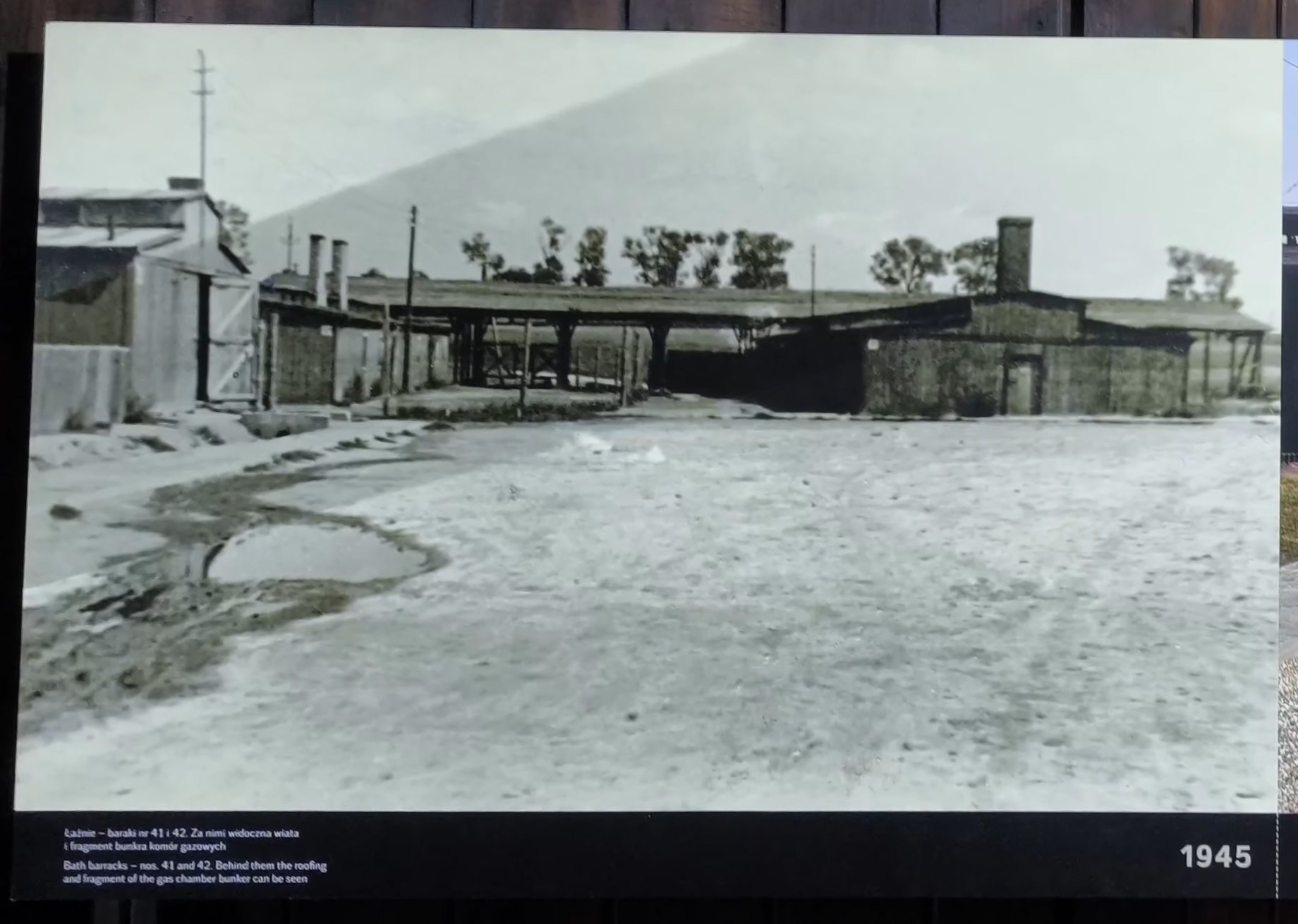
photo of front of B42 and B41, 1945.jpg
photo of front of B42 and B41, 1945.jpg (271.83 KiB) Viewed 234 times

If I am seeing this photo correctly, it shows a barbed wire fence running from the corner of B43 circling around B42 and ending at the southern gate of the canopy roof. The gate opens into this fenced path. Not pictured, we also know from the museum that there is a fenced enclosure to the west (left) of B42 where selections were performed, referred to as the "Rosengarten selection square". Presumably this path leads there.

Now let's consider how this is supposed to have worked. Prisoners entered B41 from the south and in the first room they undressed (if not already naked) and were shaved here, then continued north to the shower. Then what? Those to be gassed were to continue north through to the gas chambers. However, those selected to live would also march north, getting fresh clothing in what the museum calls "the dressing room". They must then have exited by the north door, which would actually put them inside the barbed wire fence surrounding the gas chamber bunker. The only sensible path from here would be to exit the fence through one of the two vehicle gates, but this poses a novel problem. The north gate takes them outside and away from the camp. A backwards path of travel. The south gate takes them into the B42 enclosure, which leads back to the "Rosengarten selection square". Again, a backwards path of travel.

I consider this pretty strong evidence that the path of travel has been reversed from its reality.

However there are still some lingering questions. Most importantly, from where did prisoners enter the Rosengarten square? I'm struggling to chart a complete path for the prisoners that does not have unclean prisoners walking through an area deemed clean or vice versa. I assume the clean/unclean distinction was maintained across the facility. But maybe a different photo or something can clarify the path.

Admittedly, your greenish photo contradicts my whole thesis. It shows an entirely different fence arrangement. Determining the date of this photo could decide whether this matters or not. In the video you got it from, it's mixed in with photos from different time periods and which are missing the fence.

Separate from all this, it is very unclear how selections took place at Majdanek. According to the first few museum signs in B41, the prisoners were marched naked from an Effektenbaracke to B41, but then a later sign says that they actually came clothed from the Rosengarten square to B41. A contradiction. Another contradiction is whether selection took place in the shower, as a sign in B42 claims, or in the Rosengarten square. The story is mercurial which makes it difficult to disprove.
Post Reply