Soviet Extraordinary State Commission (ChGK) Investigations of Camps

A revisionist safe space
Post Reply
p
pilgrimofdark
Posts: 402
Joined: Sat Aug 09, 2025 7:46 pm

Soviet Extraordinary State Commission (ChGK) Investigations of Camps

Post by pilgrimofdark »

The Soviet Extraordinary State Commission (ChGK / ESC) did investigations of the Nazi camps of Majdanek and Treblinka. Majdanek/Lublin was investigated in August 1944, and Treblinka in October 1944.

Majdanek documents: https://docs.historyrussia.org/ru/nodes/354230
Treblinka documents: https://docs.historyrussia.org/ru/nodes/354229

I AI-translated the Treblinka documents into English and posted on the Wiki. But you can also go to the Russian website and use a browser translator to auto-translate.

Majdanek discussion: Wetzelrad read through the Majdanek documents and added some analysis. He might repost that here or add more thoughts?

Treblinka discussion: the main focus of the Treblinka interrogations/report is the deportation of US and British citizens to be killed at Treblinka. They are said to have been among the first deportees/victims of the camp.

Interestingly, the ESC conflates the T-II camp with the T-I camp, concluding that Baron van Eupen was commandant of the camp, which had a gassing installation for killing American/British citizens.
This brutal extermination was carried out primarily by gassing in a specially equipped room. Some prisoners were shot.
[...]
All atrocities at the Treblinka camp were carried out by the Germans under the direction and with the personal participation of the camp commandant, Baron van Eupen.
[...]
On the basis of the investigation carried out, the Extraordinary State Commission established that this monstrous crime – the extermination of US and British citizens – was committed by the commandant of the Treblinka camp, Baron van Eupen, the head of the camp, Oberscharführer Franz...

- from the Draft Report
There were 3 other Soviet investigations of Treblinka before the ESC: August, September, and SMERSH in September/November. So the ESC had several reports and several months to straighten out the difference between T-I and T-II and ended up with van Eupen and Franz in charge. No mention of Stangl at all.

Of the people interrogated by the ESC, several make appearances later. Oskar Strawczynski was at the 1945 Polish site visit and has published memoirs ("Ten Months in Treblinka"). Aleksander Kudlik was also at the site visit. Two of the maps on the DeathCamps.org website list Kudlik as a source.

The Poles attempted to interviews others, like Mendel Koritnicki, Wolf Szejnberg, and Pinkhus Weissman, and were unable to find them for the 1945 investigation.

Short look at 1944 Soviet/1945 Polish investigation overlap here.

Majdanek-Treblinka link: the reason I've included both in one thread so far is the involvement by Dmitry Ivanovich Kudryavtsev. One of the Russian books listed above states this about Kudryavtsev:
Dmitry Ivanovich Kudryavtsev was an engineer-economist and specialist in international law. In the 1920s, he worked at the Soviet trade mission in Vienna. He was one of the most active members of the Extraordinary State Commission (ChGK). In August 1944, he served as deputy chairman of the Polish-Soviet Extraordinary Commission for investigating German atrocities at Majdanek in Lublin.
Klaus Schwensen examined the "genesis of a propaganda project" of the ESC's report on Sachsenhausen, which also involved D. I. Kudryavzev/Kudryavtsev. Schwensen found six drafts of this report.

The report on Treblinka has numerous corrections/edits and exists in two versions. The Majdanek documents also show numerous edits, some material changes to the actual testimony of witnesses.

Neither the ESC's Sachsenhausen report nor the Treblinka report were published.

Although the ESC was large and expansive, there are some key links between the investigation of these three camps, especially in the personal involvement of Dmitry Ivanovich Kudryavtsev.
p
pilgrimofdark
Posts: 402
Joined: Sat Aug 09, 2025 7:46 pm

Re: Soviet Extraordinary State Commission (ChGK) Investigations of Camps

Post by pilgrimofdark »

Kudryavtsev was also involved in ChGK investigations of other camps.

Ozarichi. March-April, 1944. Documents are transcribed so can be auto-translated.

The Germans are accused of intentionally spreading typhus among the Soviet population, among other atrocities like shootings and burning people alive.

Lamsdorf. 1946. Documents are transcribed.

Accusations of general neglect of Soviet prisoners and shootings.
W
Wetzelrad
Posts: 589
Joined: Wed Feb 26, 2025 6:35 am

Re: Soviet Extraordinary State Commission (ChGK) Investigations of Camps

Post by Wetzelrad »

It's great to have these resources in English. To be clear, this book (Majdanek Concentration Camp. Research. Documents. Memoirs.) may not be fully comprehensive. It contains seven protocols ranging from the first meeting on August 18 to what could be the last meeting on August 28, 1944. It does not contain the more technical reports on gas chambers and the crematorium from the same period which are quoted in Graf and Mattogno's Concentration Camp Majdanek, pp.117f and 114f respectively, although they are referenced and summarized.

Here is my previous post about the Majdanek reports, for those interested:
Spoiler
Wetzelrad wrote: Thu Jan 29, 2026 3:50 pm Thanks, I wasn't able to find this on my own. Maybe the reason they haven't been published in plain English is because they are so conspicuously filled with lies or exaggerations. Even the people who compiled and edited this book had to add a lot of corrective footnotes for that reason.

These reports are not strictly the same as what Graf/Mattogno included. The technical reports on gassing and cremation are totally missing from this collection. I don't have much of consequence to say that hasn't already been said better by Graf/Mattogno. Still, here are my thoughts.

These reports are very propagandistic reading from top to bottom. Among many absurdities, they said moldy horse sausage was "considered a special delicacy" (p.311), and also "crushed glass was added to the food" to kill people (p.312), and "Infants were smashed against walls and trees, some were torn in half" (p.317). Obviously someone who makes up stories like this will still be making up stories when he talks about gas chambers and torture. None the less, this is the Holocaust Narrative, so we all pretend it must be taken seriously.

The first and only mention of photographs was made in the context of the gas chambers and crematorium (p.333). Are those photos available somewhere? More to the point, why didn't they take photos to prove what were claimed to be the bones "of hundreds of thousands of people" (p.319)?

An incredible claim was made about Zyklon B (p.334):
The "Zyklon" preparation, by its very nature, could only be used for suffocating people, and in no case for any disinfection purposes. The chemical expert analysis entirely confirms that the design of the gas chambers and the chemical devices found in them served exclusively one main purpose, which guided everything at Majdanek – the purpose of exterminating as many people as possible.
[Addition: These remarks are written as part of a summary of the words of chief engineer G. P. Grigorev (or Grigoriev), who helped write the gas chamber report. That report makes similar false remarks about exclusivity.]

So the Soviet position was that a common disinfestant could never be used for disinfestation, and a place designed explicitly as a "disinfestation facility" did not even have a dual purpose of disinfestation but was instead exclusively used for murder. This is extremely far from the museum's current position.

A witness by the name of Tadeusz Budzyn described a strange process for the supposed "Harvest Festival". Whereas the official narrative is that the fence of Field V was cut open to walk the victims to the pits, Budzyn claimed the victims were sent through "a special trench" which went literally "under the barracks" in which they undressed. The trench was dug just "that moment". (p.343) Another witness by the name of Andrei Stanislavsky corroborated that there was a tunnel (p.352). The Soviets must have realized some time later that cutting a fence made more sense than digging a tunnel under a fence and a building.

One document includes a remarkable speech by the Jewish Zionist Emil Sommerstein, chairman of the newly formed Central Committee of the Jews in Poland. Sommerstein's idea was that the commission's findings at Majdanek should be used to propagandize the whole world. Here are a few sentences (pp.335-336):
What we have heard must be spoken about, it must be shouted on all the streets, at all the crossroads, to the whole world. [...] The description of Majdanek, like an injection, must be administered to all people against the German contagion. [...] But at Majdanek, all available material evidence must be preserved as a heritage of all mankind. Streams
of visitors should flock to these places, just as processions go to great world shrines.
Very prescient, if not causative. Sommerstein also helped question witnesses.

Numerous speakers spoke about Jewish victimhood or even the superior victimhood of Jews. This surprised me since I have often been told that the Soviets erased Jewish identity from the Holocaust.

I would like to hear what the editors of this book, or really anyone at all, think of the copious handwritten "corrections" made to witness testimonies. In some places whole questions and answers were crossed out. In others there are material rewordings. For example a witness claimed the victims of gassing had their "lungs burst", but someone downgraded this to say that their "lung tissue could not withstand" the gas (p.351). Every page of the report on witness testimony has a bunch of these corrections. Wasn't this an overt rewriting of history?

In the conclusion to the report on witness testimony, a handwritten correction changed the number of dead from 2,000,000 to 1,500,000 (p.362). There are some other changes similar to this, e.g. "more than" was downgraded to "approximately" (p.418).

Perhaps this entire commission could be summed up with one handwritten note which asked, "How does he know this?" but which was then subsequently crossed out (p.404).

I am retaining an English translation of these reports to reference and pull quotes from in the future.
The most remarkable -- and most revealing -- part of these reports are the conclusory remarks about gas chambers. They literally denied that the disinfection facility ("Entwesungsanlage") was designed for disinfection and that the fumigant (Zyklon B) was a fumigant. In so doing they exposed a giant gaping hole in their gassing narrative. Any average Joe with a spark of skepticism would tend to wonder if the supposed gas chambers at Majdanek had a more mundane purpose, but the Soviets tried to head off that skepticism by denying that a mundane purpose was even possible. A giant lie to cover up a giant hole. (Today the museum does admit that delousing clothing and blankets with Zyklon B was common in these locations. One of the Majdanek Museum's many concessions to revisionism.)

Another matter that warrants careful consideration is the many handwritten corrections to factual allegations. In what world is it acceptable to alter a witness's answer from "I don't know for sure" to "Yes" (p.341)? Or to alter another witness's answer from "6 p.m." to "8 p.m." (p.343)? Or to delete entire sentences, like "moreover, the road from Lublin to Majdanek was strewn with corpses." (p.344)? Some of these testimony pages have 10 or more of these alterations, applying both to questions and answers.

Hundreds of thousands of people were also wiped away with the flick of a pen. The words "the Germans killed approximately 2,000,000" were rewritten as "The total number of people tortured to death in the camp exceeds one and a half million people." (p.362). Reading through these handwritten alterations, I do not get the impression that the editor was concerned so much with truth as with being found out.

I also neglected to mention Katyn. In these reports the Soviets repeatedly claimed that cremation was spurred on or inspired by the revelations of Poles murdered and buried in the Katyn Forest -- revelations that historians now agree came from the Germans, and murders which historians now agree were committed by the Soviets. These Katyn claims appear on pages 318, 322, 375, and lastly in this passage from page 412:
After the exposure of the German atrocities in the Katyn forest, they particularly carefully set about extracting the corpses from the pits and trenches where they had previously been buried, and burning them.
I sometimes think that Holocaust skeptics overemphasize the importance of the Katyn Massacre, but the Soviets keep proving me wrong. Believing in their version of Katyn seems to have been integral to their version of the Holocaust Narrative.

Katyn is given as the direct reason for why Germans had to erase the bodies of their victims. Are we supposed to pretend that this reasoning remains in tact when the Soviets were proven wrong about Katyn? It was a nice propaganda story when they came up with it. Now it's a sort of lingering belief that people still hold today (e.g. on Wikipedia), but it doesn't make as much sense, and I can't find any supporting evidence for it. A topic for another thread, I suppose.
p
pilgrimofdark
Posts: 402
Joined: Sat Aug 09, 2025 7:46 pm

Re: Soviet Extraordinary State Commission (ChGK) Investigations of Camps

Post by pilgrimofdark »

Just as interesting as the Treblinka reports are the eyewitness interrogations and the story they tell.

The Soviets considered several angles in constructing this narrative, gathering enough evidence to conclude that 1,000 American/British citizens had been sent to Treblinka and killed in the gas chambers -- by Baron van Eupen!

There are two main types of witnesses:
  1. those who observed US/British citizens being rounded up in the Warsaw Ghetto and deported
  2. those who observed their presence at Treblinka (directly or circumstantial)
FROM Warsaw Ghetto

Koritnicki reports that, in July 1942, British and American citizens who were Jews were taken by car from the Warsaw Ghetto to the Pawiak prison.

Szejnberg reports the notices were posted on July 20, stating citizens of foreign countries were required to report to the Pawiak prison by July 22. This would make them among the first deportees to Treblinka. Weissman also reports the same notice and the same date.

In late August/early September, Weissman reports American/British citizens being sent from the Warsaw SS prison to Treblinka. He knew about it, "everyone in the Warsaw ghetto" knew about it, and Lichtenbaum, Stolzman, Finkel, and others also told him about it.

TO Treblinka

Ciechanowski claims to being in the camp as of early June 1942. Six to seven weeks later, he speaks with people at Treblinka who tell him in broken Polish, "We are English, we were brought from Warsaw."

Ciechanowski also claims that Maier Greenberg, who was in charge of unloading people from the trains and cleaning the traincars, told him of the arrival of a train of Englishmen.

Someone named Jozef told Kudlik that "hundreds" of American and British citizens were murdered in the camp.

In September, Koritnicki (same as above) was sent to Treblinka and was told that the British/American Jews were among the first people brought to the camp. He was told this by Shlema Skiba, Hersz Jabkowski, and Leib Wenger.

The blacksmith Hersz Jabkowski also told Strawczynski about the arrival and executions.

The cook Maier (maybe different from above?) also told Strawczynski about this.

Strawczynski claims "many other carpenters, tailors, and shoemakers" reported this to him.

Szejnberg claims that American and British Jews were even sent to the Treblinka I Labor Camp and shot in the woods in February 1943. Szejnberg also talked to Koritnicki who said American/British Jews were also killed at T-II.

In May 1943, Weissman was among the last deportees from Warsaw to Treblinka. He was told there that British/American citizens had been killed in gas chambers. "All the prisoners were talking about this." He also heard from attorney Reisner that some had been shot in the forest near T-I.

Circumstantial evidence:
  • American/British passports (Kudlik, Rosenthal), a huge pile of them (Strawczynski) that were burned (Koritnicki). Kudlik also claims other prisoners who worked sorting belongings also reported finding passports in the pockets of those murdered
  • Photographs with city stamps like "Chicago" and "New York" and "Boston" (Strawczynski)
  • Pens from a Canadian brand not sold in Poland before the war (Kudlik)
  • Suitcases with labels in English (Koritnicki)
  • American and British currency (Koritnicki)
  • College diplomas (Rosenthal)
  • Labels on shoes made in England (Ciechanowski)
  • Stock certificates (Rosenthal)
  • Marriage certificates (Rosenthal)
  • Postage stamps with photo of the White House (Rosenthal)
Rosenthal was told by Jakub Ackerman and Mendel Cohn that they had also encountered American documents and items many times.
User avatar
Stubble
Posts: 3355
Joined: Sun Dec 08, 2024 10:43 am
Location: 5th Circle of Hell

Re: Soviet Extraordinary State Commission (ChGK) Investigations of Camps

Post by Stubble »

This reminds me of something in the refugee files.

Document counterfeiting was a big industry, supported by jews, during ww2. The German Authorities actually went so far as to arrest some south American diplomats for issuing 'funny papers' to jews so they could move more freely in the Reich and occupied territories, likely so they could get out. A special section of Bergen Belsen was set up to house jews with 'Funny Papers'.

Sorry for the slight derailment, but, this seemed tangentially related and may or may not be widely known.
If I were to guess why no t4 personnel were chosen to perform gassing that had experience with gassing, it would be because THERE WERE NONE.
p
pilgrimofdark
Posts: 402
Joined: Sat Aug 09, 2025 7:46 pm

Re: Soviet Extraordinary State Commission (ChGK) Investigations of Camps

Post by pilgrimofdark »

Strawczynski's involvement in this raises a number of other issues.

Strawczynski's story is that he was deported from Czestochowa in October 1942 to Treblinka, then remained there until the uprising on August 2, 1943. Then he escaped to the forest and joined a partisan group that included members of the Jewish Combat Organization (ZOB) that had escaped the Warsaw Ghetto after the ghetto uprising in April/May 1943.

Four of the Soviet ESC interrogations were done in Wegrow.
  • Strawczynski - deported from Czestochowa
  • Boraks - deported from Czestochowa
  • Kudlik - deported from Czestochowa
  • Ciechanowski - deported from Stoczek
Then the others elsewhere:
  • Koritnicki - deported from Warsaw, interview in Sterdyn
  • Rosenthal - deported from Kozienice, interview in Sterdyn
  • Szejnberg - deported from Warsaw, interview in Kosow Lacki
  • Weissman - deported from Warsaw, interview in Kosow Lacki
They were all done over two days, October 3-4, 1943.

So numerous deportees from Czestochowa were working in Treblinka and survived from October through the uprising and the chase afterwards, eventually ending up in Wegrow.

Strawczynski (and maybe others) joined a Warsaw-based partisan movement living in the woods around Treblinka, surviving there until the Soviets arrived.

Then they gave info to the Soviet ESC/ChGK on the execution of American/British citizens.

Did these Jewish partisans perpetuate a fraud on the Soviets, and the Soviets just bought it?

Did the Jewish partisans collaborate with the Soviets to perpetuate a fraud?
p
pilgrimofdark
Posts: 402
Joined: Sat Aug 09, 2025 7:46 pm

Re: Soviet Extraordinary State Commission (ChGK) Investigations of Camps

Post by pilgrimofdark »

Dmitry Ivanovich Kudryavtsev/Kudryavzev only has a few mentions on CODOH, one of them in Scwhensen's article on the ESC Sachsenhausen drafts.

"He was one of the most active members of the Extraordinary State Commission (ChGK)," according to the Russian book on Treblinka.

That might be understating his importance in documenting and fabricating evidence.

List of camps that he was part of the ESC investigation for:
  • Ozarichi - March/April, 1944
  • Majdanek - August 1944
  • Treblinka - October/December 1944
  • Auschwitz - January 1945 (USSR-8 in IMT)
  • Sachsenhausen - May/June 1945
  • Lamsdorf - 1946
He investigated as many "extermination/death" camps as Zdzisław Łukaszkiewicz, who did Majdanek, Treblinka, and Sobibor for the Polish communist government.

So this one person was a major chokepoint for information on the investigations of important camps. Some of his work was used at the IMT, while other reports show clear signs of fabrication and were swept under the rug.
User avatar
Archie
Site Admin
Posts: 1601
Joined: Thu Sep 12, 2024 6:54 am

Re: Soviet Extraordinary State Commission (ChGK) Investigations of Camps

Post by Archie »

For Majdanek, the joint commission invited foreign press to tour the camp. The accounts of these journalists are another source, and often there are additional details.

These first two are earlier reports from Soviet journalists
Konstantin Simonov, Krasnaya Zvezda (Red Star), 10-12 Aug 1944
Roman Karmen, Daily Worker, 14 Aug 1944

W. H. Lawrence, NYT, 30 Aug 1944
Maurice Hindus, New York Herald Tribune, 30 Aug 1944
Daniel De Luce, Associate Press (Evening Star and others), 30 Aug 1944
Alexander Werth, Christian Science Monitor, 1 Sep 1944
Arthur Inkpin, United Press (Detroit Evening News and others), 30 Aug 1944
Richard Lauterbach, Time, 11 Sep 1944
"Merchants of Murder," Newsweek, 11 Sep 1944
Incredulity Enthusiast
User avatar
Hektor
Posts: 447
Joined: Mon Nov 18, 2024 6:58 pm

Re: Soviet Extraordinary State Commission (ChGK) Investigations of Camps

Post by Hektor »

Archie wrote: Tue Feb 24, 2026 6:24 am For Majdanek, the joint commission invited foreign press to tour the camp. The accounts of these journalists are another source, and often there are additional details.

These first two are earlier reports from Soviet journalists
Konstantin Simonov, Krasnaya Zvezda (Red Star), 10-12 Aug 1944
Roman Karmen, Daily Worker, 14 Aug 1944

W. H. Lawrence, NYT, 30 Aug 1944
Maurice Hindus, New York Herald Tribune, 30 Aug 1944
Daniel De Luce, Associate Press (Evening Star and others), 30 Aug 1944
Alexander Werth, Christian Science Monitor, 1 Sep 1944
Arthur Inkpin, United Press (Detroit Evening News and others), 30 Aug 1944
Richard Lauterbach, Time, 11 Sep 1944
"Merchants of Murder," Newsweek, 11 Sep 1944

I recall photos from Majdanek, which appeared over the top. Are they from those commissions / journalists.
User avatar
Stubble
Posts: 3355
Joined: Sun Dec 08, 2024 10:43 am
Location: 5th Circle of Hell

Re: Soviet Extraordinary State Commission (ChGK) Investigations of Camps

Post by Stubble »

Looking over The Hadamar Trial and the 'loophole' I am wondering if the 'dead American and British Citizens' were to get the legal ball rolling before Nuremberg. Seems that was the route that was taken with Hadamar under the claim of Poles and Soviet POW's.

Just a thought.

I wish I had something more to add here, but, it would appear this thread has moved straight past me and there's next to nothing I can offer.
If I were to guess why no t4 personnel were chosen to perform gassing that had experience with gassing, it would be because THERE WERE NONE.
p
pilgrimofdark
Posts: 402
Joined: Sat Aug 09, 2025 7:46 pm

Re: Soviet Extraordinary State Commission (ChGK) Investigations of Camps

Post by pilgrimofdark »

Stubble wrote: Tue Feb 24, 2026 9:32 pm I wish I had something more to add here, but, it would appear this thread has moved straight past me and there's next to nothing I can offer.
It's moved past me, too.

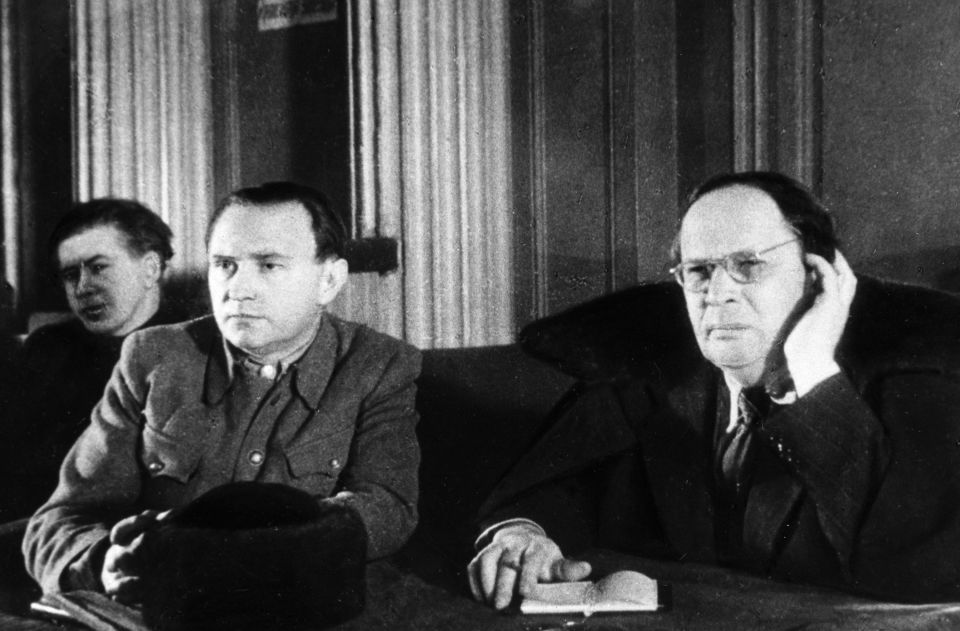
Image
Caption: February 28, 1943. Writer Alexei Tolstoy (right) and head of the Extraordinary State Commission department Dmitry Kudryavtsev at a meeting of the Extraordinary State Commission. Source

The USHMM has an entry on Endlager Ozarichi, where it's claimed the Wehrmacht set up detention camps, built fences around them, planted mines, and then just left tens of thousands of people to die. That's similar to what the ESC report says, with added intentional spreading of typhus.

A few books/articles seem to mention him, but they didn't have access to these unpublished Draft Reports full of fabrications.

Studies on the Warsaw Ghetto know nothing about this supposed imprisonment of US/British citizens in Pawiak Prison on July 22, 1942. The conventional story is that the Germans took some Warsaw Jewish hostages and put them there in order to ensure the deportation went smoothly. And July 22 was the start of the deportation action -- no "foreign nationals" action preceding it, and all the Pawiak prison hostages were freed by September.

The Ringelblum Archive is the most likely source for a copy of the "notice" announcing the roundup of foreign nationals. But the catalog of materials has nothing like it in the sections on German documents/periodicals.

There's not a lot written about this Kudryavtsev person. He shows up in ChGK reports and documents, but no study tracing which investigations he was a part of and his role in them.

---
Wetzelrad wrote: Mon Feb 23, 2026 5:57 am I sometimes think that Holocaust skeptics overemphasize the importance of the Katyn Massacre, but the Soviets keep proving me wrong. Believing in their version of Katyn seems to have been integral to their version of the Holocaust Narrative.
I also get "Katyn fatigue," assuming revisionist works focus too much on it.

But then I pick up an eyewitness testimony or Soviet report, and Katyn is shoehorned in by them.

Another example, from the article "People and Procedures: Toward a History of the Investigation of Nazi Crimes in the USSR" that Archie recommended elsewhere. It's also referenced in Schwensen's article on the ChGK and Sachsenhausen:
But only as the “Katyn affair” began to unfold in mid-April 1943 did the activity of the ChGK really start to gather momentum. The Soviet leadership was forced to energize the work of the ChGK by concern over the political implications of Katyn and the urgent need for a tough response, combined with the need to restore economic, political, and ideological control over the territories that had either already been or were in the process of being freed.
So even the mainstream position is that the German discovery of the Katyn victims spurred the ChGK to further action. It had been created in late 1942.
p
pilgrimofdark
Posts: 402
Joined: Sat Aug 09, 2025 7:46 pm

Re: Soviet Extraordinary State Commission (ChGK) Investigations of Camps

Post by pilgrimofdark »

Kudriavtsev (Kudryavtsev/Kudryavzev) is discussed a bit in the article "Europe by Numbers: Soviet Investigators Count the Dead during World War II."

Before the war, he "worked as the manager of the department of imports of the Soviet Trade Office in Vienna."

He was head of the department of crimes registration for the ChGK.

Kudryavtsev was Moscow's "envoy" to the Polish-Soviet Extraordinary Commission, and was sent to Lublin on July 28, 1944. He'd already been the ChGK representative for investigations in Stalino and Odesa oblasts in the Ukraine.

Even the Soviet War News of September 19, 1944, associates Katyn with the excavation-burning of corpses "after the exposure of the German atrocities in Katyn Forest."

Then for the IMT, "Kudriavtsev joined two different secret commissions to support the Soviet prosecution team at Nuremberg."

It looks like the above-referenced Russian book on Majdanek contains only ChGK reports. In Concentration Camp Majdanek HH#5, Graf & Mattogno utilize documents by the Polish-Soviet Extraordinary Commission. So like with Treblinka, multiple investigations by different Soviet organizations?

Best quote in the article:
Even when numbers fail to capture the realities of historical events, they still have much to reveal about the methods and motivations of the people who produced them.
---

Also, Wolf Szejnberg, a witness from the ESC Treblinka investigation in October 1944, was also a translator for the September joint Polish-Soviet Treblinka investigation. Szejnberg is the one who claims American/British citizens were shot in the woods at T-I, in the process conflating T-I and T-II.

I'm not sure where any of this is going.
p
pilgrimofdark
Posts: 402
Joined: Sat Aug 09, 2025 7:46 pm

Re: Soviet Extraordinary State Commission (ChGK) Investigations of Camps

Post by pilgrimofdark »

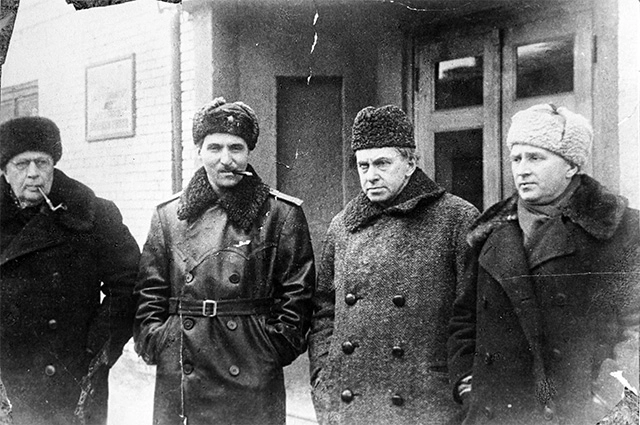
Here is Dmitry Kudryavtsev hanging out with Ilya Ehrenburg and some other writers. Alexei Nikolaevich Tolstoy was a member of the ChGK at its founding. Konstantin Mikhailovich Simonov was a wartime correspondent.

Image
Commission for the Investigation of the Atrocities of the Fascists and Their Accomplices in the Occupied Territories of the USSR. Writers Alexei Nikolaevich Tolstoy, Konstantin Mikhailovich Simonov, Ilya Grigorievich Erenburg and Head of the Department of the Extraordinary State Commission for the Establishment and Investigation of the Atrocities of the German Fascist Invaders Dmitry Kudryavtsev (from left to the right). Photo: RIA Novosti / I. Kudryavtsev (Source)

The previous photo is dated February 1943, so Kudryavtsev was involved even before the Katyn disclosures. The Katyn propaganda was baked into the ChGK reports from the moment the Soviets knew about the German investigation.

Just tracing Kudryavtsev through the ChGK investigations of the German camps is a big project, but there's obviously a ratcheting up of the propaganda, especially in the Polish camps. Being involved with the Polish-Soviet joint commissions also establishes continuity with the postwar Polish investigations.
p
pilgrimofdark
Posts: 402
Joined: Sat Aug 09, 2025 7:46 pm

Re: Soviet Extraordinary State Commission (ChGK) Investigations of Camps

Post by pilgrimofdark »

This is a collection of publications by the ESC. Kudryavtsev is mentioned 9 times in various investigations. It includes investigations of Ozarichi, Majdanek, Auschwitz, and others.

Kudryavtsev was also involved in another investigation in Poland, "On the Murder of Soviet POWs in the Area of the City of Ostrów Mazowiecka."

It's all in Russian, but having all of these in the language they were written in might be preferable.

The Treblinka and Sachsenhausen documents aren't in here, since they were totally buried. And most of the extra documents like interrogation protocols are also not here.

Collection of materials of the Extraordinary State Commission

Somewhat related from the same website is a collection of Nuremberg IMT documents, also in Russian.

The website says "This collection is a compilation of various publications dedicated to the Nuremberg Trials and contains full and expanded versions of documents presented in the two-volume edition edited by K.P. Gorshenin, as well as extensive additional materials."

Nuremberg Trials, collection of documents (Appendices)
Post Reply