Hoess's story is inherently anachronistic

For more adversarial interactions
Online
User avatar
Archie
Site Admin
Posts: 1654
Joined: Thu Sep 12, 2024 6:54 am

Hoess's story is inherently anachronistic

Post by Archie »

[ETA: Summary of "the Hoess Challenge"
A - Receives order to implement "Final Solution"
B - Visits Treblinka which was already in operation
C - Sets up extermination facilities at Auschwitz (as an improvement upon the Treblinka procedures)
Suggest a set of dates for these events that is not impossible.]

The most popular debunk of Hoess is to point out that he was tortured. It's a strong point, and it has the virtue of being readily understandable. But imo the truly fatal flaws in the Hoess statement are the problems with the timeline. Hoess's story is fundamentally and irresolvably anachronistic. In this post I will attempt to lay out the timeline argument as clearly as I can. The drawback to it is that it is a somewhat involved argument, but if we can hone it I think it could be a very effective point.

The Treblinka Visit

Hoess says he got his orders in 1941 and that mass killings were already underway at Treblinka at that time. That is universally acknowledged to be wrong since TII had not opened yet, but this problem is usually brushed off by saying that Hoess was bad with dates. Okay, so let's be generous and set aside the calendar dates and focus instead on the basic sequence of events in Hoess's story. From PS-3868.
I was ordered to establish extermination facilities at Auschwitz in June 1941. At that time there were already in the general government three other extermination camps, BELZEC, TREBLINKA and WOLZEK. These camps were under the Einsatzkommando of the Security Police and SD. I visited Treblinka to find out how they carried out their exterminations. The Camp Commandant at Treblinka told me that he had liquidated 80,000 in the course of one-half year. He was principally concerned with liquidating all the Jews from the Warsaw Ghetto. He used monoxide gas and I did not think that his methods were very efficient. So when I set up the extermination building at Auschwitz, I used Cyclon B, which was crystallized Prussic Acid which we dropped into the death chamber from a small opening.
Another improvement we made over Treblinka was that we built our gas chambers to accommodate 2,000 people at one time, whereas at Treblinka their 10 gas chambers only accommodated 200 people each.
A - Receives order to implement "Final Solution"
B - Visits Treblinka which was already in operation
C - Sets up extermination facilities at Auschwitz (as an improvement upon the Treblinka procedures)

However,

-Deportations to Treblinka did not begin until July 22, 1942
-Hoess says the exterminations at Treblinka had been going on for "one-half year" which would push the Treblinka visit all the way to January 1943
-Elsewhere Hoess mentions bodies being dug up and burned at Treblinka which would push the visit well into 1943.
The last camp where cremation of the corpses was instituted was Treblinka. During Himmler's visit to the camp at the end of February/beginning of March 1943, he was surprised to find that in Treblinka the corpses of over seven hundred thousand Jews who had been killed there had not yet been cremated. The very fact that cremation began immediately after his visit makes it more than possible than Himmler, who was very sensitive about the erasure of the crimes committed by Nazi Germany, personally ordered the cremating of the corpses there. (Arad, 215)
Key Point: Within Hoess's story, the Treblinka visit is early (1941), but based on his description it would have to be very late (1943).

The problems get worse when we consider the timeline for Auschwitz gassings.
Block 11, Krema I - around Sep 1941 link
Bunker 1 - Mar 20, 1942 (HH#11, pg. 20)
Bunker 2 - Jun 30, 1942
Kremas II-V - Mar 15, 1943 (II) - Jun 25, 1943 (III) link (with the plans going back to summer 1942 and even earlier)

These dates are fundamentally irreconcilable with a 1943 Treblinka visit.

Now that we are familiar with the key dates, the contradictions and anachronisms in Hoess's story should be more obvious. I will quote from the Goldensohn interview as I think that version makes the problems especially clear.
In the summer of 1941, I was called to Berlin to see Himmler. I was given the order to erect extermination camps. I can almost give you Himmler's actual words, which were to the effect: 'The Fuehrer has ordered the final solution to the Jewish problem. Those of us in the SS must execute these plans. This is a hard job, but if the act is not carried out at once, instead of us exterminating the Jews, the Jews will exterminate the Germans at a later date."

That was Himmler's explanation. Then he explained to me why he selected Auschwitz. There were extermination camps already in the East but they were incapable of carrying out a large-scale action of extermination. Himmler could not give me the exact number, but he said that at the proper time Eichmann would get in touch with me and tell me more about it. He would keep me informed about the incoming transports and like matters.

I was ordered by Himmler to submit precise plans as to my ideas on how the extermination program should be executed in Auschwitz. I was supposed to inspect a camp in the East, namely Treblinka, and to learn from the mistakes committed there.

A few weeks later, Eichmann visited me in Auschwitz and told me that the first transports from the General Government and Slovakia were to be expected. He added that this action should not be delayed in any way so that no technical difficulties would arise and that the schedules of transports should be maintained at all costs.

Meanwhile, I had inspected the extermination camp of Treblinka in the General Government, which was located on the Bug River. Treblinka was a few barracks and a railroad line side track, which had formerly been a sand quarry. I inspected the extermination chambers there.
How did they remove the bodies? "They were removed by other internees. At first they were placed in mass graves in the sand quarries, and later when I inspected they had just started burning the corpses in open sand quarries or ditches and had begun to excavate the mass graves and burn those that had been buried." How long did you stay in Treblinka? "Only a few hours, then I went back to Auschwitz."

"Then the first transports arrived in Auschwitz.

I had two old farmhouses somewhat removed from the camp which I had converted into gas chambers. I had the walls between the rooms removed and the outer walls cemented to make them leakproof. The first transport that arrived from the General Government was brought there. They were killed with Zyklon B gas."

I believed that crematoriums could be erected fast and so wanted to burn the corpses in the mass graves in the crematory, but when I saw that the crematory could not be erected fast enough to keep up with the ever-increasing numbers exterminated, we started to burn the corpses in open ditches like in Treblinka. A layer of wood, then a layer of corpses, another layer of corpses, etc.
He very clearly refers to bodies being burned in Treblinka which according to Arad did not occur until ~March 1943, nearly two years later than his 1941 dating he gives for the visit. To make things worse, he explicitly mentions converting the two "bunkers" into gas chambers and says this was AFTER the Treblinka visit. But the bunkers would be March 1942 whereas the Treblinka visit is March 1943 at the earliest. Impossible. And there are no alternative dates that would resolve the issue.

Essentially Hoess takes a 1943 Treblinka description and inserts it into a 1942 Auschwitz timeline.

Further Reading: https://codoh.com/library/document/on-r ... treblinka/

Receiving the Extermination Order

Hoess says he got the orders in the summer of 1941. As this is way too early, the typical suggestion is to say he got things shifted by a year and really meant summer of 1942 (when Himmler visited the camp). But the summer of 1941 dating was typical at that time and is fully consistent with the IMT judgment.
In the summer of 1941, however, plans were made for the ‘final solution’ of the Jewish question in Europe. This ‘final solution’ meant the extermination of the Jews, which early in 1939 Hitler had threatened would be one of the consequences of an outbreak of war, and a special section in the Gestapo under Adolf Eichmann, as head of Section B 4 of the Gestapo, was formed to carry out the policy.

The plan for exterminating the Jews was developed shortly after the attack on the Soviet Union. Einsatzgruppen of the Security Police and SD, formed for the purpose of breaking the resistance of the population of the areas lying behind the German armies in the East, were given the duty of exterminating the Jews in those areas. (IMT, Vol 1, pg. 250)
Another problem with the year-shift explanation is that in at least one statement Hoess refers directly to the Himmler visit and gives the correct date for it. The order came a year before this, according to Hoess.

In the 'final solution' documents (included as an appendix in most printings of the "autobiography"), Hoess says:
In the summer of 1941, I cannot remember the exact date, I was suddenly summoned to the Reichsfuhrer SS, directly by his adjutant's office.
I cannot say on what date the extermination of the Jews began. Probably it was in September 1941, but it may not have been until January 1942.

During his visit to the camp in the summer of 1942, the Reichsfuhrer SS watched every detail of teh whole process of destruction from the time when the prisoners were unloaded to the emptying of Bunker II. At that time the bodies were not being burnt.
The two large crematoria I and II were built in the winter of 1942-3 and brought into use in the spring of 1943.
Note that Hoess gives the correct date for the Himmler visit (summer 1942), and he is also correct on the dates for the crematoria construction. Given this, I do not think we can ignore his 1941 dating for the hypothetical order as is typically done. In relative terms he clearly places the original order well before the Himmler visit. To conflate the order with the 1942 visit is not a reasonable interpretation of the statement.

So we have a 1941 order, a visit to Treblinka, a 1942 visit from Himmler. Within the timeline, TII didn't exist yet. But his description corresponds to 1943. These are fatal flaws in his story.

"He's Just Bad With Dates!"

This excuse doesn't cut it here. You can play around with the dates as much as you want. Hoess's story will never work because he gives a late Treblinka description and weaves it into his Auschwitz narrative in a way that cannot be fixed. If he simply got the dates the wrong, then it should be possible to supply the correct dates he should have used. This can't be done because the actual sequence of events he describes is impossible.

Incredulity Enthusiast
User avatar
Wahrheitssucher
Posts: 848
Joined: Mon May 19, 2025 2:51 pm

Re: Hoess's story is inherently anachronistic

Post by Wahrheitssucher »

Archie wrote: Fri Apr 24, 2026 7:48 am …imo the truly fatal flaws in the Höß statement are the problems with the timeline.
Höß's story is fundamentally and irresolvably anachronistic…
[snip]
“He's just bad with dates!
This excuse doesn't cut it here.
You can play around with the dates as much as you want. Höß's story will never work…
If he simply got the dates the wrong, then it should be possible to supply the correct dates he should have used.
This can't be done because the actual sequence of events he describes is impossible.
Great analysis.
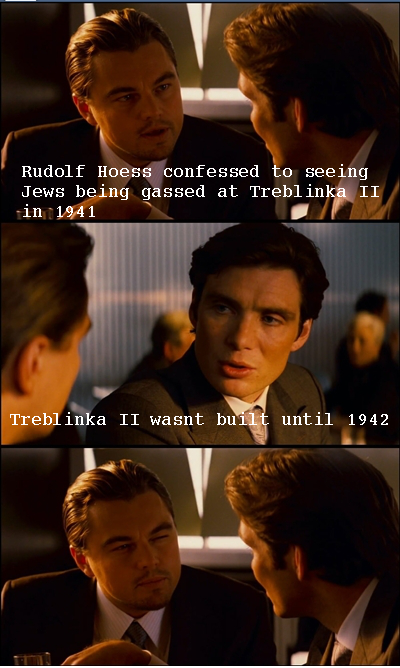
Image

When I was new to holyH skepticism and revisionism, this amusing pic made a deep impression.

Image
A ‘holocaust’ believer’s problem is not technical, factual, empirical or archeological — their problem is psychological.
User avatar
Callafangers
Administrator
Posts: 1233
Joined: Tue Sep 24, 2024 6:25 am

Re: Hoess's story is inherently anachronistic

Post by Callafangers »

Code: Select all

Claim by Hoess                                      Required Date per Hoess     Actual Date per Mainstream Historians           Impossible Because
____________________________________________________________________________________________________________________________________________________________________________________________

Treblinka already killing for 6+ months             Early 1942                  Starts July 1942; mass burning starts Mar 1943  Off by 1–2 full years
Sees bodies being dug up and burned at Treblinka    Early 1942                  Begins ~March 1943                              Description only matches early 1943
Converts Auschwitz Bunkers AFTER Treblinka visit    After early 1942            Bunker 1: Mar 1942   Bunker 2: Jun 1942         If visit is 1943, bunkers were already operating for a year
Copies open-pit burning from Treblinka              1942–1943                   Auschwitz already doing it in 1942              Reverses the actual sequence of events
Receives extermination order from Himmler           Summer 1941                 Generally dated to summer 1942                  Places order before Treblinka even existed

HoessAna2.jpg
HoessAna2.jpg (102.15 KiB) Viewed 438 times
[Edit: Table was incomplete -- fixed]
Forensics lack both graves and chambers—only victors' ink stains history's page.
User avatar
Callafangers
Administrator
Posts: 1233
Joined: Tue Sep 24, 2024 6:25 am

Re: Hoess's story is inherently anachronistic

Post by Callafangers »

I would only add that the threats to his family and torture Hoess endured, and the anachronism we see from him -- are not mutually exclusive. One might of course interpret the former to explain the latter (coercion explaining falsehoods/deception).
Forensics lack both graves and chambers—only victors' ink stains history's page.
User avatar
TlsMS93
Posts: 867
Joined: Sun Sep 29, 2024 11:57 am

Re: Hoess's story is inherently anachronistic

Post by TlsMS93 »

Wait. He said the crematoriums couldn't cope and he had to resort to open-air cremations in mass graves, but didn't he also say that the crematoriums never reached their capacity because transportation was insufficient?

His statement seems more like a veiled insult, "none of that happened and you have to decipher it to figure it out."
User avatar
Eye of Zyclone
Posts: 352
Joined: Fri Apr 04, 2025 3:12 pm

Re: Hoess's story is inherently anachronistic

Post by Eye of Zyclone »

Callafangers wrote: Fri Apr 24, 2026 10:21 pm I would only add that the threats to his family and torture Hoess endured, and the anachronism we see from him -- are not mutually exclusive. One might of course interpret the former to explain the latter (coercion explaining falsehoods/deception).
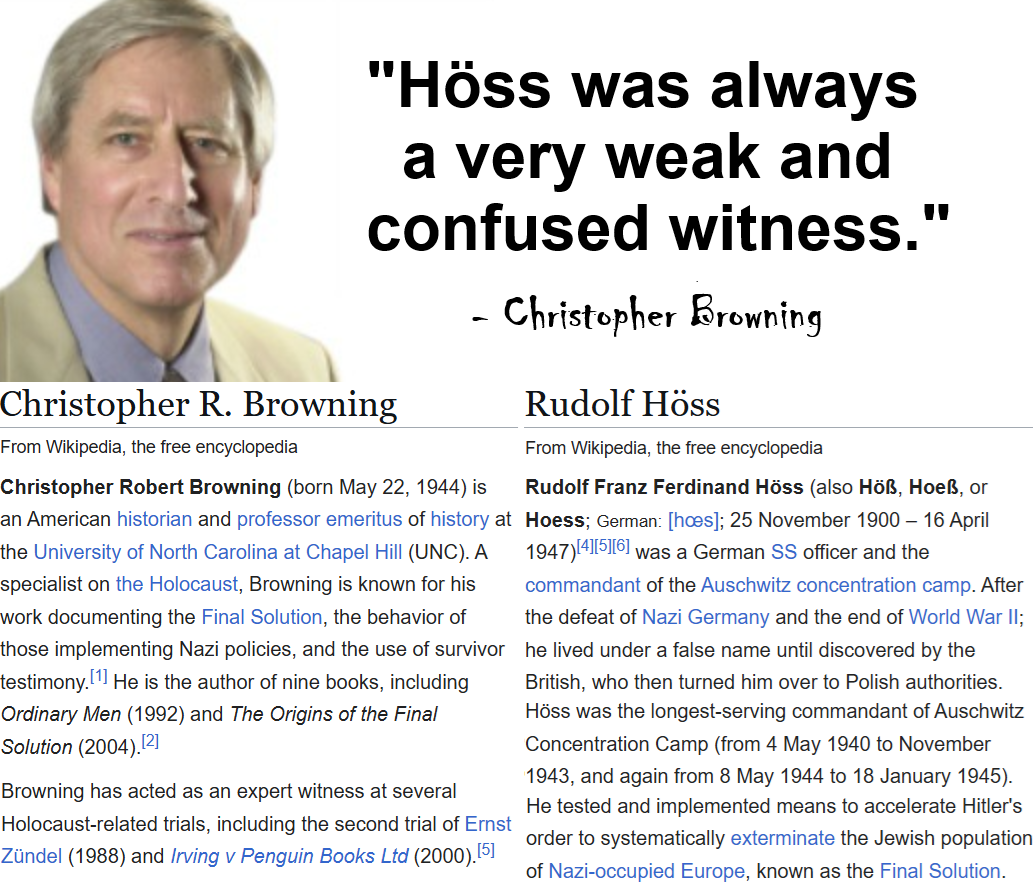
Image

Image
"Holocaust deniers are very slick people. They justify everything they say with facts and figures."
User avatar
Eye of Zyclone
Posts: 352
Joined: Fri Apr 04, 2025 3:12 pm

Re: Hoess's story is inherently anachronistic

Post by Eye of Zyclone »

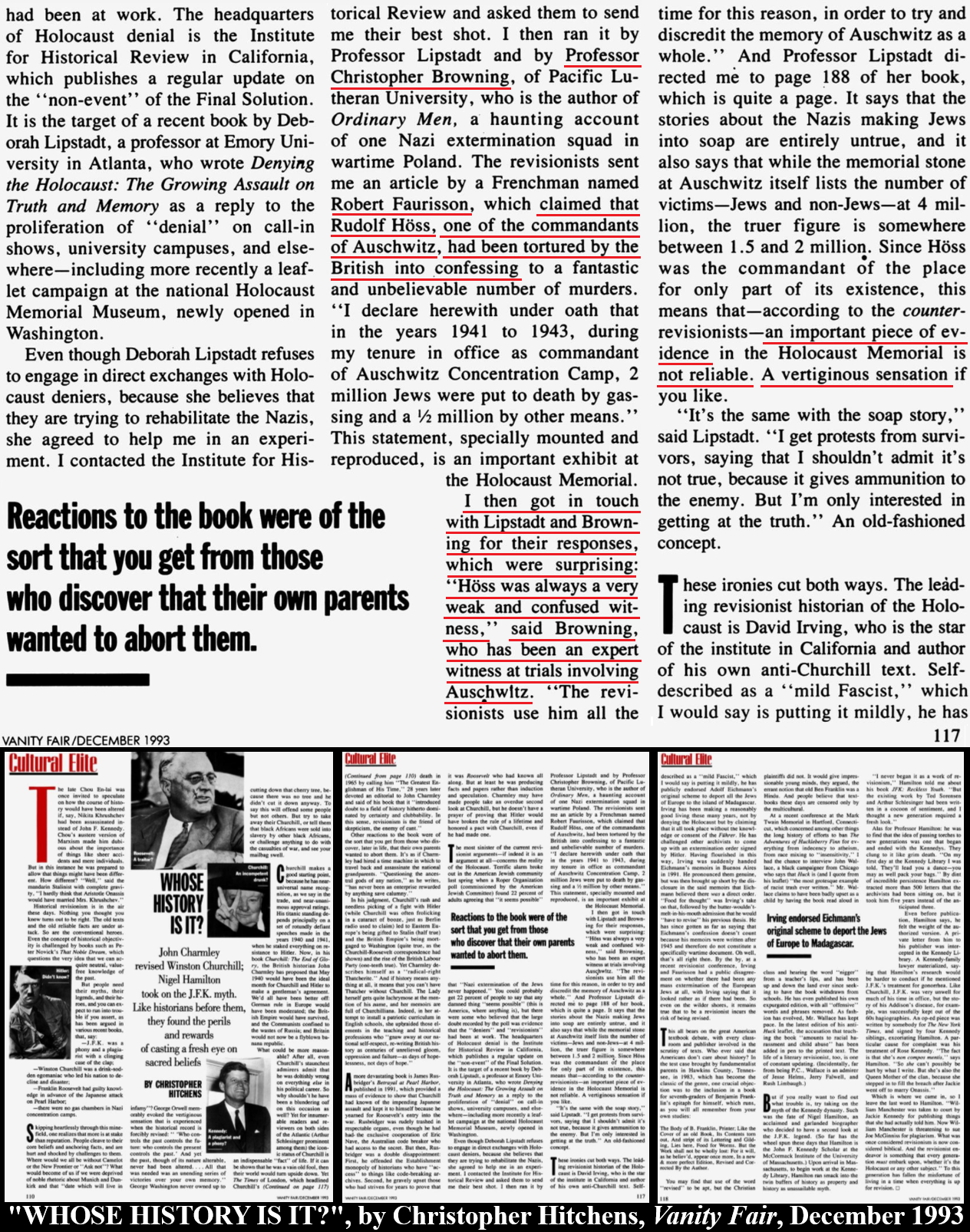
Speaking of Treblinka's anachronisms...

Image

Image
https://postimg.cc/sQb76b8N
"Holocaust deniers are very slick people. They justify everything they say with facts and figures."
Online
User avatar
Archie
Site Admin
Posts: 1654
Joined: Thu Sep 12, 2024 6:54 am

Re: Hoess's story is inherently anachronistic

Post by Archie »

Reposting a comment from Quarantine back over here:

Most functionalist historians date the "final solution" decision to around Sep-Dec 1941. For these historians, a summer 1941 dating is impossible, so they move it to 1942. Others like Danuta Czech and Richard Breitman favor a more traditional timeline and have rejected the 1942 redating for the order and insist that Hoess's 1941 dating is correct.

Breitman:
Various attempts to redate this meeting have been off the mark. Höss
could not have mistaken a summer-1942 meeting with Himmler for 1941 –
first, because Himmler’s 1942 appointment book, which exists, contains no
such entry, and, second, because Höss was already gassing Jews then. (Breitman, quoted in HH11, pg 18)
Incredulity Enthusiast
Online
User avatar
Archie
Site Admin
Posts: 1654
Joined: Thu Sep 12, 2024 6:54 am

Re: Hoess's story is inherently anachronistic

Post by Archie »

If I were trying to argue this from the other side, given that the "bad with dates" argument fails, I would begin considering other tactics. One possibility would be to say Hoess has falsified the timeline because for some reason. The most common reason would be to minimize personal responsibility. But while this is a common issue with confessions, it doesn't really work in Hoess's case.

Superior Orders - Could Hoess have falsified/moved back the date for when he got orders to set up a superior orders defense? Not a good explanation since the standard story is that there were superior orders. In fact, if you try to say the extermination program wasn't a top down decision by Hitler, this is usually considered a form of Holocaust denial. What reason would Hoess have to pretend he got the order a few months before?

Is Hoess trying to minimize personal culpability? Clearly not because he wildly exaggerates the number killed and he describes himself as playing a pivotal role in setting up the extermination facilities. If he'd wanted to downplay things, he could have easily tried to say he's delegated everything or something like that.

Sometimes Holocaust apologists will make a big deal about Hoess being a defense witness (for Kaltenbrunner). But it is extremely unlikely that Hoess constructed his statements for nuanced legal reasons for the simple reason that his first statement (NO-1210) was collected in March 1946 and he had no access to counsel during this first interrogation. It is absurd to think he was working out legal strategies for Kaltenbrunner a month later while he was being tortured.

I cannot think of any incentive Hoess would have had to falsify the orders or pretend he visited Treblinka much earlier than he did, or to claim he used Treblinka for ideas when he didn't.
Incredulity Enthusiast
User avatar
Eye of Zyclone
Posts: 352
Joined: Fri Apr 04, 2025 3:12 pm

Re: Hoess's story is inherently anachronistic

Post by Eye of Zyclone »

Archie wrote: Wed Apr 29, 2026 5:09 pm Sometimes Holocaust apologists will make a big deal about Hoess being a defense witness (for Kaltenbrunner). But it is extremely unlikely that Hoess constructed his statements for nuanced legal reasons for the simple reason that his first statement (NO-1210) was collected in March 1946 and he had no access to counsel during this first interrogation. It is absurd to think he was working out legal strategies for Kaltenbrunner a month later while he was being tortured.
It is the Holohoax debunkers who should make a big deal about Hoess being a witness rather than an accused at the 1st Nuremberg show trial because 'confessing' crimes at the trial of others is not really a self-incriminating confession. It's more of a servile collaboration with almighty victors in the hope of lenient treatment for oneself as a reward for helping them convict one's former bosses. Looks like a sound defense strategy if I'm asked.

Image

Image
"Holocaust deniers are very slick people. They justify everything they say with facts and figures."
b
bombsaway
Posts: 1845
Joined: Sun Sep 29, 2024 2:23 am

Re: Hoess's story is inherently anachronistic

Post by bombsaway »

This is how the AI explains it, which I think is pretty good, especially the self - exculpatory stuff
From an orthodox lens, Höss made those errors because his testimony was not a clean, contemporaneous operational report. It was a postwar reconstruction under interrogation, built from memory, self-protection, hearsay, later knowledge, and a desire to produce a coherent explanation.

The strongest orthodox explanations are:

He was compressing events retrospectively. By 1946, he knew Auschwitz, Treblinka, Belzec, Sobibor, crematoria, open-air burning, transports, and Himmler/Eichmann orders as parts of one extermination system. When narrating backward, he folded later knowledge into earlier stages.

He was not actually trying to produce a precise development timeline. He was explaining “how Auschwitz came to function as an extermination center,” not carefully distinguishing every phase: experimental killings, Bunker 1, Bunker 2, crematoria, later open-pit burning, and what he learned from other camps.

He likely conflated different sources of knowledge. “I visited Treblinka and learned X” may mix: what he personally saw, what Eichmann or other SS men told him, what he learned later, and what he inferred after the fact.

He may have had self-exculpatory incentives. Placing initiative with Himmler, Eichmann, or other camps makes Auschwitz look less like his own innovation and more like an assigned implementation job. That does not mean the whole confession is false; it means the narrative may be shaped to reduce personal originality or agency.

So the orthodox answer is not “he was simply bad with dates.” It is: Höss was a perpetrator-witness giving a compressed retrospective account under pressure, with memory contamination and self-serving framing. His testimony is useful for the broad structure, but not trusted as a precise chronological map.
Since I've spent so much time defending the orthodox narrative and revisionists have not spent time defending their narrative, I probably won't do much else here besides post AI analysis which I will vet beforehand. But I would pose a question to revisionists, what is your explanation of Hoess's narrative, both the blatant deviations from orthodoxy and the very precise ways his testimony aligns with the narrative?
Online
User avatar
Archie
Site Admin
Posts: 1654
Joined: Thu Sep 12, 2024 6:54 am

Re: Hoess's story is inherently anachronistic

Post by Archie »

bombsaway wrote: Wed Apr 29, 2026 10:51 pm
From an orthodox lens, Höss made those errors because his testimony was not a clean, contemporaneous operational report. It was a postwar reconstruction under interrogation, built from memory, self-protection, hearsay, later knowledge, and a desire to produce a coherent explanation.

The strongest orthodox explanations are:

He was compressing events retrospectively. By 1946, he knew Auschwitz, Treblinka, Belzec, Sobibor, crematoria, open-air burning, transports, and Himmler/Eichmann orders as parts of one extermination system. When narrating backward, he folded later knowledge into earlier stages.

He was not actually trying to produce a precise development timeline. He was explaining “how Auschwitz came to function as an extermination center,” not carefully distinguishing every phase: experimental killings, Bunker 1, Bunker 2, crematoria, later open-pit burning, and what he learned from other camps.

He likely conflated different sources of knowledge. “I visited Treblinka and learned X” may mix: what he personally saw, what Eichmann or other SS men told him, what he learned later, and what he inferred after the fact.

He may have had self-exculpatory incentives. Placing initiative with Himmler, Eichmann, or other camps makes Auschwitz look less like his own innovation and more like an assigned implementation job. That does not mean the whole confession is false; it means the narrative may be shaped to reduce personal originality or agency.

So the orthodox answer is not “he was simply bad with dates.” It is: Höss was a perpetrator-witness giving a compressed retrospective account under pressure, with memory contamination and self-serving framing. His testimony is useful for the broad structure, but not trusted as a precise chronological map.
Nope. Read the statements. The Treblinka visit is integral to Hoess's story. It's not some incidental thing. FFS, he should know whether he went to Treblinka and saw bodies being dug up and burned! And he should have some idea why he went there.

Re: self-exculpatory incentives, this argument could be made for some SS men but not for Hoess. If Hoess were trying to minimize, why would he confess to overseeing the murder of 3 million people? That's a 3x exaggeration according to current consensus. That makes no sense if his goal was miminization. He also doesn't claim he tried to stop it. He doesn't claim he wasn't involved. He brags about how he made the gas chambers more effective than the Treblinka gas chambers. It just doesn't fit.

By the way, I noticed you didn't ask the AI to suggest possible dates for the three events I listed.
A - Receives order to implement "Final Solution"
B - Visits Treblinka which was already in operation
C - Sets up extermination facilities at Auschwitz (as an improvement upon the Treblinka procedures)
Here's what it told me.

A - "Late May–June 1942"
B - "Late July or August 1942"
C - "Systematic extermination facilities begin: Spring–Summer 1942"

This is a whiff. It has C before B (and even before A) which doesn't work. Furthermore, B can't be that early because the Treblinka details don't match. And A can't be that late.
Incredulity Enthusiast
User avatar
Eye of Zyclone
Posts: 352
Joined: Fri Apr 04, 2025 3:12 pm

Re: Hoess's story is inherently anachronistic

Post by Eye of Zyclone »

One of Jewry's trained computer parrots :
Höss made those errors because his testimony was not a clean, contemporaneous operational report. It was a postwar reconstruction under interrogation, built from memory, self-protection, hearsay, later knowledge, and a desire to produce a coherent explanation.

Höss was a perpetrator-witness giving a compressed retrospective account under pressure, with memory contamination and self-serving framing. His testimony is useful for the broad structure, but not trusted as a precise chronological map.
:lol: :lol: :lol: :lol: :lol: :lol:

Image

In the next episode : The reasons why Konrad Morgen confessed the use of gas chambers in Monowitz (Auschwitz III) rather than Birkenau (Auschwitz II) but is still a major witness to the Holocaust.
"Holocaust deniers are very slick people. They justify everything they say with facts and figures."
b
bombsaway
Posts: 1845
Joined: Sun Sep 29, 2024 2:23 am

Re: Hoess's story is inherently anachronistic

Post by bombsaway »

re minimization: AI response, which I agree with
I agree the simple “he was minimizing” argument is weak if stated crudely. He was not minimizing the death toll; he inflated it. But self-exculpation does not only mean “make myself look innocent.” It can mean “make myself look like an executor of an already-existing centralized system rather than an initiator or improviser.” Saying “Himmler ordered it, Eichmann coordinated it, other camps already existed, I adapted methods” shifts agency upward and outward even while admitting massive guilt.
Within orthodoxy where the death camps were real, Hoess probably knew Auschwitz was high volume, even compared to Treblinka.

Now what what is your explanation of Hoess's narrative, both the blatant deviations from orthodoxy and the very precise ways his testimony aligns with the narrative?

all you guys can do is criticize orthodoxy, when the tables are turned and you are asked to provide your own narratives you RUN
Online
User avatar
Archie
Site Admin
Posts: 1654
Joined: Thu Sep 12, 2024 6:54 am

Re: Hoess's story is inherently anachronistic

Post by Archie »

bombsaway wrote: Thu Apr 30, 2026 6:17 am re minimization: AI response, which I agree with
I agree the simple “he was minimizing” argument is weak if stated crudely. He was not minimizing the death toll; he inflated it. But self-exculpation does not only mean “make myself look innocent.” It can mean “make myself look like an executor of an already-existing centralized system rather than an initiator or improviser.” Saying “Himmler ordered it, Eichmann coordinated it, other camps already existed, I adapted methods” shifts agency upward and outward even while admitting massive guilt.
Within orthodoxy where the death camps were real, Hoess probably knew Auschwitz was high volume, even compared to Treblinka.

Now what what is your explanation of Hoess's narrative, both the blatant deviations from orthodoxy and the very precise ways his testimony aligns with the narrative?

all you guys can do is criticize orthodoxy, when the tables are turned and you are asked to provide your own narratives you RUN
More AI. Lame.

The problem with that reply is that the official story is still that he did have superior orders. So then that would be accurate, according to current theory, not a distortion for sake "self-exculpation." As I said, it is usually considered a form of Holocaust denial to claim that there wasn't an official top-down policy.

The reason Hoess's testimony "aligns with the narrative" is because the narrative was based on Hoess to a large extent. Details like the 10 gas chambers at Treblinka had already been published in Wiernik in 1944. The basic Auschwitz story is similar to the WRB report and to USSR-8. Hence much of it is regurgitating prior material but from the mouth of the camp commandant, giving it some authority.

The blunders in the statements are simply plot holes. Plot holes are common in made up stories.
Incredulity Enthusiast
Post Reply