Given the number of public lies by authorities -- take your pick, COVID counter-measures, some men are women, immigrants don't commit crimes, green energy is cheap etc. -- naturally some people start wondering what other lies (or falsehoods in general) they've been told. The most extreme one would be Holocaust numbers. So how do we know roughly how many Jews died? Well, the simplest method is the before and after count. You start with maps like this one from 1881.
[Map from Richard Andrée: https://commons.wikimedia.org/wiki/Image:Juden_1881.JPG]
Then you try to figure out what happened to the Jews in each area. The Nazis obviously tried to destroy their records near war's end, the Soviets tried to make them seem worse (almost impossible task), so trying to trace them seems like a sensible simple approach.
[Screenshots of tables from Richard Andrée's Zur Volkskunde der Juden: https://archive.org/details/bub_gb_SfzW ... 7/mode/2up]
At war's end, you then find new counts of the Jews and the difference, minus expectations from other factors (population growth or decline, hunger, disease, migration etc.) is the number killed. Special care has to be taken with double counting. Obviously, Nazis mostly them around so the survivors didn't end up where they started in many cases.
AI summary of academic estimates. You might be tempted to say these are self-serving Jewish scholars, but it seems not so. The estimates from the Jewish ones are about the same as from the German ones.
- AI summary.png (169.33 KiB) Viewed 12457 times
Source of map numbers 1881
https://archive.org/details/bub_gb_SfzW ... 5/mode/2up
"Before and after count" proves the Holocaust
"Before and after count" proves the Holocaust
Emil Kirkegaard is a notable intelligence researcher who occasionally tries to support the Holocaust Narrative using a big-picture approach. Yesterday he posted a short thread on X which I reproduce here for anyone who wants to debate it.
Re: "Before and after count" proves the Holocaust
As a matter of indisputable fact, it has to be pointed out that everyone on this list is Jewish except for Wolfgang Benz, who made a career out of writing about antisemitism. He also worked at the Institute of Contemporary History, established by the Allies in part to address exactly this topic. To say that these individuals are not "self-serving" is atrocious reasoning.AI summary of academic estimates. You might be tempted to say these are self-serving Jewish scholars, but it seems not so. The estimates from the Jewish ones are about the same as from the German ones.
The field of Holocaust studies is overwhelmingly Jewish. For the comparison that Kirkegaard made here to make any sense, it would have to include revisionists, who AI tends to ignore, who are mostly non-Jewish, and who certainly have not agreed with Jewish estimates.
Re: "Before and after count" proves the Holocaust
Hans wrote an article on the number of Jews statistically recorded in Europe here, which would also be relevant to this.
https://holocaustcontroversies.blogspot ... ve-of.html
https://holocaustcontroversies.blogspot ... ve-of.html
-
Callafangers

- Administrator
- Posts: 1311
- Joined: Tue Sep 24, 2024 6:25 am
Re: "Before and after count" proves the Holocaust
Both the work from Hans and from Emil Kirkegaard are missing critical questions and statistical factors in their analysis. Here's what I have gathered after review of W. Sanning's work and subsequent revisionist analyses, AI-assisted:
When your "simple method" requires ignoring the emigration documented by your own research institute, the evacuations documented by your own Jewish sources, and the post-war exodus documented by your own relief agencies... it's not "simplicity". It's a shell game.
Remember that the Allied victors (and Jews) benefited from inflating alleged killings by Germany. And we haven't even mentioned the stark lack of physical evidence, nor the pile of lies, contradictions, and provable [ulterior/secondary] motives... did not one person consider slander as a form of revenge? Was hatred not running high after a war where almost everyone lost friends and family?
Let's be serious.
In short, the "before and after" method only works if you start with accurate numbers and account for all causes of change -- not just the one you want to blame. The demographics point to a much smaller death toll within the German sphere, and the missing millions are explained by emigration, Soviet evacuation, Soviet-caused deaths, and post-war migration -- all documented from mainstream, often Zionist, sources.The method Kirkegaard describes -- count Jews before the war, count them after, subtract -- sounds like common sense. That's precisely why it's so effective as propaganda. The problem is that both numbers are wrong, and they're wrong in opposite directions.
The "before" count is inflated. The last Polish census was 1931. Mainstream scholars extrapolate to 1939 assuming Jews grew at the same rate as rural Catholics. But the Institute for Contemporary History (Munich, 1958) itself documented that "about 100,000 Jews left Poland every year after 1933" (Sanning, W., The Dissolution..., p. 30-31). Jewish birth rates had collapsed -- the 1931 census already showed below-replacement fertility for Polish Jews. By 1939, the Jewish population was substantially smaller than claimed.
The "after" count is deflated. The figures used for "survivors" come from 1946–47, not May 1945. In the intervening fourteen months, roughly one million Jews left Europe. UNRRA's own director, General Morgan, described "well-dressed, well-fed" Jews flooding into the American zone from the East. Nahum Goldmann, president of the World Jewish Congress, later wrote that 600,000 concentration camp survivors were alive in 1945. Where did they go? Not into the "survivor" statistics, apparently.
The method assumes all missing Jews were killed by Germans. But the Soviets annexed eastern Poland, the Baltics, Bessarabia, and Bukovina between 1939–1940, absorbing ~2.3 million Jews. In 1941, they evacuated 80% of Jews from areas the Germans later occupied -- confirmed by the Zionist Institute of Jewish Affairs in 1943, by Soviet Jewish leader David Bergelson in 1942, and by the German Economy Staff East's city-by-city occupation counts. Those Jews didn't die. They were in Siberia.
Then approximately one million or more Jews did die -- in the Red Army, in Siberian labor camps, on deportation trains where "a fifth to a third" perished en route (Sanning, p. 41; Joint Distribution Committee, 1943), or in destruction of the advancing front. These deaths were real. They were not caused by Germans.
The "consensus" Kirkegaard cites is circular. The Benz anthology, which produced the 5.3–6 million figure, was commissioned explicitly to refute Walter Sanning's 1983 demographic study. Germar Rudolf's chapter-by-chapter analysis (https://germarrudolf.com/germars-views- ... -analysis/) shows Benz's authors:
This is not engagement. It's avoidance. When Kirkegaard's supposedly definitive refutation refuses to mention, let alone answer, the arguments it claims to refute, he doesn't have a consensus. He has a boycott.
- Ignored Sanning's evidence on pre-war emigration entirely
- Disposed of Soviet evacuations in two paragraphs with no documentary support
- Failed to address post-war emigration at all -- not one paragraph
- Double-counted ~533,000 victims through uncoordinated boundary definitions
Kirkegaard's AI summary showing agreement between "Jewish" and "German" scholars proves nothing. German academics who question the six-million figure lose their careers -- Stäglich was stripped of his doctorate and had his pension revoked. Rudolf was denied his PhD. There are many others. The "German scholars" who contribute to anthologies like Benz's are institutionally dependent on the very narrative they are validating. The absence of dissent in a field where dissent is punished is not evidence of truth.
When your "simple method" requires ignoring the emigration documented by your own research institute, the evacuations documented by your own Jewish sources, and the post-war exodus documented by your own relief agencies... it's not "simplicity". It's a shell game.
Remember that the Allied victors (and Jews) benefited from inflating alleged killings by Germany. And we haven't even mentioned the stark lack of physical evidence, nor the pile of lies, contradictions, and provable [ulterior/secondary] motives... did not one person consider slander as a form of revenge? Was hatred not running high after a war where almost everyone lost friends and family?
Let's be serious.
Forensics lack both graves and chambers—the liar's ink stains history's page.
Re: "Before and after count" proves the Holocaust
The reason I decided to post this was half out of amusement at the claims made but also half out of genuine frustration that revisionists aren't better on this subject. This should be an easy lay up.
I've read a substantial portion of Walter Sanning's book, but it's too complex to easily regurgitate any of it. Also, he took on the difficult onus of making a relatively maximalist argument. If I understand it correctly, Sanning basically said that not more than 207,000 Jews could have died in the German SoI. This is challenging to support, especially for a non-expert, and such a large claim risks alienating those who might find it ridiculous but are otherwise open to revisionism.
For that reason, in my X response to Kirkegaard, I chose to make a minimalist argument. Basically, 15 minus 11 doesn't get to 6 or even 5 (million). This reverses his argument (the "before and after count") and immediately calls into question the estimates by court historians.
However, besides Sanning, there is a glut of revisionist literature which at the very least touches on population numbers. Perhaps it would be good to point to one of those authors, especially if there is a particularly good article or something that can be linked to. If not, perhaps some work needs doing here.
With that out of the way, thanks for responding. This summary is helpful.
I've read a substantial portion of Walter Sanning's book, but it's too complex to easily regurgitate any of it. Also, he took on the difficult onus of making a relatively maximalist argument. If I understand it correctly, Sanning basically said that not more than 207,000 Jews could have died in the German SoI. This is challenging to support, especially for a non-expert, and such a large claim risks alienating those who might find it ridiculous but are otherwise open to revisionism.
For that reason, in my X response to Kirkegaard, I chose to make a minimalist argument. Basically, 15 minus 11 doesn't get to 6 or even 5 (million). This reverses his argument (the "before and after count") and immediately calls into question the estimates by court historians.
However, besides Sanning, there is a glut of revisionist literature which at the very least touches on population numbers. Perhaps it would be good to point to one of those authors, especially if there is a particularly good article or something that can be linked to. If not, perhaps some work needs doing here.
With that out of the way, thanks for responding. This summary is helpful.
I feel you've under supported both these points. There are more strong examples of both. For example Stalin had the Soviet census increased by 8 million (likely non-existent) citizens just before the war. And as Ryan Faulk has written about, both before and after Jewish population numbers have been manipulated and revised after the fact, by 1.7 million at the most extreme.Callafangers wrote: ↑Sun May 17, 2026 10:28 pm The "before" count is inflated.
[...]
The "after" count is deflated.
Re: "Before and after count" proves the Holocaust
Ok, I will post it again...
This is a video from Alt Hype covering 'where'd they go' called 'The Eastern Alibi'.
Enjoy
This is a video from Alt Hype covering 'where'd they go' called 'The Eastern Alibi'.
Enjoy
If I were to guess why no t4 personnel were chosen to perform gassing that had experience with gassing, it would be because THERE WERE NONE.

Re: "Before and after count" proves the Holocaust
As a not very important aside, I will note that Reitlinger was indeed Jewish although for some reason Wikipedia and other online sources don't acknowledge this. His obituary in the Times of London also doesn't mention it. I remember initially thinking he might be Gentile because I couldn't easily find anything explicit except for unsourced mentions in revisionist sources. I assumed these were probably correct but wanted to confirm it.Wetzelrad wrote: ↑Sat May 16, 2026 5:45 pm As a matter of indisputable fact, it has to be pointed out that everyone on this list is Jewish except for Wolfgang Benz
He dedicates his book to his daughter, "that one day she may read and know the tragedy of her race." That certainly seems to imply Jewishness. Any doubt is removed by looking at his genealogy.
Here's his father, Albert Reitlinger (1845-1924), original name Abraham. He was from Ichenhausen which is a town with a long Jewish history. He's buried in a Jewish cemetery.
https://www.geni.com/people/Reitlinger- ... 0354889745?
https://www.cemeteryscribes.com/getpers ... Cemeteries
https://en.wikipedia.org/wiki/Ichenhausen
And his mother, Emma Brunner Reitlinger (1865-1936)
https://www.ancestry.com/genealogy/reco ... 24-1vsb7h2
And another family genealogy page. Salomon, Abraham, Isaac. Two mentions of Auschwitz.
https://freepages.rootsweb.com/~prohel/ ... inger.html
A few months ago, I happened upon a reference in a mainstream scholarly article that referred to Reitlinger as an "assimilated British Jew" (Tony Kushner, "Britain, the United States and the Holocaust" in The Historiography of the Holocaust, edited by Dan Stone). I don't know precisely what that means, but it seems he was 1) of Jewish ancestry, 2) but was maybe not all that observant and/or downplayed this identity somewhat, 3) yet was also very interested in the Holocaust.
Incredulity Enthusiast
- borjastick
- Posts: 390
- Joined: Sat Sep 28, 2024 11:49 am
- Location: Europe
Re: "Before and after count" proves the Holocaust
Let's apply the same 'they must be dead because they weren't here afterwards and we cannot count as many' routine to the great famines of Ireland. In the mid 19th century in Ireland there were two famines caused by crop failure and as some would say caused by English absentee landlords not caring nor maintaining their farms and ignoring the plight of their sitting tenants. It was just as much to do with Irish absentee landlords as well by the way.
Crops failed and already desperately poor people living in the wilds of southern Ireland suffered immense hardship and death. Take your pick on the numbers but it could easily have been a million dead. I've tried getting to a proper figure but found it impossible as records were not kept very diligently in those days. But overall the population dropped by as much as 2-3 million which was a huge percentage of the total. Where did they go or did they all die??? Using the ashkenazi process and method we can quite strongly assert they all died.
In reality people left for the US, UK, Canada etc. They went where Irish people are now, all over the shop. Today the Irish state wishes to try to bring the relatives of the Irish diaspora back into the fold so to speak by offering them Irish citizenship. I am one such person. My dad was Irish and his parents and grand parents too of course which takes us back to the period of the famines and further. So I have an Irish passport and citizenship as well as UK/British passport and citizenship.
So we weren't all deaded in them peat bogs in the famine. The Irish left and were not recorded anywhere but they, the offices of the state don't try to claim we were all killed or died directly in the famines as these jews do in their holocaust calculations.
Crops failed and already desperately poor people living in the wilds of southern Ireland suffered immense hardship and death. Take your pick on the numbers but it could easily have been a million dead. I've tried getting to a proper figure but found it impossible as records were not kept very diligently in those days. But overall the population dropped by as much as 2-3 million which was a huge percentage of the total. Where did they go or did they all die??? Using the ashkenazi process and method we can quite strongly assert they all died.
In reality people left for the US, UK, Canada etc. They went where Irish people are now, all over the shop. Today the Irish state wishes to try to bring the relatives of the Irish diaspora back into the fold so to speak by offering them Irish citizenship. I am one such person. My dad was Irish and his parents and grand parents too of course which takes us back to the period of the famines and further. So I have an Irish passport and citizenship as well as UK/British passport and citizenship.
So we weren't all deaded in them peat bogs in the famine. The Irish left and were not recorded anywhere but they, the offices of the state don't try to claim we were all killed or died directly in the famines as these jews do in their holocaust calculations.
Last edited by borjastick on Tue May 19, 2026 6:26 am, edited 2 times in total.
Of the four million jews under German control, six million died and five million survived!
-
Callafangers
- Administrator
- Posts: 1311
- Joined: Tue Sep 24, 2024 6:25 am
Re: "Before and after count" proves the Holocaust
Great example. There are no doubt many others like this, and worth noting that the Jewish mass scattering post-WW2 is the most geographically diverse (and multi-directional, global) dispersal in modern history, and one of the largest ethnic dispersions overall, no matter which side of the 'Holocaust' debate one falls upon. There was ample opportunity to point out 'losses' and associate these to atrocity propaganda narratives, and this false association is precisely what is evidenced to have occurred by victorious powers and their network of witnesses.borjastick wrote: ↑Mon May 18, 2026 11:29 am So we weren't all deaded in them peat bogs in the famine. The Irish left and were not recorded anywhere but they, the offices of the state don't try to claim we were all killed or died directly in the famines as these jews do in their holocaust calculations.
Forensics lack both graves and chambers—the liar's ink stains history's page.


Re: "Before and after count" proves the Holocaust
A lot of fantastic points made here, i'll add another:
The subtract-post-from-pre-figures approach will always fail because it by necessity must use Soviet (Polish) figures, especially on a per-camp basis.
Immediate post-war figures will use a base assumption of 4 million dead in Auschwitz alone. Correspondingly, the death toll dropping to ~1 million after Societ collapse was not met in parallel with the resurfacing of 3 million Jews pottering around in occupied Palestine or New York somewhere.
Therefore holocaust enjoyers have already bought the ticket, and are happy to explain away the debit of an overinflated figure without a corresponding credit of resurfaced jews. To accept this approach for 3 million is already 3/4s the way there to accepting it for the total.
The subtract-post-from-pre-figures approach will always fail because it by necessity must use Soviet (Polish) figures, especially on a per-camp basis.
Immediate post-war figures will use a base assumption of 4 million dead in Auschwitz alone. Correspondingly, the death toll dropping to ~1 million after Societ collapse was not met in parallel with the resurfacing of 3 million Jews pottering around in occupied Palestine or New York somewhere.
Therefore holocaust enjoyers have already bought the ticket, and are happy to explain away the debit of an overinflated figure without a corresponding credit of resurfaced jews. To accept this approach for 3 million is already 3/4s the way there to accepting it for the total.
-
Callafangers
- Administrator
- Posts: 1311
- Joined: Tue Sep 24, 2024 6:25 am
Re: "Before and after count" proves the Holocaust
For anyone interested in a more detailed breakdown (yet easier to follow than Sanning's complete book), here is an essay capturing key aspects:
The Four Pillars of Revisionist Demography
Why Mainstream Holocaust Scholarship Has Failed to Engage the Evidence
Introduction
In 1983, Walter N. Sanning published The Dissolution of Eastern European Jewry (https://holocausthandbooks.com/wp-conte ... tdoeej.pdf), a demographic study that concluded, based almost entirely on Allied, Zionist, and Jewish sources, that the number of Jews who perished under German control during World War II could be measured in the hundreds of thousands—not millions. Eight years later, the German Institute for Contemporary History published Dimension des Völkermords (Dimension of the Genocide), a 584-page anthology edited by Wolfgang Benz that was widely understood as the establishment's definitive reply to Sanning. The Benz volume arrived at the expected conclusion: "a minimum of 5.29 and a maximum of just over 6 million" Jewish victims.
Yet, as Germar Rudolf demonstrated in his detailed chapter-by-chapter comparison of the two works (https://germarrudolf.com/germars-views- ... -analysis/), Benz and his seventeen co-authors largely avoided engaging with Sanning's central arguments. Sanning's thesis rests on what might be called four pillars—four demographic phenomena that, if properly accounted for, would drastically reduce the number of Jews who could have been killed by the Third Reich. Each pillar draws substantial support from sources that mainstream scholars themselves consider authoritative. And each pillar remains, to this day, largely unanswered by the orthodox historiography.
This essay examines these four pillars in turn, demonstrating why they pose such a fundamental challenge to the conventional narrative. It also addresses the two most commonly cited mainstream counterarguments—the Korherr Report and the Einsatzgruppen event reports—and explains why neither rescues the orthodox account. Finally, it considers the scope of Soviet-caused Jewish deaths, a category whose magnitude may be even greater than Sanning originally estimated.
---
Pillar One: Pre-War Emigration from Eastern Europe
The Claim
Sanning argues that approximately one million Jews emigrated from Eastern and Central Europe during the 1930s—primarily from Poland, but also from Germany, Romania, the Baltic states, and elsewhere—and that this emigration is systematically ignored or minimized in mainstream calculations of the 1939 Jewish population baseline. If the baseline is inflated, the number of "missing" Jews after the war will be correspondingly exaggerated.
The Evidence
The most striking evidentiary fact is that Sanning's claim about massive emigration does not originate with revisionist sources. It comes directly from the pro-Zionist Institute for Contemporary History (IfZ) in Munich—the very same institution that later published Benz's anthology. In a 1958 publication, the IfZ stated:
This is an extraordinary admission. If 100,000 Jews left Poland annually after 1933, that yields roughly 600,000–700,000 emigrants from Poland alone by the outbreak of war. The Universal Jewish Encyclopedia (1942) independently confirmed that "in the period between 1925 and 1939, an average of 100,000 Jewish men, women and children emigrated from the area of Jewish misery in Europe each year"—a figure totaling 1.5 million over fifteen years.The wave of emigration of German Jews was only a part—and not even the largest one at that—of a general Jewish emigration from central, eastern and southeastern Europe. In the years following 1933 about 100,000 Jews left Poland every year, partly because of the increasingly anti-Semitic policies of the Polish government, but also because of the progressively worsening pauperization of the Polish Jews. Similar tendencies existed in Latvia, Lithuania, Rumania and, to a lesser degree, in Hungary.
Meanwhile, U.S. Assistant Secretary of State Breckinridge Long testified before Congress in November 1943 that the United States had admitted approximately 580,000 refugees from Nazi persecution since 1933, "the majority" of whom were Jews. Official U.S. immigration statistics listed only about 165,000 Jewish immigrants during this period, but Long explained under oath that many Jews entered on visitors' visas and were not counted as immigrants—meaning the official figures understate actual Jewish arrivals by approximately 240,000.
Palestine absorbed nearly 300,000 Jewish immigrants between 1932 and 1944. Latin America and Western Europe each accepted hundreds of thousands more. The Jewish populations of France, Belgium, and the Netherlands swelled with refugees. Simple arithmetic compels the conclusion that the 1939 Jewish population of Eastern Europe must have been significantly smaller than the figures used by mainstream Holocaust scholars.
The Mainstream Response
In Benz's Dimension des Völkermords, the chapter on Poland—the country at the center of the dispute—devotes exactly two sentences to the question of pre-war population trends, concluding that the Jewish population grew at the same rate as the general Polish population and that emigration was essentially negligible. The author, Frank Golczewski, then adds a remarkable qualifier: "We repeat: these figures are not certain."
This is not a refutation. It is an evasion. The IfZ's own earlier publication, the Universal Jewish Encyclopedia, U.S. State Department testimony, and immigration records from destination countries all point in the same direction: massive emigration. Golczewski's method—extrapolating the 1931 census at the general Polish growth rate—assumes, without argument or evidence, that highly urbanized, economically devastated, and systematically persecuted Polish Jews had the same fertility as rural Catholic Poles. This assumption contradicts everything known about Jewish demography in interwar Europe, where birth rates had been declining sharply since the mid-1920s and had fallen below replacement levels in several countries before the war.
The significance of this pillar is straightforward: if Sanning's 1939 figure of approximately 2.66 million Polish Jews is correct, and if the mainstream figure of 3.35–3.45 million is inflated, then roughly 700,000–800,000 "Holocaust victims" were never in Europe to begin with. They emigrated before the killing allegedly began.
---
Pillar Two: Soviet Territorial Absorption and Mass Evacuation
The Claim
Between September 1939 and June 1941, the Soviet Union annexed eastern Poland, the Baltic states, Bessarabia, and northern Bukovina—acquiring approximately 2.3 million Jews in the process. When Germany invaded the USSR in June 1941, the Soviets evacuated the vast majority of Jews from the western territories before German forces arrived, relocating them to Siberia, the Urals, and Central Asia. Consequently, only a small fraction of Soviet Jews—perhaps 700,000 to 800,000, mostly elderly—ever came under German control.
The Evidence
Again, the most compelling evidence comes from Zionist and Jewish sources. David Bergelson, writing in the Moscow Yiddish newspaper Eynikeyt on December 5, 1942—while the war was still raging—stated unequivocally:
The Soviet poet Itzik Feffer declared publicly in New York during the war that the Red Army had "saved a few million Jews." The Institute of Jewish Affairs (pro-Zionist, New York-based) reported in 1943 that "in numerous cities and towns, particularly in the Ukraine and White Russia, Jews were among the first to be evacuated," and that "there was time enough to evacuate the civilian population."The evacuation saved a decisive majority of Jews of the Ukraine, White Russia, Lithuania, and Latvia. According to information coming from Vitebsk, Riga and other large centers which have been captured by the Fascists, there were few Jews there when the Germans arrived... This means that a majority of the Jews of these cities was evacuated in time by the Soviet government.
Shachne Epstein, secretary of the Soviet Jewish Anti-Fascist Committee, stated at a plenary session in autumn 1944—fully eighteen months after the tide of war had turned—that 3.5 million Jews had been evacuated from the territories occupied by Germany.
Sanning also documented city-by-city German occupation counts that reveal staggering evacuation rates. In Minsk, pre-war population approximately 240,000, the Germans found only 100,000—and Reich Commissar Kube reported that only a "few thousand" Jews remained of the pre-war 90,000. In Kishinev, the Romanian census of August 1941 found only 201 Jews of a pre-war population of 70,000. In Baranowicze, only 10% of the population remained when German forces arrived. Across dozens of cities listed in Table 6 of Sanning's work, the pattern is consistent: evacuation rates of 50–90%, with Jews consistently overrepresented among evacuees.
The German Economy Staff East reported in August 1941 that "the Russian and Jewish upper classes withdrew together with the Red Army," and that the clearing of industrial machinery and personnel typically began "8–10 days before the withdrawal of the Red Army." The German naval attaché witnessed locked prison trains deporting "undesirables" from eastern Poland as early as May 19, 1941—more than a month before the German attack.
The demographic evidence from the 1959 Soviet census provides retrospective confirmation. If, as the mainstream claims, the Germans killed most Soviet Jews while the Soviets evacuated mostly military-age males, we would expect postwar sex ratios showing a large surplus of Jewish men—the evacuated soldiers—relative to Jewish women. But the 1959 census shows exactly the opposite: for the age cohort that was 29 and older in 1959 (and thus of military age during the war), the male-to-female ratio was 43.4 to 56.6—a deficit of men comparable to other Soviet peoples who suffered heavy combat losses. This pattern makes sense only if men and women were evacuated in roughly equal numbers, meaning entire families were moved east, not just soldiers.
The Mainstream Response
The Benz volume's chapter on the Soviet Union, authored by Gert Robel, disposes of the evacuation question in two paragraphs, asserting that Stalin avoided evacuations so as "not to provoke Hitler." No documentary evidence supports this claim. It contradicts Stalin's speech of May 5, 1941, in which he reportedly told officers that the war plan was complete, airfields had been built, and "everything has been done to clear out the rear areas; all the foreign elements have been removed." It contradicts the German Economy Staff East reports. And it contradicts the testimony of the German naval attaché.
Robel ultimately concludes that all Jewish wartime deaths in the USSR—including those of soldiers, partisans, and victims of starvation during flight—count as Holocaust victims because "this is justified. They too were victims of violent National Socialist policies." This catch-all formulation relieves the author of any obligation to investigate how many Jews actually fell into German hands, how many died under Soviet authority, or how many survived in the Soviet interior.
The significance of this pillar is profound. If 4.3 million Soviet Jews survived the war (Sanning's estimate, supported by Goldmann, Zand, and Jewish dissidents) rather than the 2.0 million claimed by mainstream scholarship, then approximately 2.3 million "Holocaust victims" were, in reality, Jews who lived under Soviet rule throughout the war and were simply not counted as survivors by Western statisticians who lacked access to Soviet data.
---
Pillar Three: Soviet-Caused Deaths Among Deported and Evacuated Jews
The Claim
Of the Jews who came under Soviet control—whether through pre-war annexation, the 1941 evacuations, or the 1940 deportations of Polish-Jewish refugees—a very large number died from causes attributable to the Soviet regime: in Siberian labor camps, from starvation and disease during the deportations themselves, or as soldiers in the Red Army. These deaths were real, but they occurred outside the German sphere of influence and cannot properly be counted as Holocaust victims—unless one adopts the imperialist logic that all deaths everywhere during the war were Germany's fault.
The Evidence
The fate of Polish-Jewish refugees deported to Siberia in the spring of 1940 is particularly instructive. According to the Joint Distribution Committee, which provided relief to these deportees, "from a fifth to a third of the number of refugees died" during the journey east—a journey Rabbi Aaron Pechenick described as lasting "four to six weeks" in "cattle wagons under the most horrible circumstances." The JDC initiated a relief program in early 1942 for 600,000 Polish-Jewish refugees in Asiatic Russia. But if 600,000 arrived alive, and 20–33% died en route, then 750,000–900,000 must have been deported. Of these, only 157,500 returned to Poland after the war. The Jewish economist Jacob Lestschinsky placed the number who died in Siberia and Central Asia at 500,000, while Gédéon Haganov arrived at approximately 450,000. The American Jewish Committee suggested 200,000.
Sanning estimates that 200,000 Jews died serving in the Red Army—a figure consistent with the Encyclopaedia Judaica's own 1971 estimate of 200,000 Soviet Jewish soldiers killed "in action." He further estimates that approximately 700,000 perished in Soviet deportations, labor camps, and the inhuman conditions of the Siberian "accommodations." To these must be added perhaps 130,000 who died in the German-Soviet theater of war from non-German causes: pogroms by local populations, starvation, epidemics, and lack of medical care among the mainly elderly Jews who stayed behind.
The total of these Soviet-caused deaths—approximately 900,000 to 1,030,000—is consistent with the 1959 census data. The census showed the Soviet Jewish population at 2.27 million—a figure Jewish demographers themselves consider to be an undercount, since many assimilated Jews registered under other nationalities. If the true number of survivors was 4.3 million, and the pre-war population was 5.3 million, then approximately 1 million Jews died under Soviet rule during the war—a mortality rate of roughly 19%, comparable to the overall Soviet civilian loss rate.
The American Jewish Year Book (1947) described the demographic accounting problem with unusual candor:
Despite this admission, the Year Book proceeded to publish a figure of 2,032,500 Soviet Jewish survivors—a number arrived at, it acknowledged, through "estimates" based on "hypothetical" reasoning.Statistics concerning the Russian Jews were meager and not always reliable even before the war... Pieced together from a wide variety of unofficial Soviet data and other sources, available information is necessarily fragmentary and often hypothetical. There is no adequate basis for presenting a complete picture of present-day Soviet Jewry or assessing the far-reaching changes caused by the war and the period of post-war reconstruction.
The Flexibility of the Soviet Death Toll
It bears emphasis that the figure of 900,000–1,030,000 Soviet-caused Jewish deaths is almost certainly a minimum, not a maximum. Several factors—some of which Sanning did not fully develop—suggest the true number could be significantly higher.
A reasonable lower estimate of Soviet-caused Jewish deaths might therefore be 1.0–1.2 million, with an upper range of 1.5 million or even higher. The wide range reflects the scarcity of reliable data from the Soviet period, the regime's systematic concealment of Jewish-specific suffering, and the deliberate conflation, by mainstream Holocaust scholars, of all Jewish wartime deaths into a single category attributed to German actions.
- Understated Red Army losses. Sanning's estimate of 200,000 Jewish soldiers killed is based on the lower range of reported figures. The American Jewish Year Book reported 600,000 Jews serving in the Red Army. If Jewish soldiers suffered casualties at the same rate as the Red Army overall—which lost approximately 13.6 million dead—Jewish military deaths could have exceeded 300,000.
- Additional deportation waves. The 1940 deportations of Polish refugees were followed by further mass deportations from the Baltic states in June 1941 (one week before the German attack), as well as deportations of "politically unreliable" elements throughout the war. The Encyclopaedia Judaica describes Baltic deportees being "interned in forced labor camps and set to work in coal mines, wood cutting, and other heavy labor"—conditions under which mortality was extremely high.
- The 1941 evacuation conditions. Soviet court historian Telpuchowski described the evacuees' conditions: "The most elementary lodging facilities were lacking; they had to live in tents and sod huts. Food was scarce. Work continued throughout the day. The workday often lasted from 12 to 14 hours and more." The Hungarian Minister in Moscow, Prof. Szekfu, described Jews returning from Siberia after the war as "sick and enfeebled, starved and bedraggled, in rags, without clothes or any other possessions." How many of the 2.9 million evacuated Jews died under these conditions is unknown, but the mortality must have been substantial.
- The pre-1940 deportations. Sanning's figure of 150,000 deaths among the 750,000 Polish-Jewish deportees of 1940 may be conservative. The Joint Distribution Committee's estimate that "a fifth to a third" perished implies 150,000–250,000 deaths from this wave alone. If the higher figure is correct, and if subsequent deportation waves produced comparable mortality, the total could approach 400,000–500,000 for deportees alone.
- Soviet camp mortality generally. The overall mortality rate in the Soviet Gulag system during the war years was catastrophic—estimated at 20–25% annually in some periods. Jews, concentrated in the harshest eastern camps and often subjected to particularly brutal treatment as "foreign elements," may well have died at rates exceeding the camp average.
- The "missing" returnees. Of the 600,000 Polish-Jewish refugees whom the JDC assisted in Siberia in 1942, only 157,500 returned to Poland after the war. Even accounting for those who may have remained in the USSR voluntarily (likely a small number, given the option to leave), the disappearance of over 400,000 people points to massive mortality during the later war years and the immediate post-war period.
- Deaths during the Soviet re-occupation of formerly German-held territories. When the Red Army swept westward in 1944–1945, it re-occupied vast territories—Ukraine, White Russia, the Baltic states, Poland—where some hundreds of thousands of Jews had survived under German occupation. The fate of these survivors upon Soviet re-entry is poorly documented, but several possibilities point to significant additional mortality:
- Jews who had survived in ghettos, camps, or in hiding emerged into a war zone where food, shelter, and medical care were virtually nonexistent. The Soviet military administration prioritized military objectives over civilian welfare, and many survivors—already weakened by years of deprivation—succumbed to exposure, starvation, and disease in the chaotic months following "liberation."
- Soviet security organs (NKVD) conducted mass arrests in re-occupied territories, targeting perceived collaborators, "anti-Soviet elements," and those who had contact with the German administration. Jews who had served in ghetto administrations, Jewish police forces, or other roles under German occupation were particularly vulnerable to such accusations. Many were executed or deported to the Gulag, where mortality rates remained high.
- The Soviet regime's ideological hostility to Jewish particularism meant that Jewish survivors were often treated with suspicion rather than solicitude. Zionist activists and those expressing a desire to emigrate were singled out for repression. The USSR may have actively concealed the discovery of Jewish survivors and imprisoned those deemed politically suspect—actions that would have contributed to additional deaths in custody.
- In the Baltic states and western Ukraine, where nationalist partisan movements continued fighting Soviet forces after the German retreat, the general breakdown of order produced conditions in which civilian deaths—including among surviving Jews—were commonplace and largely unrecorded.
- Post-war Soviet anti-Jewish campaigns. In the late 1940s and early 1950s, Stalin launched a series of purges that disproportionately targeted Jews. The campaign against "rootless cosmopolitans," the suppression of Jewish cultural institutions, the murder of prominent Yiddish writers and intellectuals (including members of the Jewish Anti-Fascist Committee), and the so-called Doctors' Plot all created an atmosphere of terror. While the direct mortality from these campaigns is difficult to quantify, they resulted in executions, deaths in custody, and suicides that further reduced the Soviet Jewish population. Moreover, the post-war famine of 1946–1947, which killed an estimated 1–1.5 million Soviet citizens, would have affected the weakened and displaced Jewish population disproportionately.
- Deaths in annexed territories after absorption. When the USSR permanently annexed eastern Poland, Bessarabia, northern Bukovina, the Baltic states, and Ruthenia after the war, the local Jewish populations—including those who had survived German occupation in these regions—were subjected to Sovietization campaigns. Those who resisted collectivization, refused Soviet citizenship, or were identified as "bourgeois elements" faced deportation, imprisonment, or execution. The Ruthenian (Carpathian) Jews, annexed into the USSR in 1945, provide one documented example: of approximately 100,000 Jews in this territory, Sanning could account for only 86,000 as absorbed by the USSR, with the remainder classified as "missing"—likely a euphemism for deaths during the annexation and Sovietization process.
The critical point, however, is not the precise number but the locus of responsibility. Whether the number is 900,000 or 1.5 million, these deaths occurred under Soviet jurisdiction, as a result of Soviet policies—forced deportation, camp incarceration, conscription into suicidal military operations, deliberate neglect of civilian welfare in re-occupied zones, and post-war political repression. To classify these deaths as "Holocaust victims," as the Benz anthology does without quantification or qualification, is to absolve Stalin of his crimes and to inflate the Holocaust death toll by a figure that may approach or even exceed two million when all categories are fully accounted for.
The Mainstream Response
The Benz volume addresses this pillar in a single sentence: Robel's closing declaration that Jewish soldiers, partisans, and those who "succumbed to the strain of flight and to starvation" are all counted as Holocaust victims because "this is justified." No quantification is attempted. No distinction is drawn between deaths caused by German actions and deaths caused by Soviet deportations, camp conditions, or combat operations. The effect is to transform Stalin's victims into Hitler's—a methodological choice that inflates the Holocaust death toll by perhaps a million or more.
---
Pillar Four: Unregistered Post-War Emigration (The "Exodus")
The Claim
In the chaotic years immediately following the war, approximately one million Jewish survivors emigrated from Europe to Palestine, the United States, Latin America, and elsewhere—largely without being counted in the recipient countries' immigration statistics or in the "survivor" censuses conducted in 1946–1947. Because mainstream scholars calculate Holocaust deaths by subtracting the 1946–1947 survivor counts from the 1939 population estimates, they systematically double-count these emigrants as dead.
The Evidence
The evidence for a massive, semi-organized post-war Jewish exodus comes from multiple, mutually corroborating sources—none of them revisionist.
British General Sir Frederick Morgan, head of UNRRA operations in Germany, declared at a January 1946 press conference that "the exodus from Poland" was "a vast plot, engineered by an unknown secret Jewish organization," adding that the arrivals "did not look like a persecuted people" and were "well-dressed, well-fed, rosy-cheeked and have plenty of money." The American Jewish Year Book reported that by the end of January 1946, "the flow of refugees into the American zone reached such proportions that it was estimated more than 600,000 persons would be interned in displaced persons camps by March"—with additional tens of thousands in the British, French, and Soviet zones, plus 35,000 in Austria and 30,000 in Italy.
Where did these 700,000-plus Jewish DPs go? The Year Book does not say. They simply vanish from the demographic record.
Long-time World Jewish Congress president Nahum Goldmann wrote in his 1978 memoir, Das jüdische Paradox, that "in 1945, there were up to six hundred thousand Jewish concentration-camp survivors which no country wanted to accept; this is... a historical fact." Israeli Mossad agent David Kimche, in his 1954 book The Secret Roads, boasted that the Zionist underground had "succeeded in directing a stream of 300,000 Jews across Europe and in transporting well over 100,000 to Palestine" during the war—before May 1945.
The U.S. War Refugee Board, created in January 1944 and led by Roosevelt's Treasury Secretary Henry Morgenthau, reported that it had rescued some 200,000 Jews to safety outside the German sphere of influence by war's end. The Institute of Jewish Affairs reported in 1943 that 180,000 Jews had escaped from Axis territory between the outbreak of war and mid-1943. HICEM (the HIAS-ICA Emigration Association) assisted 90,000 Jews in escaping from Lisbon on neutral Portuguese ships by 1945.
Adding these figures—even allowing for some overlap—yields approximately one million Jews who survived German control and left Europe, but who were not counted in the 1946–1947 "survivor" statistics on which Holocaust death tolls are calculated.
The Statistical Implausibility of the Mainstream Position
The demographic implausibility of the mainstream position can be illustrated arithmetically. Between 1946 and 1970, the Jewish population outside the Soviet Union allegedly grew from 9.0 million to 12.3 million—an annual rate of 1.3%. This is a fertility rate approaching that of developing nations, applied to a population that was almost entirely urbanized, highly educated, and disproportionately elderly. By contrast, the same population grew at only 0.5% annually between 1970 and 1979—a rate consistent with the low fertility documented in Western Jewish communities. The only way to reconcile these figures is to conclude that the 1946 baseline was artificially depressed by approximately 1.5 million.
Conversely, if the actual 1945 survivor population outside the USSR was approximately 10.4 million (as Sanning argues), the growth rate to 12.3 million by 1970 is 0.5% annually—consistent with the documented post-1970 rate and with the known fertility patterns of Western Jewry.
This discrepancy is not marginal. It is mathematically inescapable.
The Mainstream Response
The Benz volume contains not a single paragraph on post-war Jewish emigration from Europe. Not one. The first ten chapters are silent on the subject. A few chapters (Greece, Yugoslavia) acknowledge a few hundred or thousand departures. The massive population transfers documented by UNRRA, the American Jewish Year Book, Goldmann, Kimche, and the War Refugee Board are simply ignored.
This is perhaps the most damning omission in the mainstream literature. The post-war exodus of European Jewry is a well-documented historical phenomenon—the subject of books, films, and scholarly articles. Yet it is entirely absent from the one book that claims to provide a definitive demographic accounting of the Holocaust. The omission is not an oversight. It is a structural necessity. If the post-war emigration of one million Jews were acknowledged, the demographic "hole" that defines the Holocaust would largely disappear.
---
Interlude: Addressing the Mainstream Counterarguments
Mainstream scholars might object that two bodies of documentary evidence—the Korherr Report and the Einsatzgruppen event reports—independently validate the claim that millions of Jews were killed. A brief examination of each shows why neither rescues the orthodox narrative.
A. The Korherr Report: "Evacuation" or Extermination?
Richard Korherr, the chief statistician of the SS, prepared two reports in early 1943 on the demographic development of European Jewry. The report notes that "between 1937 and early 1943 the number of Jews in Europe had decreased by approximately 4 million, due partly to emigration, partly to the excess of deaths over births among the Jews of Central and western Europe, and partly to evacuations, particularly from the more densely populated eastern regions, which are counted here as part of the decrease."
The mainstream interprets "evacuation" as a code word for extermination and points to the report as documentary proof that approximately 2.5 million Jews had been killed by early 1943. This interpretation founders on several points:
The Korherr Report, far from refuting Sanning, is actually consistent with his central claim: millions of Jews were moved eastward, out of the German sphere, during the war.
- Korherr's own testimony. In 1977, Korherr stated that he did not know anything about an extermination of the Jews and was not aware that "Sonderbehandlung" (special treatment) was supposedly a code word for mass murder. He said he had called the RSHA to ask what the term meant and was told it referred to Jews settled in the Lublin district.
- The internal logic of the report. If "evacuated" meant "killed," why would Korherr add the explicit clarification that these evacuations were "counted here as part of the decrease"? One does not clarify that dead people are counted as a decrease—that is tautological. The clarification only makes sense if the evacuated Jews were not dead, but were rather being treated statistically as emigrants (i.e., removed from the European population count) despite still being alive.
- The intended audience. The report was prepared for Himmler, who intended to show it to Hitler. If a policy of mass extermination existed, why would its chief statistician, reporting to its chief architects, employ euphemisms? The use of "evacuated" to mean "killed" in a top-secret internal document defies all logic of bureaucratic communication.
- The arithmetic of the report. When one adds Korherr's individual country figures back together, the total world Jewish population in 1943 is only slightly less than the pre-war total—which would be impossible if 2.5 million had been killed. The "evacuated" Jews thus appear to have been relocated, not murdered, consistent with a policy of deportation to the occupied eastern territories.
- Consistency with Sanning's thesis. A figure of 2.5 million Jews "evacuated to the East" is entirely consistent with Sanning's account—except that Sanning attributes the evacuation to the Soviets (who deported Jews to Siberia and the Urals) rather than to the Germans. The Korherr Report, relying on German data, would naturally classify Jews removed from the German sphere by Soviet actions as having "decreased" from the European population.
B. The Einsatzgruppen Reports: How Reliable Are They?
The mainstream also relies heavily on the so-called "Ereignismeldungen" (Event Reports) filed by the Einsatzgruppen operating behind the German front lines. These reports, it is claimed, document the shooting of hundreds of thousands—perhaps more than a million—Jews in the occupied Soviet territories.
The problems with this evidence are substantial:
---
- The documents are from the IMT series. These reports were introduced as evidence at the Nuremberg trials. The provenance, chain of custody, and authenticity of many IMT documents have been challenged. Some are demonstrable forgeries; others contain internal contradictions that cast doubt on their reliability. The Einsatzgruppen reports fall into a category of documents whose accuracy cannot be assumed without independent corroboration.
- Even orthodox scholars acknowledge problems. Benz's own contributing author, H.-H. Wilhelm, noted that the reliability of the figures in the Einsatzgruppen reports is doubtful. The reports themselves contain obvious exaggerations and contradictions when compared with other documentary evidence.
- The reports do not distinguish between killing and deportation. The Einsatzgruppen were security units tasked with combating partisans, securing rear areas, and—according to the mainstream—carrying out executions. But the reports do not always clearly distinguish between Jews who were killed and Jews who were rounded up, detained, or deported. The ambiguity of the terminology ("liquidated," " dealt with," "resettled") parallels the Korherr problem.
- The Babi Yar case. The single most famous Einsatzgruppen action—the alleged massacre of 33,771 Jews at Babi Yar near Kiev—has been subjected to revisionist scrutiny. Air photos taken by German reconnaissance aircraft and analyzed by John Ball show no evidence of mass graves or ground disturbance at the site. The absence of physical evidence for the most well-documented massacre in the Einsatzgruppen repertoire raises questions about the entire genre of Einsatzgruppen reporting.
- The totals do not add up to millions. Even if one accepts the Einsatzgruppen reports at face value, the documented killings (totaling ~728,000 with more than 40% being unverifiable; see Mattogno, 'Einsatzgruppen') do not approach the scale required by the six-million narrative. The mainstream must therefore supplement the reports with "estimates" and "extrapolations"—the very methodology it condemns when employed by revisionists.
- The presence of Jews in the occupied East was far smaller than assumed. As demonstrated under Pillar Two, the massive Soviet evacuation meant that only a fraction of the pre-war Jewish population remained in German-occupied territory. If only 700,000–800,000 Jews were present—predominantly elderly—the scope for Einsatzgruppen killings is correspondingly limited. The Einsatzgruppen reports cannot generate millions of victims from a population that did not exist in the claimed numbers.
Conclusion: The Cumulative Weight of the Unanswered
Taken individually, each of Sanning's four pillars represents a significant challenge to the conventional six-million figure. Taken together, their cumulative weight is devastating:
The sum of these four adjustments exceeds 5.5 million—very close to the total "missing" attributed to the Holocaust.
- Pre-war emigration suggests that the 1939 Jewish population of Eastern Europe was inflated by approximately 700,000–800,000.
- Soviet territorial absorption and evacuation suggests that approximately 2.3 million Jews were removed from the German sphere of influence through annexation and mass relocation.
- Soviet-caused deaths suggest that upwards of 1.5 million Jewish wartime deaths are attributable to Soviet, not German, actions.
- Post-war unregistered emigration suggests that approximately 1,000,000 survivors were not counted in the 1946–1947 statistics used to calculate Holocaust losses.
What is most striking about the mainstream response—represented by the Benz anthology—is not that it disputes Sanning's evidence, but that it largely refuses to acknowledge that the evidence exists. The Benz volume mentions Sanning only once, in a footnote characterizing his work as "methodologically unsound" without specifying why. It provides lavish detail on anti-Jewish legislation, on the history of Jewish communities, and on the mechanisms of deportation—topics on which there is little dispute. But on the four demographic questions that actually determine the death toll—the size of the 1939 population, the scale of Soviet evacuations, the number of Soviet-caused Jewish deaths, and the magnitude of post-war emigration—it is virtually silent.
The two primary documentary pillars of the mainstream narrative—the Korherr Report and the Einsatzgruppen event reports—fail to rescue the orthodox account. The Korherr Report is equally consistent with Soviet-conducted evacuations as with German-conducted extermination; its author denied any knowledge of mass killing. The Einsatzgruppen reports are of doubtful reliability, their totals fall far short of the six-million figure, and they cannot create victims from a population evacuated by the Soviets before the Germans arrived.
This is not how scholarship refutes an argument. It is how scholarship avoids one.
The four pillars of revisionist demography have stood for more than three decades. They are built from materials supplied by the mainstream's own most trusted sources: the Institute for Contemporary History, the Universal Jewish Encyclopedia, the Joint Distribution Committee, the American Jewish Year Book, the International Red Cross, the U.S. State Department, and the Israeli intelligence services. Until the orthodox historiography engages with these pillars—not with ad hominem attacks on their messenger, but with data, analysis, and argument—the revisionist case will continue to gain force, not from ideology, but from the simple, stubborn refusal of inconvenient facts to disappear.
Forensics lack both graves and chambers—the liar's ink stains history's page.
-
Callafangers
- Administrator
- Posts: 1311
- Joined: Tue Sep 24, 2024 6:25 am
Re: "Before and after count" proves the Holocaust
Here's a summary table capturing likely Jewish outcomes by region, also highlighting points of contention between Sanning and Benz (right-click to open full view):
[Note: this table lacks some of the adjustments for Soviet territory captured in the essay above, which increase the total there.]
- Rev Summary Demography 4.jpg (459.26 KiB) Viewed 11825 times
Forensics lack both graves and chambers—the liar's ink stains history's page.
-
Callafangers
- Administrator
- Posts: 1311
- Joined: Tue Sep 24, 2024 6:25 am
Re: "Before and after count" proves the Holocaust
To boil it down even further (quick/easy summary):
Key Methodological Disputes Summarized
1. Pre-War Emigration from Poland. Sanning documents ~500,000 Jewish emigrants from Poland 1932–1939, citing the IfZ which stated "about 100,000 Jews left Poland every year after 1933." Benz's Poland chapter ignores this entirely, extrapolating at the general Polish growth rate.
2. The 1939 Flight Eastward. Multiple Zionist sources (JDC caring for 600,000 Polish Jews in Siberia; Rabbi Nurok speaking of "several hundred thousand"; Menachem Begin among deportees) corroborate Sanning's figure of 750,000+ fleeing east. Benz estimates only 300,000.
3. Soviet Evacuations of 1941. Sanning devotes four chapters to this, citing German military reports (60%+ urban evacuation rates), Zionist sources (Bergelson: 80% of Jews evacuated), and demographic evidence (sex ratios). Benz dismisses it in two paragraphs, calling Stalin an appeaser—a position now rejected even by Russian historians.
4. Post-War Exodus. Sanning documents ~1.5M Jewish emigrants to non-European destinations after the war (Goldmann, Kimche, UNRRA, War Refugee Board). Benz's 584-page book contains not a single paragraph on post-war emigration.
5. Double-Counting in Benz. Rudolf identifies ~533,000 victims counted twice in Benz due to uncoordinated boundary definitions across chapters.
6. The Demographic "Hole." The mainstream's own post-war figures require a Jewish fertility rate of ~1.3% annually from 1946–1970 to reconcile with known 1970 populations—a rate approaching biological maximum for an urbanized, aging population. The actual documented Jewish fertility rates were near zero or negative in most Western countries. This implies the 1946 baseline was artificially low by 1–2 million.
7. Soviet-Caused Deaths: A Wider Lens. Beyond Sanning's original categories (deportation deaths, Red Army losses), further Soviet-caused mortality occurred during the 1944–45 re-occupation of formerly German-held territories (NKVD arrests, famine, exposure), the post-war Stalinist purges targeting Jews, and the 1946–47 Soviet famine. These additional categories, poorly documented due to Soviet concealment practices, suggest Sanning's original estimate of ~1M Soviet-caused deaths is conservative.
Forensics lack both graves and chambers—the liar's ink stains history's page.
Re: "Before and after count" proves the Holocaust
John Zimmerman and others have challenged the claim of 100,000 Jews leaving Poland annually.
https://holocaustcontroversies.blogspot ... art-1.html
https://holocaustcontroversies.blogspot ... art-1.html
https://forum.axishistory.com/viewtopic.php?t=2313The number of Jews counted in the Polish census of 1931 was 3,113,900. Estimates of the Jewish population in 1939, the year Poland was invaded by Germany and the Soviet Union, place the population between 3.3 and 3.5 million. In The Dissolution of Eastern European Jewry (hereafter cited in the text) Walter Sanning tried to depopulate Poland of its Jews so that few would come under Nazi control. He placed the actual number of Jews in Poland at the war’s outbreak in 1939 at 2,664,000 (p. 32).
He did this by citing a statement in a publication by Munich’s Institute of Contemporary History that in the years following 1933 about 100,000 Jews annually emigrated from Poland. The Institute gives no source for this assertion. In fact, this is the only mention of Polish emigration in the article. The article deals mostly with German-Jewish emigration. Moreover, the article does not state to which countries these Jews emigrated from Poland whereas it gives such a discussion for German emigrants. The purpose of the article, as is clear from the title, is to deal with German emigration.
...
The official Polish figures for the years 1931-1937 place total Jewish emigration at 109,716. These figures were published in 1940, before the Holocaust, so that Sanning could not claim they were “politically motivated”. The figures also gave a breakdown as to which countries the Polish Jews immigrated. A Jewish emigration of the size claimed by the Institute would surely have been noticed. However, there is no mention of such a large scale emigration in any of the studies dealing with Polish Jews in the inter war years from 1919-1939. When figures are cited, the official ones are used. A study of minorities in Poland during the inter war years also cites the official Polish emigration figures. It is probable that few, if any, are even familiar with the Institute’s numbers.
-
Eye of Zyclone

- Posts: 585
- Joined: Fri Apr 04, 2025 3:12 pm
Re: "Before and after count" proves the Holocaust
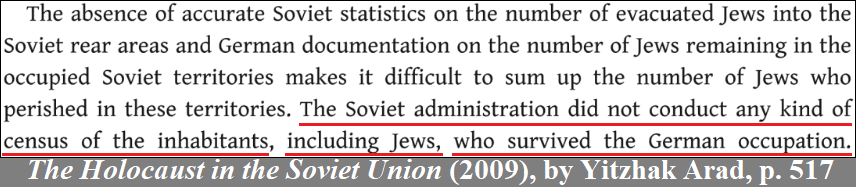
Yitzhak Arad
Yitzhak Arad (né Icchak Rudnicki; November 11, 1926 – May 6, 2021) was an Israeli historian, author, IDF brigadier general and Soviet partisan. He also served as Yad Vashem's director from 1972 to 1993, and specialised in the history of the Holocaust.
Arad was born Icchak Rudnicki on November 11, 1926, in what was then Święciany in the Second Polish Republic (now Švenčionys, Lithuania). In his youth, he belonged to the Zionist youth movement Ha-No'ar ha-Tsiyyoni.
According to Arad's 1993 interview with Harry J. Cargas, he was active in the ghetto underground movement from 1942 to 1944.[4]
In December 1945, Arad illegally migrated to Mandate Palestine, on the Ha'apala boat named after Hannah Szenes. In Arad's military career in the IDF, he reached the rank of brigadier general and was appointed to the post of Chief Education Officer.[7] He retired from the military in 1972.[8]
During his academic career as a lecturer in Jewish history at Tel Aviv University, he Arad researched World War II and the Holocaust, and published extensively as an author and editor, primarily in Hebrew. His later research dealt with the Holocaust in the USSR. Arad also served as the director (Chairman of the Directorate) of Yad Vashem, Israel's Holocaust Remembrance Authority, for 21 years (1972–1993). He remained associated with Yad Vashem in an advisory capacity.
https://en.wikipedia.org/wiki/Yitzhak_Arad
"Holocaust deniers are very slick people. They justify everything they say with facts and figures."