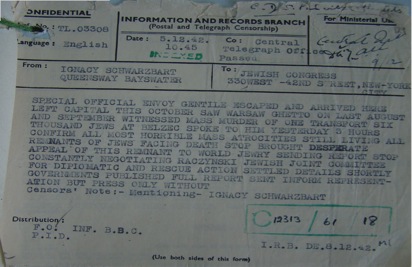
Special official envoy Gentile escaped and arrived here left capital this October saw Warsaw ghetto on last August and September witnessed mass murder of one transport six thousand Jews at Belzec spoke to him yesterday three hours ...
Spoiler
https://www.tandfonline.com/doi/full/10 ... 310#d1e153[Karski] collaborated with the bilingual translator and secretary Krystyna Sokołowska, who translated into English, edited and typed up the sections that Karski completed in Polish on a daily basis. Subsequently, as Karski reported, the manuscript was edited and adapted by an American writer, William Poster, who contributed to the book's final composition and style (Karski Citation1944b). Eventually, through collaborative translation and editing the Polish manuscript was turned into a four-hundred-page book in English, which was completed in July 1944, and published in November 1944. Although it was a translation, Sokołowska's name did not appear on the title page and the book was effectively marketed as an English-language production.
The account of the death camp is found in chapter 30.
https://archive.org/details/in.ernet.dl ... 7/mode/2up
Karski says nothing about gas chambers or mass graves. He rather bizarrely (from a modern orthodox perspective) claims that Jews were loaded into trains and sent out of the camp. Evidently to be left to die in the train. If we take this testimony seriously, Karski is essentially saying Belzec was a transit camp, i.e., his testimony unwittingly debunks the Holocaust.Here the lime served a double purpose in the Nazi economy of brutality. The moist flesh coming in contact with the lime is rapidly dehydrated and burned. The occupants of the cars would be literally burned to death before long, the flesh eaten from their bones. Thus, the Jews would ‘die in agony,’ fulfilling the promise Himmler had issued ‘in accord with the will of the Fuehrer, in Warsaw, in 1942. Secondly, the lime would prevent decomposing bodies from spreading disease. It was efficient and inexpensive — a perfectly chosen agent for their purposes.
It took three hours to fill up the entire train by repetitions of this procedure. It was twilight when the forty-six (I counted them) cars were packed. From one end to the other, the train, with its quivering cargo of flesh, seemed to throb, vibrate, rock, and jump as if bewitched. There would be a strangely uniform momentary lull and then, again, the train would begin to moan and sob, wail and howl. [...]
As I listened to the dwindling outcries from the train, I thought of the destination toward which it was speeding. My informants had minutely described the entire journey. The train would travel about eighty miles and finally come to a halt in an empty, barren field. Then nothing at all would happen. The train would stand stock-still, patiently waiting while death penetrated into every corner of its interior. This would take from two to four days. (pg 349-350)
viewtopic.php?t=763
Karski became a professor of government at Georgetown after the war. Public interest in him increased considerably in the late 70s/early 80s when "the Holocaust" was getting big and when there were controversies over wartime knowledge and the failure of the Allies to intervene. In 1982, the Israelis gave him the Righteous Among the Nations award.
In interviews around this time, Karski seems to stick to something similar to his original story. Here are some clips from his interview with Claude Lanzmann in the late 70s for the film Shoah.
A transcribed excerpt:
Again, he says there were transports out of Belzec, which sharply contradicts the current story. The orthodox side never really had a good explanation for this other than just stepping over this awkward little problem. Here is Laqueur's weak attempt (pg. 231 of The Terrible Secret).What I understood ... and the train went somewhere. And they actually died in those [trains/trucks?]. Some of them were taking--later I learned--to Sobibor. And in Sobibor they were finished. Why they didn't do it at that time in Belzec, I don't know. Because they were doing this before in Belzec. For months. They actually were gassing the Jews before. At that moment and this is--the date now is important--when later on trying to investigate how it was, yes, apparently the end of October or November the camp liquidated completely with the last remnants of the Jews shifted to Sobibor and secondly at that last stage Jews from other ghettos passed through Belzec being shifted somewhere else.
In the 1990s, E. Thomas Wood, developed an alternative theory: Karski accidentally infiltrated the wrong camp. He thought he was sneaking into the Belzec but he was actually just going to some random, unimportant camp called Izbica. This theory appears to be an attempt to harmonize Karski's story with orthodoxy while still maintaining some of Karski's credibility (i.e., without having to dismiss such a heavily decorated hero as a false witness).Karski says that he learned only in later years that Belzec was not a transit but a death camp and that most of the victims were killed in gas chambers. He had not actually seen the gas chambers during his visit, apparently because these were walled in and could be approached only with a special permit.
The problem with this Izbica theory is that it does not fit what Karski says in his original book. The book says Belzec. The Dec 1942 telegram says Belzec. And from the way he describes it, a mix up does not seem possible.
The Bund leader had "the most detailed information in its operations" ... except apparently he didn't know where it actually was. That is what this Wood guy wants us to believe. And I guess the guards they were bribing also didn't know what camp they were in. Imo, the idea that they got mixed up is a non-starter. The only way they end up going to Izbica is if the Bund people for some reason told Karski (falsely) they were going to take him to Belzec but ultimately decided to take him to a different camp for unclear reasons and even though the entire purpose of this endeavor was to witness the exterminations.A FEW days after my second visit to the Warsaw ghetto, the Bund leader was to arrange an opportunity for me to see the Jewish death camp.
The camp was located near the town of Belzec about one hundred miles east of Warsaw and was well-known all over Poland from the tales of horror that were circulated about it. The common report was that every Jew who reached it, without exception, was doomed to death. The Bund leader had never been in it but had the most detailed information in its operations.
I was to go on a day when executions were scheduled. The information was easy to obtain because many of the Estonian, Latvian, and Ukrainian attendants who worked there under Gestapo supervision were in the service of Jewish organizations. Not from any humane or political consideration, but for money. (pg. 339)
According to Wood and various other sources, Karski himself personally endorsed the Izbica correction later in life. But when I looked for anything from Karski himself saying this directly I didn't find much. In most interviews through the 1980s it seems like he continued saying Belzec. But there is one interview--quite late, seemingly from the 90s--where Karski does seem to go along with the Izbica theory.
https://remember.org/karski/kaudioTwice in the Warsaw ghetto, once in the concentration camp — Wood established that it was Izbica, the name of that concentration camp.
But this would be some 50 years after the fact and Karski would have been over 80 at this point. And clearly he was directly influenced by Wood whom he mentions by name. I would not give this any weight at all. I have to wonder if Wood ran a gift card scam on Karski after the interview.
From a revisionist standpoint, if Karski did go to Belzec, then his testimony is actually helpful, from one point of view. If he didn't, that's okay too because then he's just yet another false witness. Another point that is raised by those arguing for the Izbica theory is to say that Karski's description of the camp cannot be Belzec due to various inaccuracies. There may be something to this, but this point amuses me because since when have holocaust apologists ever been bothered by inaccurate testimony? Only when it's convenient do they suddenly start doing revisionist-style critiques of testimony.
There are some prior articles by Friedrich Jansson and Ted O'Keefe
https://codoh.com/library/document/jan- ... to-belzec/
https://ihr.org/journal/v07p504_Okeefe.html
https://holocaustencyclopedia.com/histo ... i-jan/601/