"Proximity meant they could cooperate on occasion" makes no sense given the sensitivity and security of the operation. If TI was this entirely separate administrative entity from the "extermination camp" why would guards from "SS-Arbeitslager Treblinka" be employed for that task? Proximity doesn't explain this in a world where these were entirely different camps with one of them supposed to have been an extermination operation.Proximity meant they could cooperate on occasion, thus guards from SS-Arbeitslager Treblinka are reported to have escorted trains from Warsaw to SS-Sonderkommando Treblinka in the summer of 1942, while the labour camp was stocked up with small selections from some transports otherwise perishing in SS-Sonderkommando Treblinka.
Nov 1942 Treblinka Report, Ringelblum (the "Steam Chamber" report)
- PrudentRegret
- Posts: 167
- Joined: Sat Sep 21, 2024 2:01 am
Re: Nov 1942 Treblinka Report, Ringelblum (the "Steam Chamber" report)
On the subject of cooperation SanityCheck reported:
"Not being a real Zyklon B chimney doesn't make it a fake Zyklon B chimney."
- Sergey_Romanov
- Sergey_Romanov
Re: Nov 1942 Treblinka Report, Ringelblum (the "Steam Chamber" report)
Source 2 claims to have 'at least 18 [pages]' from this set. When they come this way, I will pass them your way.pilgrimofdark wrote: ↑Thu Jan 22, 2026 11:31 pm I don't see it as a derail, but more a development of various themes.
The Ringelblum Archive is being published in English, but it doesn't seem to be available in any English-speaking countries. A bold marketing strategy. Some of it is online at least.
But at least one source confirmed that the "Treblinka" report was produced by three important members of the Ringelblum Archive. And Karski was responsible for smuggling out numerous reports to the London Polish government in exile.
I think this (and Mattogno's Document 17) confirm that this is the relevant set of archival documents that both Berger and Mattogno reference:PrudentRegret wrote: ↑Fri Jan 23, 2026 6:03 am Carlo Mattogno was the first one AFAIK to call out the "SS-Sonderkommando Treblinka" involvement in the administration of the gravel operation with this document:

Bauleitung der Waffen SS und Polizei Trawniki - Schriftwechsel
"Construction management of the Waffen SS and police in Trawniki - correspondence"
The whole file is around 300 pages. Is the whole file worth requesting scans of? It wouldn't exactly be cheap.
If I were to guess why no t4 personnel were chosen to perform gassing that had experience with gassing, it would be because THERE WERE NONE.
- pilgrimofdark
- Posts: 505
- Joined: Sat Aug 09, 2025 7:46 pm
Re: Nov 1942 Treblinka Report, Ringelblum (the "Steam Chamber" report)
Some more material on what else was going on around Małkinia. If van Eupen was really moved up there, he wouldn't have been moved just to oversee the Treblinka camps.
The USHMM encyclopedia mentions a labor camp in Małkinia Gorna, but not in its own entry.
In Siedlce, the prisoners were doing the usual: gravel quarry work, wood cutting, road construction, unloading railcars, building fortifications.
Disregarding ChGK's sanctimonious veneration of horror schlock about villages of Jews being murdered in "electric furnaces," there seems to be more to explore about the camp(s) around Małkinia.
I'm not sure where all this is going yet, but I'm putting it in here since the debate Małkinia thread is more than half about Auschwitz
The USHMM encyclopedia mentions a labor camp in Małkinia Gorna, but not in its own entry.
From the same volume, Stalag 333 had a subcamp in Małkinia between November 1941 and September 1943. After that, the legion soldiers were transferred to Stalag 366 in Siedlce or Stalag 307. So around the time the T-II camp was winding down and before the T4 personnel were relocated to Italy.Foreign legionnaires who came from the territories of the Soviet Union and from Eastern Europe were mostly transferred to “special camps” (labor camps), which existed, for example, in Ostrov (Ostrovskii raion, Pskovskaia oblast’, Russia) and in Małkinia Górna in Poland.
WEHRMACHT DISCIPLINARY FACILITIES INTRODUCTION
In Siedlce, the prisoners were doing the usual: gravel quarry work, wood cutting, road construction, unloading railcars, building fortifications.
Disregarding ChGK's sanctimonious veneration of horror schlock about villages of Jews being murdered in "electric furnaces," there seems to be more to explore about the camp(s) around Małkinia.
- Labor Camp
- POW Camp
- Transit Camp
I'm not sure where all this is going yet, but I'm putting it in here since the debate Małkinia thread is more than half about Auschwitz
- pilgrimofdark
- Posts: 505
- Joined: Sat Aug 09, 2025 7:46 pm
Re: Nov 1942 Treblinka Report, Ringelblum (the "Steam Chamber" report)
I didn't catch this before. I really need to go through these 1944 Soviet Treblinka reports again. They need a lot of proofreading, but have some interesting material.
The Extraordinary State Commission did an "investigation" of US and British citizens sent to Treblinka and killed. They wrote up a Draft Report, which was totally swept under the rug.
They state van Eupen was commandant of the Treblinka death camp.
If anyone is "confused" about the distinction between the Treblinka camps, they're in good company: the initial investigators and supposed eyewitnesses are the source of this confusion, both chronologically and geographically.
And to tie it back to the Ringelblum Archive, it's like the 1942 report got modified to become the Wiernik book, which was then clumsily stapled onto the Soviet Treblinka investigations.
The Extraordinary State Commission did an "investigation" of US and British citizens sent to Treblinka and killed. They wrote up a Draft Report, which was totally swept under the rug.
They state van Eupen was commandant of the Treblinka death camp.
Who do they say was in charge of this?In June 1942, 3 kilometers southeast of the Treblinka railway station, 2 kilometers southwest of the village of Wólka Okrąglik in the Warsaw Voivodeship, the Germans built concentration camp No. 2, in which they killed civilians, mainly Jews, citizens of the United States of America, England and various occupied European countries – France, Czechoslovakia, Poland, Bulgaria and others.
...
This brutal extermination was carried out primarily by gassing in a specially equipped room.
So the ChGK never mentions Stangl in any of their interviews or the draft report. Van Eupen gets quite a few more mentions throughout the various 1944 Soviet investigations than Stangl. Franz also gets numerous mentions.All atrocities at the Treblinka camp were carried out by the Germans under the direction and with the personal participation of the camp commandant, Baron van Eupen. (underlined with a red pencil in the original)
...
On the basis of the investigation carried out, the Extraordinary State Commission established that this monstrous crime – the extermination of US and British citizens – was committed by the commandant of the Treblinka camp, Baron van Eupen, the head of the camp, Oberscharführer Franz, his assistant, Oberscharführer Fles, Unterscharführers Fuchs, Mitzik, Stumpe, Schwartz, Zenf, Lanz, Hagen, on the orders of the Hitlerite government.
If anyone is "confused" about the distinction between the Treblinka camps, they're in good company: the initial investigators and supposed eyewitnesses are the source of this confusion, both chronologically and geographically.
And to tie it back to the Ringelblum Archive, it's like the 1942 report got modified to become the Wiernik book, which was then clumsily stapled onto the Soviet Treblinka investigations.
- PrudentRegret
- Posts: 167
- Joined: Sat Sep 21, 2024 2:01 am
Re: Nov 1942 Treblinka Report, Ringelblum (the "Steam Chamber" report)
IIRC Franz Stangl denied being the commandant of "Treblinka extermination camp" in 1967 before "confessing" to that journalist immediately before his untimely death in the 70s. I couldn't find that interview, but I wonder what he says on that point in '67.
"Not being a real Zyklon B chimney doesn't make it a fake Zyklon B chimney."
- Sergey_Romanov
- Sergey_Romanov
- PrudentRegret
- Posts: 167
- Joined: Sat Sep 21, 2024 2:01 am
Re: Nov 1942 Treblinka Report, Ringelblum (the "Steam Chamber" report)
This is the only mainstream historical account I could find on that matter:
https://zdjp.si/wp-content/uploads/2015 ... farrer.pdf
https://zdjp.si/wp-content/uploads/2015 ... farrer.pdf
Well, well, well so Stangl himself in that interview apparently affirmed the "Operation Reinhardt" interpretation of T-II and his role in that camp. Stangl having that role would not contradict van Eupen as the overall commander of "Arbeitslager Treblinka", encompassing what we call "T-II".The first attempt to connect Stangl to the function of chief of camp failed, because it turned out that the representative delegated to directly manage the working Jews was his deputy; consequently Stangl's presence was not conspicuous enough for the people to remember him...
...
The commanders of Treblinka, Stangl and Franz, always denied their involvement in the direct action of murder. Franz insisted that his only obligations concerned the squad on guard, while Stangl maintained that his responsibility was only to assure the delivery of the Jewish assets – which he evasively referred to as "material" – to Globocnik.
"Not being a real Zyklon B chimney doesn't make it a fake Zyklon B chimney."
- Sergey_Romanov
- Sergey_Romanov
- pilgrimofdark
- Posts: 505
- Joined: Sat Aug 09, 2025 7:46 pm
Re: Nov 1942 Treblinka Report, Ringelblum (the "Steam Chamber" report)
This Treblinka map was apparently drawn by Kurt Franz while awaiting trial, and lists various personnel.
The only copy I could find online is very low resolution and almost unreadable, so this has a super zoom filter applied to it.
I'm not sure of the original archival source.
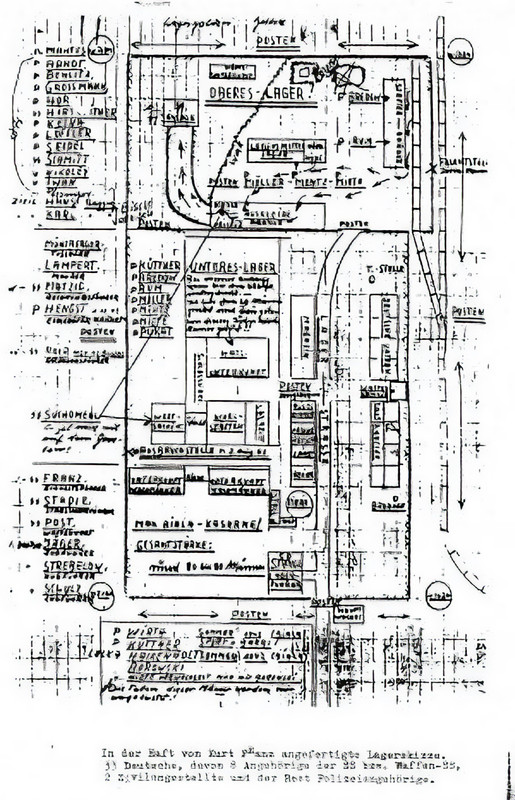
The only copy I could find online is very low resolution and almost unreadable, so this has a super zoom filter applied to it.
I'm not sure of the original archival source.
Spoiler
Re: Nov 1942 Treblinka Report, Ringelblum (the "Steam Chamber" report)
Gee, he drew Wernick's map (basically) and it doesn't reflect reality, what a surprise.
Did he 'draw it' with somebody else's hands a gunpoint?
Did he 'draw it' with somebody else's hands a gunpoint?
If I were to guess why no t4 personnel were chosen to perform gassing that had experience with gassing, it would be because THERE WERE NONE.
- pilgrimofdark
- Posts: 505
- Joined: Sat Aug 09, 2025 7:46 pm
Re: Nov 1942 Treblinka Report, Ringelblum (the "Steam Chamber" report)
By the 1960s when his trial occurred, Trapezoidal Treblinka was canonical. The 1942 Ringelblum/Wiernik map was supposedly due to "hearsay, memory disorders, PTSD."
So that's the conundrum.
Why would Kurt Franz draw a "hearsay, memory disorders, PTSD" map of a camp that's inaccurate? He was repeating hearsay he got from the Warsaw ghetto
Or did he draw a roughly accurate map of the camp he was at? If so, then what is Trapezoidal Treblinka?
I wonder if gathering maps of Treblinka and separating them by rectangle/trapezoid would help clarify anything.
So that's the conundrum.
Why would Kurt Franz draw a "hearsay, memory disorders, PTSD" map of a camp that's inaccurate? He was repeating hearsay he got from the Warsaw ghetto
Or did he draw a roughly accurate map of the camp he was at? If so, then what is Trapezoidal Treblinka?
I wonder if gathering maps of Treblinka and separating them by rectangle/trapezoid would help clarify anything.
Re: Nov 1942 Treblinka Report, Ringelblum (the "Steam Chamber" report)
Nazgul and Fangers have a thread some place with conjecture about where 'the rectangle camp of death' may have been. I will see if I can find it. If I recall correctly you had piped in on it with that ww2 field map showing the defensive installations nearby, the road work going on etc.
Regardless, that this is what he drew speaks volumes. He drew exactly what he was told to draw.
Regardless, that this is what he drew speaks volumes. He drew exactly what he was told to draw.
If I were to guess why no t4 personnel were chosen to perform gassing that had experience with gassing, it would be because THERE WERE NONE.
Re: Nov 1942 Treblinka Report, Ringelblum (the "Steam Chamber" report)
The deathcamps website has a better version of it, with interpretation in red:pilgrimofdark wrote: ↑Fri Jan 30, 2026 9:22 pm The only copy I could find online is very low resolution and almost unreadable, so this has a super zoom filter applied to it.
http://www.deathcamps.org/treblinka/pic/03b.jpg
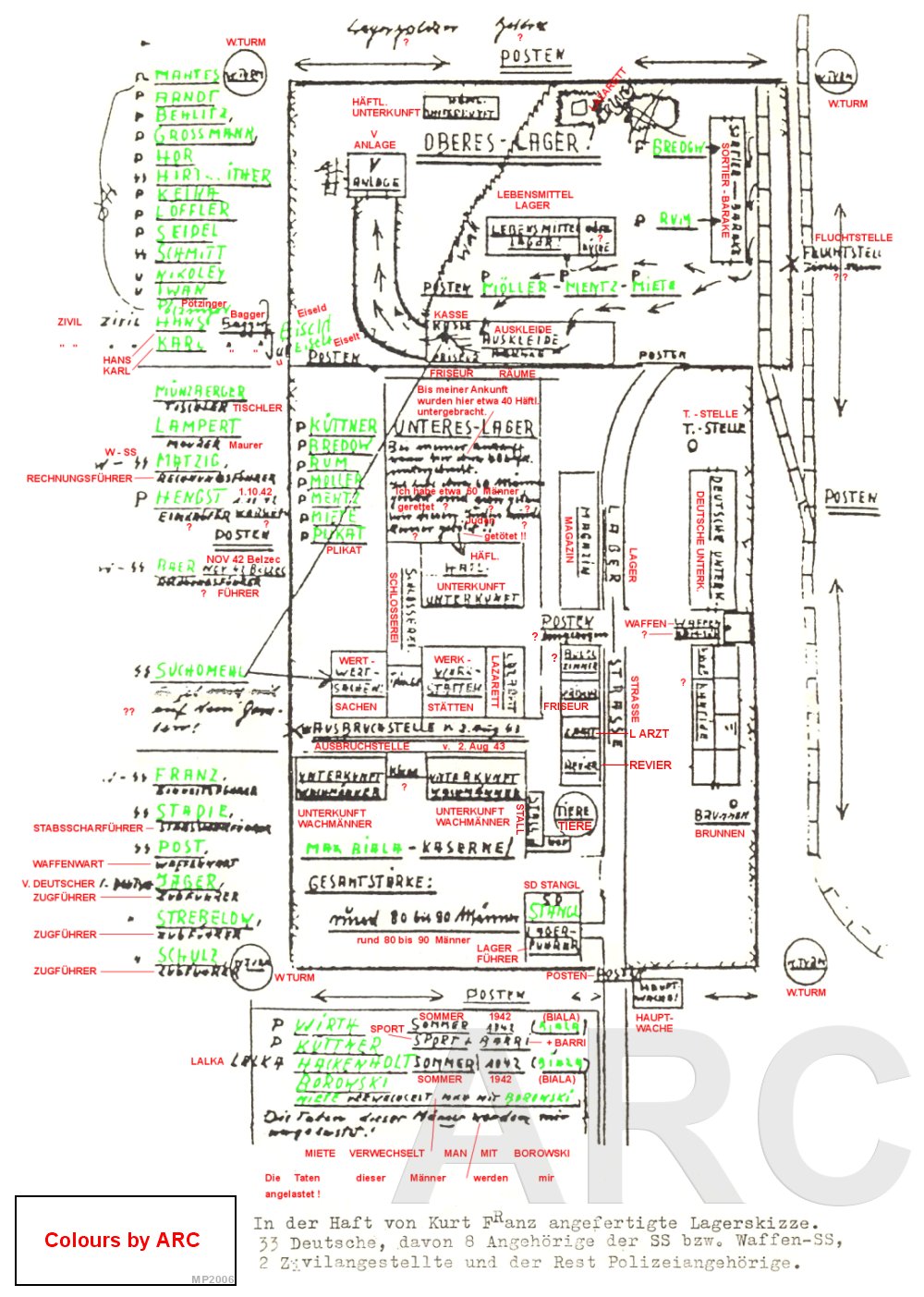
From this page:
http://www.deathcamps.org/treblinka/perpetrators.html
- pilgrimofdark
- Posts: 505
- Joined: Sat Aug 09, 2025 7:46 pm
Re: Nov 1942 Treblinka Report, Ringelblum (the "Steam Chamber" report)
From earlier in the thread...
These are the two construction firms that are said (by Arad/Webb) to have built the Treblinka II camp:
However, Witold Chrostowski gives a different citation for the same information in his book Extermination Camp Treblinka.
Chrostowski cites Donat's The Death Camp Treblinka, which does have this information.
I hadn't heard of Eberl being commandant of Chelmno before this, and it's not in either Mattogno's book nor Montague's. It's mentioned on Eberl's Wikipedia page with a citation link to a PDF that seems to be... a high school lesson plan
It's like they don't want to cite Donat directly, maybe because Donat doesn't cite anything at all to back up his claims.
These are the two construction firms that are said (by Arad/Webb) to have built the Treblinka II camp:
- Robert Schönbrunn
- Hans Schmidt and Heinrich Münsterman
However, Witold Chrostowski gives a different citation for the same information in his book Extermination Camp Treblinka.
Chrostowski cites Donat's The Death Camp Treblinka, which does have this information.
Donat also gives no citation for this information.After the establishment of Camp Chelmno, Eberl briefly served as its commandant, then was placed in charge of the construction of the Treblinka camp. The construction work was done by the Leipzig construction firm of Schönbrunn and the Warsaw branch of another German firm, Schmidt and Münstermann, both of which used Polish and Jewish slave labor.
- p. 274, section "Dr. Irmfried Eberl"
I hadn't heard of Eberl being commandant of Chelmno before this, and it's not in either Mattogno's book nor Montague's. It's mentioned on Eberl's Wikipedia page with a citation link to a PDF that seems to be... a high school lesson plan
It's like they don't want to cite Donat directly, maybe because Donat doesn't cite anything at all to back up his claims.
Re: Nov 1942 Treblinka Report, Ringelblum (the "Steam Chamber" report)
No mention of chelmno in this 2018 article, sourced from what you have read, although, you mention it being one of the only sources cited.
https://www.holocausthistoricalsociety. ... eberl.html
This history thing, it seems it isn't easy for the mainstream to get right. I'm not accustom to thoroughly vetting history books, so, I don't know if this is normal, but, if it is, I have always assumed a higher level of professionalism and source scrutiny, as when we were being taught 'journalism' in high school we were taught to do better work than this. I don't know if it is an abortion, or a miscarriage, but, it is something.
https://www.holocausthistoricalsociety. ... eberl.html
Spoiler
In January 1940, he was recruited by the Charitable Foundation for Institutional Care, the cover name of the organization that ran the Nazi euthanasia operation under the code designation ‘T4’. He was among the group of Nazi dignitaries and doctors who witnessed the first gassing experiment in mid-January 1940, at an abandoned prison in Brandenburg-an-der- Havel, 30 km west of Berlin. The dignitaries included Reichsleiter Philipp Bouhler, head of the Führer’s Chancellery, and Dr. Karl Brandt, Hitler’s escorting physician and SS- Obersturmführer Christian Wirth was also included in this group.
From February 1940, Eberl was appointed to the post of the medical director of the ‘T4’ euthanasia institution in Brandenburg prison and when that institution ceased functioning at the end of 1940, he became medical director of the ‘T4’ institution established in a part of the mental asylum in Bernburg-an-der-Saale, near Dessau. From January 1942, Eberl spent several weeks on the Eastern Front with other ‘T4’ personnel, ostensibly ferrying wounded troops from the frontline in the Minsk area to reserve military hospitals in the rear. This duty was carried out in the uniform of the Organisation Todt (OT), the Nazi construction brigades led by Fritz Todt.
Upon on his return to Germany in the spring of 1942, Dr. Eberl was sent briefly to the Sobibor death camp in eastern Poland, which was then under construction. Towards the end of June 1942, he was appointed the first Commandant of the Treblinka death camp, but within a little over a month, after the camp became operational - it became obvious that he was not equal to the task.
If I were to guess why no t4 personnel were chosen to perform gassing that had experience with gassing, it would be because THERE WERE NONE.
- pilgrimofdark
- Posts: 505
- Joined: Sat Aug 09, 2025 7:46 pm
Re: Nov 1942 Treblinka Report, Ringelblum (the "Steam Chamber" report)
I'm not doing too much "vetting." If I read something I haven't heard before, I'll check the citation (if there is one), to familiarize myself with other sources or check the referenced work.Stubble wrote: ↑Wed Feb 18, 2026 8:43 am This history thing, it seems it isn't easy for the mainstream to get right. I'm not accustom to thoroughly vetting history books, so, I don't know if this is normal, but, if it is, I have always assumed a higher level of professionalism and source scrutiny, as when we were being taught 'journalism' in high school we were taught to do better work than this. I don't know if it is an abortion, or a miscarriage, but, it is something.
Flaws includes Chrostowski's book in his bibliography, so I got that book, and here we are in a new rabbit hole.
Maybe Donat got several details corrupted, which are now occasionally passed around.
Eberl - Sobibor - briefly visited
Eberl - Chelmno - briefly commandant
Or Donat was right and an Eberl-Chelmno-commandant connection is missing.
Thankfully, the 3.5 million corpses count is rock solid, just leaving everything else hanging.
Here's the Eberl letter from Sobibor:
German:
Spoiler
Dr.med.Irmfried Eberl SS-Untersturmführer
2.2t. SS-Arbeitslager Sobibor
Sobibor, den 26.4.42.
An die
Landes-Heil- und Pflegeanstalt Bernburg - Verwaltung -
z.Hd. Fräulein Dittmann
Bernburg/Saale
Postfach 263.
Betrifft: Medikamentenbestellung.
Sehr geehrtes Fräulein Dittmann !
In der Anlage übersende ich Ihnen zwei Aufstellungen von Kedikamenten und Instrumenten, die ich Sie zu besorgen bitte. Diese Dinge sind für das Lager hier und für tax mein Lager be- stimmt und werden dringenst benötigt. Das für Sobibor bestimmte Paket bitte ich an Herrn Schütt, 35-Oberscharführer, SS-Arbeits- lager Sobibor zu schicken das zweite Paket an mich zu addressieren. Beide Pakete können über Berlin mittels Kurier an uns geschickt werden. Den Paketen bitte ich auch eine Rechnung beizulegen, damit die Kosten verrechnet werden können.
Heil Hitler!.
2 Anlagen
Spoiler
Dr. med. Irmfried Eberl, SS-Untersturmführer
2.2t. SS Labor Camp Sobibor
Sobibor, April 26, 1942.
To the
Bernburg State Sanatorium and Nursing Home - Administration -
Attn: Miss Dittmann
Bernburg/Saale
P.O. Box 263.
Subject: Medication order.
Dear Miss Dittmann!
Enclosed please find two lists of medications and instruments that I request you to procure. These items are intended for the camp here and for my camp and are urgently needed. Please send the package for Sobibor to Mr. Schütt, 35-Oberscharführer, SS Labor Camp Sobibor, and address the second package to me. Both packages can be sent to us via courier from Berlin. Please also include an invoice with each package so that the costs can be settled.
Heil Hitler!
2 facilities
Re: Nov 1942 Treblinka Report, Ringelblum (the "Steam Chamber" report)
Not that I disagree Sir, I just think this incestuousness and copy pasties by mainstream 'historians' is sloppier than I was taught to be in high school with simple journalism.
These 'kissing cousins', that are all swapping their work around in some kind of verbal atrocity orgy, don't even bother to look at the source material for the subject they are writing to.
This is highlighted with The Good Doctor here and with the 'Station Master' over there. The list can get long pretty quick.
The selective quotes to lend legitimacy to absolutely insane tales to blend together some sense of coherence is another point where the main stream chooses to piss on my leg and tell me it is raining. They will unironically quote about cremation pyres while ignoring 'corpse volcanoes'. They will talk about 'Huge Mass Graves' without mentioning that none have been proven up congruent with the claims.
These people fail basic rigor time and time again!
These 'kissing cousins', that are all swapping their work around in some kind of verbal atrocity orgy, don't even bother to look at the source material for the subject they are writing to.
This is highlighted with The Good Doctor here and with the 'Station Master' over there. The list can get long pretty quick.
The selective quotes to lend legitimacy to absolutely insane tales to blend together some sense of coherence is another point where the main stream chooses to piss on my leg and tell me it is raining. They will unironically quote about cremation pyres while ignoring 'corpse volcanoes'. They will talk about 'Huge Mass Graves' without mentioning that none have been proven up congruent with the claims.
These people fail basic rigor time and time again!
If I were to guess why no t4 personnel were chosen to perform gassing that had experience with gassing, it would be because THERE WERE NONE.