Since delousing often includes showering, some photos and videos could include nudity. Viewer discretion.
Disinfection Train
Spoiler
In 1942 the Germans produced a long film on typhus titled Kampf dem Flickfieber!, now hosted on USHMM. On reel 2, starting from timestamp 00:49, it shows the operation of an Entseuchungszug, a disinfection train. After an on-camera demonstration, it also shows an animated diagram, which (collaged and cleaned up) looks like this:
Diagram labels include:
We see in the footage that the persons being disinfected are German soldiers. They are made to disrobe, turn in their clothing, proceed through a haircut and shower, wait for one half hour in private cabins, and re-robe before disembarking. The procedure looks familiar -- that is, similar to other delousing procedures we will look at -- even though the shape of a train makes the path of travel unintuitive.
One individual whose hair is not shorn is given Cuprex to apply. Cuprex seems to be an American-made anti-lice insecticide lotion.
The operators wear an outer layer of protective clothing which covers everything but their faces.
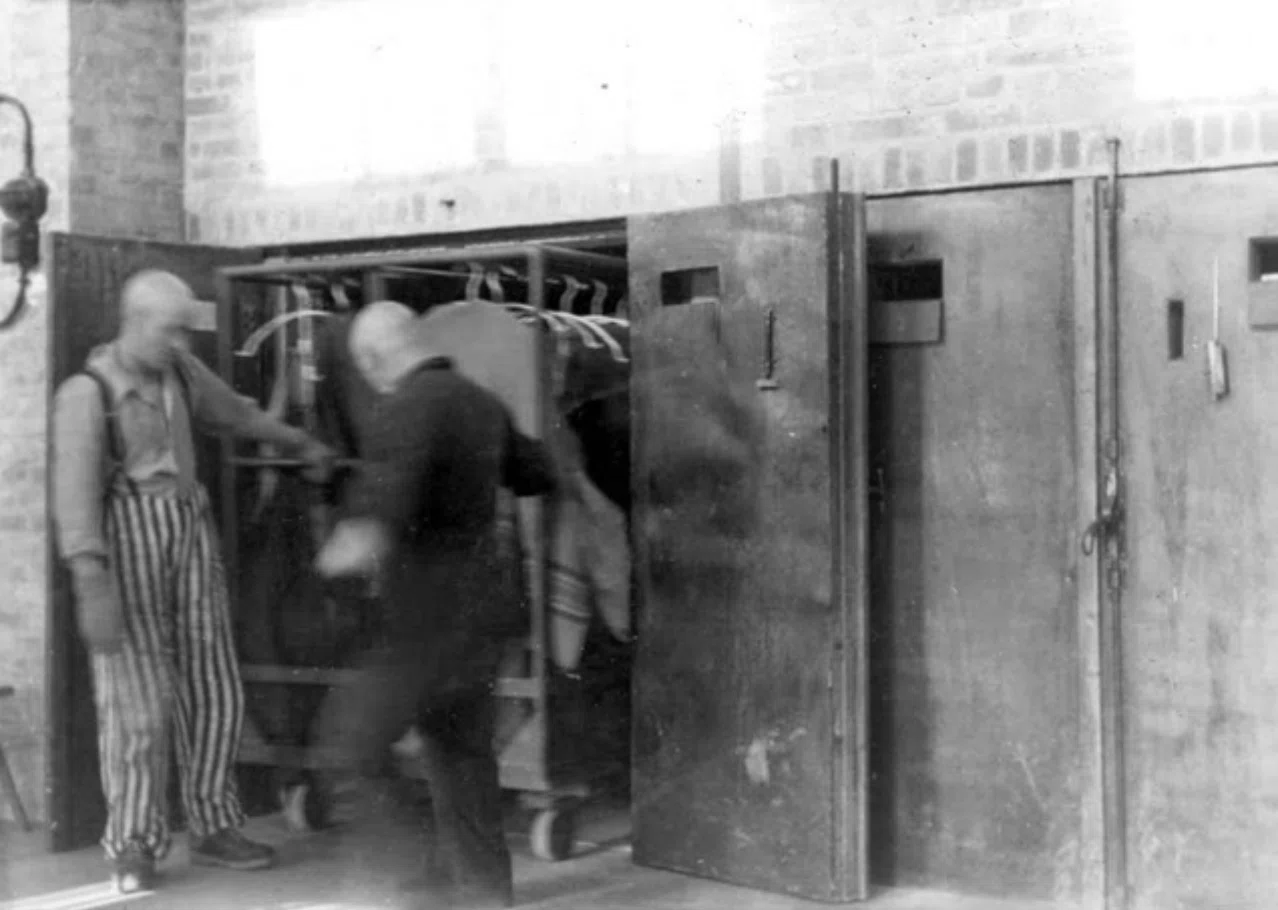
I am unable to identify the disinfection device on the train, but it resembles a two-sided steam autoclave. The uniforms are put on hooks and hanged inside the chamber.
- diagram of disinfection train from 1942 video on typhus, built by Reichsbahn-Ausbesserungswerk Potsdam, delousing, plan.jpg (345.35 KiB) Viewed 7985 times
Diagram labels include:
Code: Select all
Unreine Seite		Unclean side
Reine Seite		Clean side
Auskleideraum		Undressing room
Kleiderabgabe		Clothing drop-off
Desinfektionsgerät	Disinfection device
Frisörraum		Hairdressing room
Einseifraum		Lathering room
Brauseraum		Shower room
Trockengang		Drying hallway
Wartezeit 1/2 Std.	Waiting time: 1/2 hour
Erbauer Reichsbahn-Ausbesserungswerk Potsdam // Built by the Railway Repair Works in Potsdam
One individual whose hair is not shorn is given Cuprex to apply. Cuprex seems to be an American-made anti-lice insecticide lotion.
The operators wear an outer layer of protective clothing which covers everything but their faces.
I am unable to identify the disinfection device on the train, but it resembles a two-sided steam autoclave. The uniforms are put on hooks and hanged inside the chamber.
Spoiler
Built right next to the Birkenau train ramp, buildings 5a and 5b were designed expressly for delousing (as "Entlausungsbaracke"). They are mirror images of each other. Four blueprints of 5a can be found in Pressac's book, Auschwitz: Technique and Operation of the Gas Chambers, starting from page 55. The most readable of these is this one:
From left to right, the labels follow the path of travel:
The gas chambers in both of these buildings have Iron Blue stains from Zyklon usage. Later work converted part of this space for "hot-air disinfection" using a Hochheim Company device. A third form of delousing was installed in the form of a "steam-disinfection device" from the Eugen Werner Company. See The Real Auschwitz Chronicle for details, especially p.214.
Photos of these buildings are plentiful in The Chemistry of Auschwitz. The clothing was presumably put on clothing racks of some fashion, though I can't find an image of what those looked like.
According to camp documents, some 22 "gas doors" or "gas-tight doors" were equipped to these buildings (Special Treatment in Auschwitz, pp.48-49). Also notable is that these doors were to be manufactured "exactly like the doors for special t. of the J.", no doubt referring to the doors of the Zentralsauna, which was the "Delousing facility for special treatment".
- blueprint of BW 5a, Birkenau, 1942.jpg (111.43 KiB) Viewed 7985 times
From left to right, the labels follow the path of travel:
Code: Select all
Windfang		Windbreak
Aborte			Toilets
Unreine Seite		Unclean side
Auskleide Raum		Undressing room
Wasch u. Brauseraum	Wash and shower room
Vorraum			Vestibule
Schleuse		Airlock
Gaskammer		Gas chamber
Reine Seite		Clean side
Ankleide Raum		Dressing room
Pumpenraum		Pump room
Photos of these buildings are plentiful in The Chemistry of Auschwitz. The clothing was presumably put on clothing racks of some fashion, though I can't find an image of what those looked like.
According to camp documents, some 22 "gas doors" or "gas-tight doors" were equipped to these buildings (Special Treatment in Auschwitz, pp.48-49). Also notable is that these doors were to be manufactured "exactly like the doors for special t. of the J.", no doubt referring to the doors of the Zentralsauna, which was the "Delousing facility for special treatment".
Spoiler
The Zentralsauna or Central Sauna stands between Crematoria III and IV. In documents it was referred to by formal names like "Disinfection and disinfestation facility" ("Desinfektions- und Entwesungsanlage") or "Delousing facility for special treatment" (see Special Treatment in Auschwitz, p.40).
Pressac discusses the Zentralsauna with numerous photos and plans in Auschwitz: Technique and Operation of the Gas Chambers from pages 65 to 85. The most accurate floorplan is the one on page 72, but the Auschwitz Museum's equivalent plan is faithful enough and easier to read.

Prisoners to be treated would enter at the upper right (literally marked "Zugang" or "entrance" in the original), follow a U-shaped pathway, showering at the bottom while their clothes went to disinfection at the center of the building, and ultimately exit at the upper left ("Abgang"). Not to be overlooked are all the rooms that have direct equivalents in the crematoria, especially the doctor's room ("Artzt") and examination room ("Untersuchungs-Raum"). There was also a valuables room ("Wertsachen") noted on at least one draft plan and in the handover protocol (The Real Auschwitz Chronicle, p.387).
The Zentralsauna was equipped with "3 disinfestation ovens" installed by a Munich-based company called Goedecker (Les Crématoires d'Auschwitz, caption for document 24) and "4 disinfestation hot-air chambers" from Topf & Söhne. The Germans took some action shots of them while in operation:
https://lekcja.auschwitz.org/praca_en/i ... 2b3c92.jpg
https://www.historiography-project.com/ ... 083-01.jpg
https://assets.st-note.com/img/17741082 ... CGn4qV.png
According to Germar Rudolf, two of the Topf devices may have come from a project originally planned for Crematorium II (The Chemistry of Auschwitz, pp.121,122).
One oddity about the Zentralsauna is that it's singular, lacking an identical or split facility to keep men apart from women.
Pressac discusses the Zentralsauna with numerous photos and plans in Auschwitz: Technique and Operation of the Gas Chambers from pages 65 to 85. The most accurate floorplan is the one on page 72, but the Auschwitz Museum's equivalent plan is faithful enough and easier to read.
Prisoners to be treated would enter at the upper right (literally marked "Zugang" or "entrance" in the original), follow a U-shaped pathway, showering at the bottom while their clothes went to disinfection at the center of the building, and ultimately exit at the upper left ("Abgang"). Not to be overlooked are all the rooms that have direct equivalents in the crematoria, especially the doctor's room ("Artzt") and examination room ("Untersuchungs-Raum"). There was also a valuables room ("Wertsachen") noted on at least one draft plan and in the handover protocol (The Real Auschwitz Chronicle, p.387).
The Zentralsauna was equipped with "3 disinfestation ovens" installed by a Munich-based company called Goedecker (Les Crématoires d'Auschwitz, caption for document 24) and "4 disinfestation hot-air chambers" from Topf & Söhne. The Germans took some action shots of them while in operation:
https://lekcja.auschwitz.org/praca_en/i ... 2b3c92.jpg
https://www.historiography-project.com/ ... 083-01.jpg
https://assets.st-note.com/img/17741082 ... CGn4qV.png
According to Germar Rudolf, two of the Topf devices may have come from a project originally planned for Crematorium II (The Chemistry of Auschwitz, pp.121,122).
One oddity about the Zentralsauna is that it's singular, lacking an identical or split facility to keep men apart from women.
Spoiler
It is probably more than coincidence that at the same time the Zentralsauna was being planned and built in Birkenau (construction beginning on April 30, 1942), a very similar facility was in the works at Majdanek. A plan for an "Entlausungsanlage", drawn on March 30, 1942, accurately depicts what later became Barrack 42, the women's bathhouse, which is the place women supposedly passed through on their way to the "gas chamber" bunker stationed just behind it.
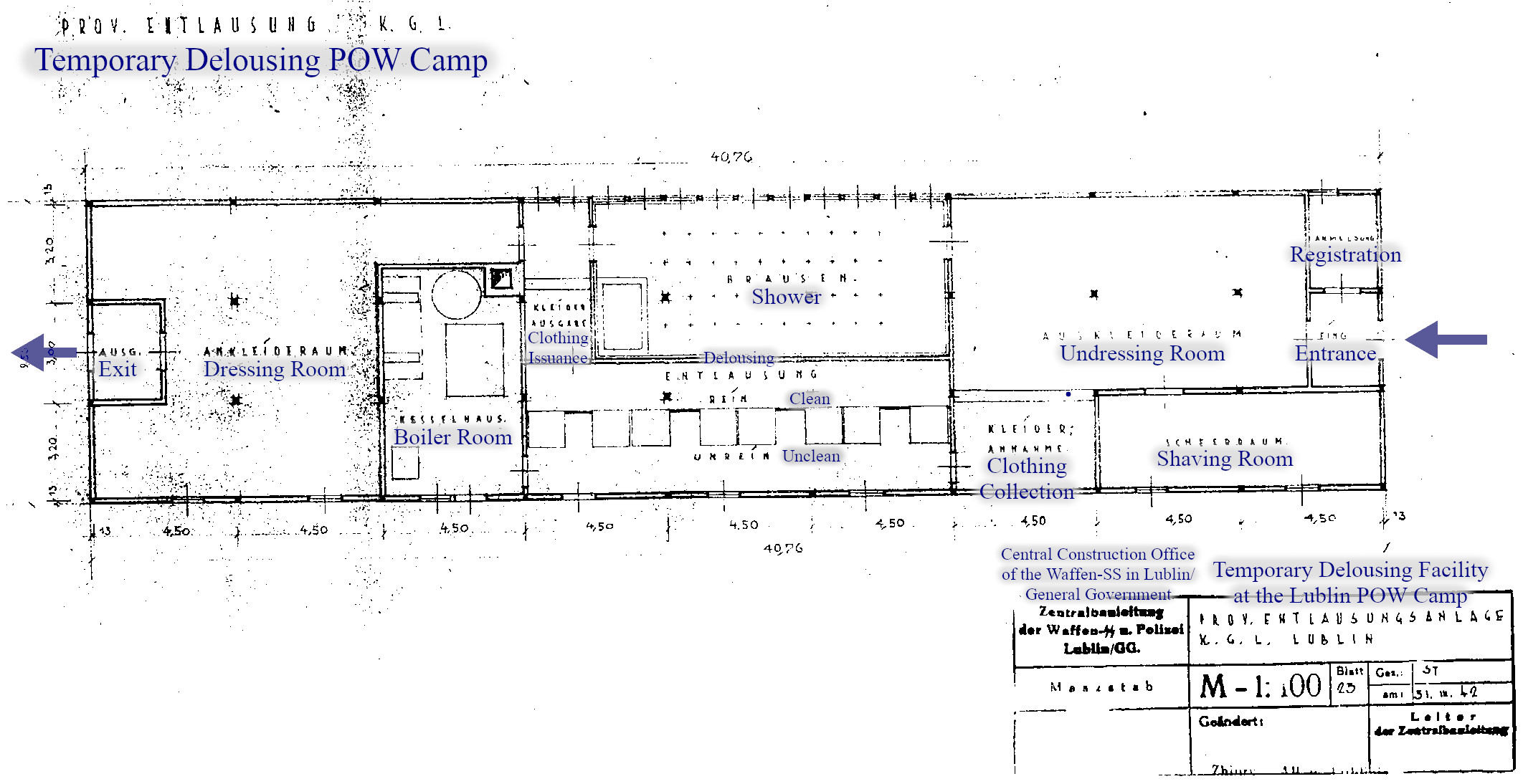
A major flaw in the "gas chamber" theory is that the plan shows the intended path of travel takes the prisoner delousees away from the bunker. This is proven by the room labels, which include the entrance ("Eingang"), undressing room ("Auskleideraum"), clothing drop-off ("Kleiderannahme"), etc. That is, the plan had delousees travel from north-to-south instead of from south-to-north (as the Soviets, the witnesses, and the Majdanek Museum all claimed, e.g. see this magazine they produced, page 17).
Barrack 42 has four small delousing chambers. I'm unable to find any information on how these worked. All the chambers have wooden doors in a style similar to Auschwitz's gas-tight doors.
Barrack 42 is the approximate mirror image of its neighbor Barrack 41, the men's bathhouse. The two notable differences in B41 are: the absence of those four delousing chambers, leaving more space for showers; and the conversion of the undressing room to perform clothing delousings. We know that in the undressing room Zyklon B was used because of the tell-tale Iron Blue stains on the walls and ceiling. However, these Zyklon gassings would be slow, probably requiring an overnight wait to air out, and this would inconveniently block off a large part of the building. For this reason, I say probably that delousing gassings were only conducted between transports, and incoming prisoners were issued fresh clothes which could easily be stored in the sizable dressing room. With those assumptions, B41 and B42 operated very similarly.
Until as recently as 2008, the Majdanek Museum claimed B41's undressing room (which it insists is a "dressing room") hosted a homicidal "gas chamber", but it has since dropped this claim (Source). It still claims B41 was the site of selections for gassing and for travel toward the "gas chamber" bunker.
B41's undressing room also has wooden doors made gas-tight plus two chimneys added for ventilation. The way the latter are described in documents, i.e. "Brick construction of two chimneys in the gas chamber", could be interpreted as criminal traces if a person was looking for any here (Concentration Camp Majdanek, p.133).
A major flaw in the "gas chamber" theory is that the plan shows the intended path of travel takes the prisoner delousees away from the bunker. This is proven by the room labels, which include the entrance ("Eingang"), undressing room ("Auskleideraum"), clothing drop-off ("Kleiderannahme"), etc. That is, the plan had delousees travel from north-to-south instead of from south-to-north (as the Soviets, the witnesses, and the Majdanek Museum all claimed, e.g. see this magazine they produced, page 17).
Barrack 42 has four small delousing chambers. I'm unable to find any information on how these worked. All the chambers have wooden doors in a style similar to Auschwitz's gas-tight doors.
Barrack 42 is the approximate mirror image of its neighbor Barrack 41, the men's bathhouse. The two notable differences in B41 are: the absence of those four delousing chambers, leaving more space for showers; and the conversion of the undressing room to perform clothing delousings. We know that in the undressing room Zyklon B was used because of the tell-tale Iron Blue stains on the walls and ceiling. However, these Zyklon gassings would be slow, probably requiring an overnight wait to air out, and this would inconveniently block off a large part of the building. For this reason, I say probably that delousing gassings were only conducted between transports, and incoming prisoners were issued fresh clothes which could easily be stored in the sizable dressing room. With those assumptions, B41 and B42 operated very similarly.
Until as recently as 2008, the Majdanek Museum claimed B41's undressing room (which it insists is a "dressing room") hosted a homicidal "gas chamber", but it has since dropped this claim (Source). It still claims B41 was the site of selections for gassing and for travel toward the "gas chamber" bunker.
B41's undressing room also has wooden doors made gas-tight plus two chimneys added for ventilation. The way the latter are described in documents, i.e. "Brick construction of two chimneys in the gas chamber", could be interpreted as criminal traces if a person was looking for any here (Concentration Camp Majdanek, p.133).
Spoiler
This building, the only one still standing between Fields I and II, is very poorly documented. From my best attempts at research, it was a crematorium equipped with two cremation ovens, but according to the Soviets and some witnesses, it was also used for homicidal gassings, delousing gassings, and/or laundry drying. The Majdanek Museum now rejects the story of homicidal gassings here (Source).
This facility is fundamentally different than others on this list because, as far as anyone knows, it didn't include showers and was not referred to in documents as a delousing facility. I include it here because it demonstrates the banality of having gas chambers in a crematoria.
This facility is fundamentally different than others on this list because, as far as anyone knows, it didn't include showers and was not referred to in documents as a delousing facility. I include it here because it demonstrates the banality of having gas chambers in a crematoria.
Spoiler
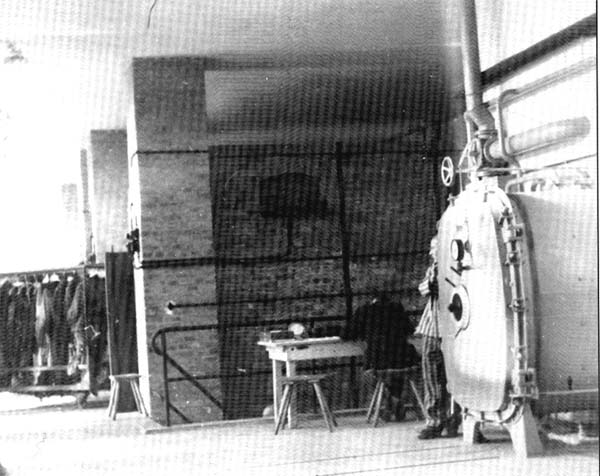
Mauthausen's laundry block is adjacent to the main entrance and the prisoners' barracks. The basement floor of the laundry is nothing more than a giant shower room and a steam autoclave. A wall bisects the space around the autoclave, splitting it into a clean room and unclean room.
This location is best seen in tourist videos, like this one:
It hardly needs to be said, but the process here was: enter, drop off clothing near the autoclave, possibly get a haircut, shower, and put on clean clothing on the clean side. Exit was made through the same door they came in through.
This location is best seen in tourist videos, like this one:
It hardly needs to be said, but the process here was: enter, drop off clothing near the autoclave, possibly get a haircut, shower, and put on clean clothing on the clean side. Exit was made through the same door they came in through.