
Understanding eyewitnesses, is crucial to correct interpretation of their testimony. Without understanding, any interpretation is likely to be inaccurate.
https://www.sciencedirect.com/science/a ... 1325000270
"Many believe that eyewitness memory is unreliable, but a better way of thinking is that eyewitness memory, like other types of forensic evidence, can be contaminated. Because contaminated evidence yields unreliable results, the focus should be placed on testing uncontaminated memory evidence collected early in a police investigation. The recent application of theories, principles, and methods from cognitive science has revealed that, both in the laboratory and in the real world, the first test of uncontaminated memory provides much more reliable information than was previously thought"
https://www.scientificamerican.com/arti ... s-have-it/
"Many people believe that human memory works like a video recorder: the mind records events and then, on cue, plays back an exact replica of them. On the contrary, psychologists have found that memories are reconstructed rather than played back each time we recall them. The act of remembering, says eminent memory researcher and psychologist Elizabeth F. Loftus of the University of California, Irvine, is “more akin to putting puzzle pieces together than retrieving a video recording.”"
So-called revisionists refuse to recognise the issues with memory and recall, preferring to claim, with no evidence, that those issues prove lying. Reder is given as an example of an unreliable witness, which is correct, but that does not therefore mean he lied about what he saw, or what he was told about at Belzec. The majority of what he related, about the process at the camp and for gassings, is corroborated. For example;
https://www.jewishgen.org/yizkor/schind ... dendum.pdf
"I was a member of the permanent death commando. We were 500 men all told."
The use of trusted labourers, to work at the gas chambers, is reported from every single death camp. That claim is corroborated and so proven. Reder's estimation of there were 500 of them, is an estimation. It is likely wrong, as it has been established he made a series of unreliable estimations. That does not make him a liar.
He escaped from Belzec in 1942, and wrote his testimony in 1945-6. That means he is relying on his memory and as shown above, studies have proved memory can be contaminated and that is fragmented and has to be reconstructed. It is easy for him to remember a detail such as he was tasked to work as a "death commando". It is harder to estimate how many of those workers there were. A witness is not lying, if they remember one thing correctly and another not.
"There were mass graves on both sides of the building housing gas chambers.
Some were already full; others were still empty. I saw many graves filled to
capacity and covered high with sand. It took quite a while for them to level
down. There always had to be one empty pit… just in case’"
Archaeological surveys corroborate that claim. A series of mass graves, were located using a borehole survey, and not all of the boreholes found any remains. He makes no estimation, and remembering graves is a simple memory, easily retained. That the physical evidence corroborates him, proves he is not lying about the presence of mass graves.
Request for Nessie - Primer on these "witness studies"
Re: Request for Nessie - Primer on these "witness studies"
Sanity Check - "Thus, currently revisionists can console themselves by affirming their incredulity..."

Re: Request for Nessie - Primer on these "witness studies"
Just to expand on this a bit,Archie wrote: ↑Sun Dec 07, 2025 6:32 pm This says that empirically for longer distances the tendency is to UNDERESTIMATE. A 23% underestimate would mean that for a 40M distance, the typical person might guess ~31M on average. That's actually not that bad.
It does say there were big outliers who were way off. But these people are outliers, i.e., NOT typical. Most of them are probably innumerate/kind of dumb. And even the maximum/outlier overestimate is only +71% whereas Reder is overestimating the graves by +100% to +2,000%. Reder is off-the-charts wrong.
If we are talking about "typical" errors, we should generally expect errors due to imperfect human perception to run in both directions, i.e., some people guess high, others guess low. Interestingly, if you take a bunch of independent guesses and average them, the group mean is often surprisingly accurate because the errors tend to cancel out. This phenomenon is known as "wisdom of the crowd."
https://en.wikipedia.org/wiki/Wisdom_of_the_crowd
So there is error, but the guesses tend to cluster around the real value. For some things, there may be some common tendency to under or overestimate. People apparently tend to underestimate vertical heights somewhat, for example.The classic wisdom-of-the-crowds finding involves point estimation of a continuous quantity. At a 1906 country fair in Plymouth, 800 people participated in a contest to estimate the weight of a slaughtered and dressed ox. Statistician Francis Galton observed that the median guess, 1207 pounds, was accurate within 1% of the true weight of 1198 pounds.[7] This has contributed to the insight in cognitive science that a crowd's individual judgments can be modeled as a probability distribution of responses with the median centered near the true value of the quantity to be estimated.[8]
The holohoax "eyewitnesses" show an entirely different pattern.
1) Magnitude of Errors: Studies do NOT show that "most" people give stupidly wrong estimates for everything. The Holocaust witnesses make errors that are more extreme than typical errors due to imperfect estimation. It is not sufficient to say merely that "errors" are "normal." We can QUANTIFY this.
2) Errors by Holocaust witnesses are not only of enormous magnitude, they also always go in the same direction. Always wildly exaggerated, never too low. This points to systematic bias and distortion, not honest errors in estimation.
Take for example the witness statements regarding the capacities of the Birkenau capacities. Note the "witnesses" all give values that are UNIFORMLY way too high. The reason for this is obvious: what these "witnesses" are describing is pure fantasy and their statements have been systematically distorted by the Polish authorities who were clearly biased and had an interest in throwing out huge numbers.
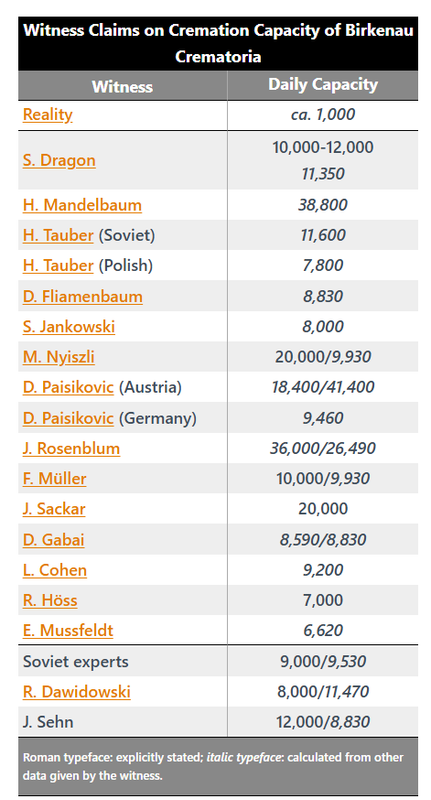
10,000/day would be 3,650,000 per year.
Incredulity Enthusiast
Re: Request for Nessie - Primer on these "witness studies"
I will remind readers that Nessie started out saying that it was not a big deal that Reder's descriptions did not "precisely" (lmao) match Kola's finding and that this is to be "expected." He has said that such errors are typical and "most of us" are similarly poor at estimations. And we would know this if we knew about "witness studies" like Nessie. When I asked him to defend his claims quantitatively, he had to backtrack and admit that Reder's errors are way bigger than what is observed in empirical studies, often beyond even the most extreme outliers. Yet Nessie has offered no retraction or apology for having lied about these studies. And he continues to lecture us in an obnoxious and condescending way even though he has shown himself to have zero understanding of this material whatsoever.
Nessie wrote: ↑Wed Nov 20, 2024 1:20 pm That Reder's recollection does not precisely match Kola's findings, and is exaggerated, is to be expected. Multiple studies of witness estimation of size and numbers prove that it is often poor. Revisionist attempts to discredit witnesses never take into account studies of memory and recall.
I am generally inclined to give people the benefit of the doubt. For example, on Nessie's frequent bungling of logical terms and his nonsense on logical fallacies, it is clear to me that Nessie lacks the necessary intelligence to understand this material. But on this point about errors in estimation, I think even Nessie has enough brains to understand that estimation errors will vary within some reasonable range (depending on the exact thing being estimated) and the really egregious errors committed by the Holocaust witnesses are not the norm. Nessie has knowingly and deliberately lied about this and is continuing to double and triple-down even though he knows he is wrong. Here when he was forced to admit Reder is outside way outside normal range, he pivoted to arguing that we can't discount witnesses for mistakes, no matter how large!No I have not, since as you say, Reder was a "big outlier", he was spectacularly wrong with his estimation. The quote states a range of -96% to -71% and Reder was at about 110%. Tregenza and I am sure other historians have also noticed that, as he is not presented as an accurate, reliable on the details, eyewitness. What you will hopefully start to understand, is that all that means is he is very poor at estimating the size of the graves.
Incredulity Enthusiast
Re: Request for Nessie - Primer on these "witness studies"
Another point about overall witness credibility. If witnesses make big errors, this generally hurts their credibility, and we should be wary of relying too heavily on unreliable/inaccurate witnesses.
In law, this concept is known as witness impeachment.
Bad witnesses will be inaccurate, will make blunders, will change their story, will contradict themselves. At a certain point the witness's overall credibility is destroyed.
https://en.wikipedia.org/wiki/Witness_impeachment
In history, there are similar considerations in source criticism.
Making precise, absolutely confident assertions about objects one has supposedly seen in physical reality and then being massively wrong by orders of magnitude can in no way be overlooked as a minor error. It strongly suggests the story is not based purely on observation of real events.
In law, this concept is known as witness impeachment.
Good witnesses will hold up well. What they say will check out. They will be generally accurate. Any errors will be minor and understandable.In the US, a party has the option of discrediting a witness through impeachment by cross-examining the witness about facts that reflect poorly on the witness's credibility or, in some cases, by introducing extrinsic evidence that reflects negatively on the witness's truthfulness or knowledge.
Bad witnesses will be inaccurate, will make blunders, will change their story, will contradict themselves. At a certain point the witness's overall credibility is destroyed.
https://en.wikipedia.org/wiki/Witness_impeachment
In history, there are similar considerations in source criticism.
Making precise, absolutely confident assertions about objects one has supposedly seen in physical reality and then being massively wrong by orders of magnitude can in no way be overlooked as a minor error. It strongly suggests the story is not based purely on observation of real events.
Incredulity Enthusiast
-
curioussoul
- Posts: 253
- Joined: Mon Oct 28, 2024 10:23 pm
Re: Request for Nessie - Primer on these "witness studies"
Didn't Nessie use to argue that because the investigators were nominally Polish, this meant they were unbiased and essentially made up an "independent" investigatory party, and that they were in no way directed by the Soviets? I don't know if he has abandoned this line of argument because of how facially ridiculous it was or if he's still running with it.
RIP Bob! #NeverForget
Re: Request for Nessie - Primer on these "witness studies"
He still claims this. He says it every single time anyone criticizes the Soviets. He thinks Poland was independent.curioussoul wrote: ↑Sun Dec 14, 2025 12:04 amDidn't Nessie use to argue that because the investigators were nominally Polish, this meant they were unbiased and essentially made up an "independent" investigatory party, and that they were in no way directed by the Soviets? I don't know if he has abandoned this line of argument because of how facially ridiculous it was or if he's still running with it.
https://codohforum.com/viewtopic.php?t=218
Incredulity Enthusiast
Re: Request for Nessie - Primer on these "witness studies"
You are nitpicking over semantics. You have quoted me saying Reder is "exaggerated" and is "poor at estimations", so I am not trying to pass him off as accurate and good at estimating. You then ask me how bad is he, and I agree he is terrible. Most of us are poor at estimating, within a large range, of which Reder is at the extreme end.Archie wrote: ↑Sat Dec 13, 2025 8:27 pm I will remind readers that Nessie started out saying that it was not a big deal that Reder's descriptions did not "precisely" (lmao) match Kola's finding and that this is to be "expected." He has said that such errors are typical and "most of us" are similarly poor at estimations. And we would know this if we knew about "witness studies" like Nessie. When I asked him to defend his claims quantitatively, he had to backtrack and admit that Reder's errors are way bigger than what is observed in empirical studies, often beyond even the most extreme outliers. Yet Nessie has offered no retraction or apology for having lied about these studies. And he continues to lecture us in an obnoxious and condescending way even though he has shown himself to have zero understanding of this material whatsoever.
Nessie wrote: ↑Wed Nov 20, 2024 1:20 pm That Reder's recollection does not precisely match Kola's findings, and is exaggerated, is to be expected. Multiple studies of witness estimation of size and numbers prove that it is often poor. Revisionist attempts to discredit witnesses never take into account studies of memory and recall.No I have not, since as you say, Reder was a "big outlier", he was spectacularly wrong with his estimation. The quote states a range of -96% to -71% and Reder was at about 110%. Tregenza and I am sure other historians have also noticed that, as he is not presented as an accurate, reliable on the details, eyewitness. What you will hopefully start to understand, is that all that means is he is very poor at estimating the size of the graves.
It is the other way around, it is you and other so-called revisionists who lack understanding of and make frequent mistakes about logic.I am generally inclined to give people the benefit of the doubt. For example, on Nessie's frequent bungling of logical terms and his nonsense on logical fallacies, it is clear to me that Nessie lacks the necessary intelligence to understand this material.
You are being dishonestly deceptive as you use the logical fallacy of cherry-picking. You are suggesting all witness exaggerate all the time. For a start, you have not read most of the witnesses. Then, your claims about extreme exaggerations fail almost completely, when it comes to the Nazi witnesses, hence the tactical switch to lying that they were all subject to torture or some sort of coercion. Much of what Reder said, is accurate, especially his recollection of the main processes at Belzec. For example, he describes "many graves", and multiple pits have been located at the camp. Therefore, on that point Reder is corroborated and he is accurate. You ignore where he has not exaggerated and the corroboration proves he is accurate.But on this point about errors in estimation, I think even Nessie has enough brains to understand that estimation errors will vary within some reasonable range (depending on the exact thing being estimated) and the really egregious errors committed by the Holocaust witnesses are not the norm.
For you to prove "errors" committed by the witnesses to the death camps are not the norm, you need to start "error" counting and then comparing to errors made by witnesses to other events that took place over many months or years, such as living in the ghettos. You would then need to show that the trauma of having to work at a death camp, is not the cause of the errors and that it is not the norm for people forced to work in such appalling conditions. Of course, you will never do that, you will just continue to peddle your deceptions.
I have never lied about Reder or any Jewish witness. I have repeatedly said that their evidence is far more emotive, hyperbolic, emotional and that they are prone to using figures of speech and exaggerating. I have then contrasted that with the far more calm, matter of fact Nazi testimony from the camp staff and have postulated in why that it. I think you have only just realised that Reder is at the extreme with some of his estimations, he is considered to not be an accurate witness and that you were not realising, is somehow my fault and I have somehow lied about him!Nessie has knowingly and deliberately lied about this and is continuing to double and triple-down even though he knows he is wrong. Here when he was forced to admit Reder is outside way outside normal range, he pivoted to arguing that we can't discount witnesses for mistakes, no matter how large!
I have not pivoted to arguing a mistake cannot be discounted, no matter how large it is. You have used the strawman fallacy, by making a claim about me, that is inaccurate. I have always said that corroboration is the test. For example, two camp workers say that there were mass graves. One said that there were 10 and the other said there were 30. Archaeologists find 11. Both witnesses are corroborated, there were multiple mass graves, but one witness is more accurate than the other. Remember, I have often distinguished between truthfulness and credibility. Both witnesses are being truthful about the existence of mass graves, one is more credible than the other.
You are wrong to cherry-pick where Reder has got it very wrong and then dismiss his entire testimony about the mass killings inside Belzec, as lies. He is a corroborated and at times, not very accurate witness.
Sanity Check - "Thus, currently revisionists can console themselves by affirming their incredulity..."
Re: Request for Nessie - Primer on these "witness studies"
You have not even bothered to do that with Reder. For example, you cherry-pick where he gets an estimation very wrong, over grave size, but you ignore he does not make any exaggerated claim about how many graves there were.Archie wrote: ↑Sat Dec 13, 2025 7:53 pmJust to expand on this a bit,Archie wrote: ↑Sun Dec 07, 2025 6:32 pm This says that empirically for longer distances the tendency is to UNDERESTIMATE. A 23% underestimate would mean that for a 40M distance, the typical person might guess ~31M on average. That's actually not that bad.
It does say there were big outliers who were way off. But these people are outliers, i.e., NOT typical. Most of them are probably innumerate/kind of dumb. And even the maximum/outlier overestimate is only +71% whereas Reder is overestimating the graves by +100% to +2,000%. Reder is off-the-charts wrong.
If we are talking about "typical" errors, we should generally expect errors due to imperfect human perception to run in both directions, i.e., some people guess high, others guess low. Interestingly, if you take a bunch of independent guesses and average them, the group mean is often surprisingly accurate because the errors tend to cancel out. This phenomenon is known as "wisdom of the crowd."
https://en.wikipedia.org/wiki/Wisdom_of_the_crowd
So there is error, but the guesses tend to cluster around the real value. For some things, there may be some common tendency to under or overestimate. People apparently tend to underestimate vertical heights somewhat, for example.The classic wisdom-of-the-crowds finding involves point estimation of a continuous quantity. At a 1906 country fair in Plymouth, 800 people participated in a contest to estimate the weight of a slaughtered and dressed ox. Statistician Francis Galton observed that the median guess, 1207 pounds, was accurate within 1% of the true weight of 1198 pounds.[7] This has contributed to the insight in cognitive science that a crowd's individual judgments can be modeled as a probability distribution of responses with the median centered near the true value of the quantity to be estimated.[8]
The holohoax "eyewitnesses" show an entirely different pattern.
1) Magnitude of Errors: Studies do NOT show that "most" people give stupidly wrong estimates for everything. The Holocaust witnesses make errors that are more extreme than typical errors due to imperfect estimation. It is not sufficient to say merely that "errors" are "normal." We can QUANTIFY this.
How do you know that? You have not shown any study that agrees with you, or conducted a study of your own. Indeed, to know for sure, would require multiple studies, to show that it is an actual pattern of behaviour and not a one off.2) Errors by Holocaust witnesses are not only of enormous magnitude, they also always go in the same direction. Always wildly exaggerated, never too low. This points to systematic bias and distortion, not honest errors in estimation.
Issues with that are;Take for example the witness statements regarding the capacities of the Birkenau capacities. Note the "witnesses" all give values that are UNIFORMLY way too high. The reason for this is obvious: what these "witnesses" are describing is pure fantasy and their statements have been systematically distorted by the Polish authorities who were clearly biased and had an interest in throwing out huge numbers.
10,000/day would be 3,650,000 per year.
1 - "reality 1000" cremation capacity. Where does that come from? In September 1943, capacity was being quoted as 1850 and that was not sufficient. What was the capacity in 1944, during the Hungarian mass arrivals, when all four Kremas were working flat out and there were pyres outside Krema V and the farmhouse/bunker gas chamber? That capacity has been deceptively reduced to a bare minimum.
2 - the evidence is that cremation capacity varied, as Kremas broke down, and outside pyres were added. That can account for the variations in the witness estimations, they were making an estimation at different times, over a period of over a year.
3 - is each witness estimation for a day, or a 12 hour shift, of for a Krema or all the Kremas and the pyres? An accurate breakdown would include the date and what the witness was likely estimating. Have they all gone for the busiest day that they can remember? If that was the case, then of course they will give higher than the actual average figure and there is a simple explanation for them being uniformly too high.
4 - what do studies say about estimating a repetitive task and numbers achieved? Studies have found that it is normal for people to overestimate how long a task took to complete. I asked AI, "how good are people at estimating how many times a repetitive task has been completed?" and it replied "People are generally not highly accurate at estimating the number of times a repetitive task has been completed without external aids, often exhibiting significant biases and errors. Their accuracy tends to decrease as the number of repetitions increases or the task duration lengthens. " It did not say if it is more common to over or underestimate. The figures presented, suggest that people are prone to overestimating, where the task involves a large number.
One thing is for sure, you have not found evidence to prove the witnesses all lied about there being mass cremations.
Sanity Check - "Thus, currently revisionists can console themselves by affirming their incredulity..."
Re: Request for Nessie - Primer on these "witness studies"
Again, I would use the LV mass shooting analogy. Amongst the many witnesses who described being there, there will be some who are more accurate than others, with the more accurate being the more credible. That does not therefore mean the ones who lack credibility, are lying and there was no mass shooting.
The most accurate and credible witnesses to the gassings, are the Nazis. Hence, you switch tactic, and claim they were tortured or coerced.
The destruction of a bad witness, does not mean that the event they describe did not happen. Bad witnesses to the LV shooting, do not prove no shooting took place. You must understand that, which is why you dodge that analogy.Good witnesses will hold up well. What they say will check out. They will be generally accurate. Any errors will be minor and understandable.In the US, a party has the option of discrediting a witness through impeachment by cross-examining the witness about facts that reflect poorly on the witness's credibility or, in some cases, by introducing extrinsic evidence that reflects negatively on the witness's truthfulness or knowledge.
Bad witnesses will be inaccurate, will make blunders, will change their story, will contradict themselves. At a certain point the witness's overall credibility is destroyed.
You have convinced yourself that you are an accurate assessor of witness accuracy, credibility and truthfulness, when in fact you just look for excuses to disbelieve. Hence you cherry pick Reder, when he is very inaccurate and ignore when he is corroborated to be accurate.
None of the witnesses are massively wrong, when it comes to the main events. It is not like the witnesses are split over TII being a death camp and a transit camp. Or that Sobibor had mass graves, or it had no such graves. Or that Belzec took mass transports of people, or it took only trains filled with property, not people.https://en.wikipedia.org/wiki/Witness_impeachment
In history, there are similar considerations in source criticism.
Making precise, absolutely confident assertions about objects one has supposedly seen in physical reality and then being massively wrong by orders of magnitude can in no way be overlooked as a minor error. It strongly suggests the story is not based purely on observation of real events.
You have to dive into the details and estimatons, to find errors and the vast majority of them can be explained by witness studies and experiments, such as estimating how many people fitted inside a chamber and how long it took to vent.
Sanity Check - "Thus, currently revisionists can console themselves by affirming their incredulity..."
Re: Request for Nessie - Primer on these "witness studies"
I have never used that claim, it is a straw man logical fallacy, by you. I often point out that the Poles, not the Soviets, ran the main camp investigations and that Poland regained its independence after the war. I often have to correct so-called revisionist claims that the Soviets conducted the investigations.curioussoul wrote: ↑Sun Dec 14, 2025 12:04 amDidn't Nessie use to argue that because the investigators were nominally Polish, this meant they were unbiased and essentially made up an "independent" investigatory party, and that they were in no way directed by the Soviets? I don't know if he has abandoned this line of argument because of how facially ridiculous it was or if he's still running with it.
The Poles were biased, against the Nazis, and many were also biased against the Soviets. There will be Poles who knew the Soviets lied about Katyn and they had to stay quiet. They did not want a Communist Poland, but had to accept it. It was Poland that eventually brought about the collapse of Communism and the Soviet Union, by staging the first successful breakaway in the early 1990s. That cannot have happened, without a lot of anti-Soviet senior Poles, gradually gaining power.
So-called revisionists want to play down Polish involvement, because even they know a Holocaust hoax could not be run by the Poles.
What is the case is that claims made by the Poles in 1945, have stood the test of time and evidence gathered by other historians and archaeologists, have further corroborated the evidence gathered by the Poles. So-called revisionists have failed to revise the primary, main event, chronological history that was largely set by the Polish, by 1945.
Sanity Check - "Thus, currently revisionists can console themselves by affirming their incredulity..."
Re: Request for Nessie - Primer on these "witness studies"
Every time a so-called revisionist claims investigations by the Poles, were made by the Soviets, I correct them. Poland was independent of the Soviet Union, unlike Ukraine or the Baltic States, but it was heavily influenced by it, until it broke free in the early 1990s. It does not matter if a Pole was pro or anti-SU, they all agreed on the history of events in Poland, during Nazi rule, because of the evidence of what took place, which the Poles know the most about, as they were there and saw the most.Archie wrote: ↑Sun Dec 14, 2025 5:02 amHe still claims this. He says it every single time anyone criticizes the Soviets. He thinks Poland was independent.curioussoul wrote: ↑Sun Dec 14, 2025 12:04 amDidn't Nessie use to argue that because the investigators were nominally Polish, this meant they were unbiased and essentially made up an "independent" investigatory party, and that they were in no way directed by the Soviets? I don't know if he has abandoned this line of argument because of how facially ridiculous it was or if he's still running with it.
https://codohforum.com/viewtopic.php?t=218
When Poland broke free and the SU collapsed, the main narrative history did not change. Only some details, such as the death toll changed, in as much as the Poles ditched the Soviet exaggerated toll to the Western one. It is not like a whole new, revised history appeared after the end of Soviet influence.
The history of the AR camps, Chelmno and the A-B Kremas, stands on the evidence, the majority of which comes from Nazi sources, so Polish or Soviet bias or influence is very limited. The investigations by the Poles have been checked and assessed by investigators from all over the world, including Germans who ran the main death camp trials, and there has been no significant revision.
Sanity Check - "Thus, currently revisionists can console themselves by affirming their incredulity..."

Re: Request for Nessie - Primer on these "witness studies"
Under the forum rules, I am requesting that this poster supports this allegation. I want him to demonstrate
i) how exactly Poland can be considered as acting with full independence during the Cold War era, and secondly
ii) as his position relates specifically to the Holocaust, to demonstrate how both the People's Republic of Poland and the Soviet Union simultaneously and independently arrived at the wildly inaccurate and inflated Auschwitz death toll of 4,000,000. Note this figure must be arrived at independently by both Nations, since the claim is that no influence was asserted from the SU onto Poland in matters relating to the Holocaust.
Failure to address these challenged satisfactorily should be met with this poster's removal from the thread
Re: Request for Nessie - Primer on these "witness studies"
You have not read or understood my previous description of post war Poland. It regained national status, unlike Ukraine or the Baltic States, that were subsumed back into the USSR. But, it was heavily under the influence of the Soviets and a leading member of the Warsaw Pact.
The Poles did not independently arrive at the same figures the Soviets used. They adopted the Soviet death toll, in a show of unity.ii) as his position relates specifically to the Holocaust, to demonstrate how both the People's Republic of Poland and the Soviet Union simultaneously and independently arrived at the wildly inaccurate and inflated Auschwitz death toll of 4,000,000. Note this figure must be arrived at independently by both Nations, since the claim is that no influence was asserted from the SU onto Poland in matters relating to the Holocaust.
Failure to address these challenged satisfactorily should be met with this poster's removal from the thread
As for the Soviets exerting influence over the Poles, regarding the Holocaust, if that was the case, why was there no Soviet memorial to, or history about the Holocaust and why did Stalin never refer to Jewish suffering, or otherwise wrote or speak about the Holocaust? The Soviets also ran very few Holocaust related trials, concentrating on Ukrainians who had been in the SS. The Polish authorities on the other hand, conducted much of the investigating, ran numerous trials and erected numerous memorials, contrary to what the Soviets were doing.
Sanity Check - "Thus, currently revisionists can console themselves by affirming their incredulity..."

Re: Request for Nessie - Primer on these "witness studies"
Solidarity...
Someone remind me, where was the 'Warsaw Pact' struck?
One might say the Poles worked hand in glove with the Soviet in their investigation. And the Poles were, the glove, as the Soviet rammed their fist firmly inside her.
Poland wasn't liberated, she was CONQUERED.
If I were to guess why no t4 personnel were chosen to perform gassing that had experience with gassing, it would be because THERE WERE NONE.