My first post in the thread;
https://codohforum.com/viewtopic.php?p=19328#p19328
Now, you evidence why they dug so much and cremains are found at the camp. Produce a chronological history.
My first post in the thread;

The challenge for you has been the same for the last half-dozen pages, Nessie: quantify your estimated range for each grave and for the camp overall.
Straw man. You just invented that.Callafangers wrote: ↑Thu Dec 18, 2025 8:18 amThe challenge for you has been the same for the last half-dozen pages, Nessie: quantify your estimated range for each grave and for the camp overall.
You keep pretending that we can have no idea how many corpses are there.
All that work from Kola/Mazurek, years of digging resulting in maps of precise length/width and estimated depth, followed by characterizations of contents and grave density, and yet you insist we cannot even wager an estimated range of how many corpses are there.
"Could be just three (3)!
Could be three million!
Nobody knows!"
Do you know how stupid this is?
c170,000 to 250,000.Give a range, Nessie.
What about "mass grave no. 15 where the eastern and southern boundaries have not been reached yet", why have you excluded that?Here is mine (range goes from what I consider "reasonable minimum" to "absolute maximum"):
Grave 1: 2 - 10 (near-empty)
Grave 2: 150 - 1,200
Grave 3: 300 - 2,500
Grave 4: 1,200 - 7,000
Grave 5: 500 - 2,500
Grave 6: 550 - 3,800
Grave 7: 0 - 0 (empty)
TOTAL: 2,702 - 17,010
This is my attempt at an objective assessment based on grave descriptions.
On the lowest end of my ranges, I assume that Mazurek and his team were not outright liars (otherwise, these estimates would be even lower).
My higher end represents what I regard as the maximum physical allowance for each grave, erring slightly on the side of more implied corpses for any ambiguity in Mazurek's description.
Most importantly: I am prepared to explain and justify the ranges I have chosen here. This could lead to a productive debate since I have actually put forth a somewhat falsifiable argument (unlike what Nessie has done, which is insist on total vagueness despite hundreds of grave measurements taken and reported on).
So then what is your forensic/physical theoretical range approximation based on grave volume and density?Nessie wrote: ↑Thu Dec 18, 2025 10:12 amStraw man. You just invented that.Callafangers wrote: ↑Thu Dec 18, 2025 8:18 am "Could be just three (3)!
Could be three million!
Nobody knows!"
Do you know how stupid this is?
This is the Wikipedia range based on 'Holocaust' lore. It is not your own, original estimate based on reported grave volumes and densities.Nessie wrote:c170,000 to 250,000.Give a range, Nessie.

I excluded graves beyond grave 7 since they are not of the original set from Kola and all appear to have very minimal corpse remains/layers regardless. Grave 15 has three "thin layers" starting at ~2m depth, which means you are looking at most at a few hundred corpses.Nessie wrote:What about "mass grave no. 15 where the eastern and southern boundaries have not been reached yet", why have you excluded that?Here is mine (range goes from what I consider "reasonable minimum" to "absolute maximum"):
Grave 1: 2 - 10 (near-empty)
Grave 2: 150 - 1,200
Grave 3: 300 - 2,500
Grave 4: 1,200 - 7,000
Grave 5: 500 - 2,500
Grave 6: 550 - 3,800
Grave 7: 0 - 0 (empty)
TOTAL: 2,702 - 17,010
Nessie, look at the actual corpse volume and density of this reported "grave" (object 568). This "grave" was a trash pit that had limited admixture of corpse remains (see descriptions of "Object 568" printed throughout numerous reports):Nessie wrote:Is your 1 to 7, the "result of archaeological works conducted in 2001" where "seven mass graves were discovered" and you excluded the rest? For example;
"Due to the fact that the place of the secondary deposition of large amount of human bones (mostly burnt) was previously determined as Graves, also object 568 should be identified as another grave no. 18"
Here is the larger excerpt of what you quoted, showing what you left out:The excavation work in the Spring of 2011 also provided the researchers with many new
artefacts. The biggest concentration of these was found in a sizeable rubbish tip located in the
south-east corner of hectare XVIII (object 568). In regard to the archaeological finds of
mobile objects, most of these were women’s combs and hairpins, broken glass of different
bottles, pieces of barbed wire, iron nails, iron nipples and other ironware items.
https://web.archive.org/web/20141019205 ... n-2011.pdf
Here are its photos:To the south, the range of the occurence of burnt human bones covers with the
southern border of are 9a hectare XXV. Within it, in the spring 2011 the object no. 568 –
garbage pit with numerous artifacts (personal items of the victims) and the burnt fragments of
human bones have been uncovered. Due to the fact that the place of the secondary
deposition of large amount of human bones (mostly burnt) was previously determined as
Graves, also object 568 should be identified as another grave no. 18 (Photo 6).
[...]
Photo 6 Sobibór, area of the former German-Nazi extermination camp of Jews, the area of the south-eastern
corner of the clearing with the mass Graves, plan oj the object 568 discovered in the spring 2011 and determined
during the current excavation research as a grave no. 18 because of the large amount of burnt human bones
located in the backfill.
Case closed (again). No gassing = no Holocaust.First, it appears they were forced to lie down on the ground. The archaeologists found there 1830 rifle bullets shot into the ground.[...]
The main difference is, however, that in the northern part of object E, there was a concentration of over 1800 deformed bullets which, most probably, had been shot into the ground. This concentration was interpreted in the
2001 research report as marking the place in the barrack where victims, perhaps ill or infirm, were executed while lying on the floor.
https://web.archive.org/web/20141019203 ... k-ANG..pdf
Nessie, the 'grave' here is 250m3 in total. However, there are only three "layers of burnt bones, with the bone thickness of 10-15cm". We can either interpret that as ~12.5cm total bone layer (if assumed Mazurek is stating the actual bone amid these layers as a combined 10-15cm), or we can interpret it to mean ~12.5cm x 3 = ~38cm total bone layers if we assume he's saying there are three layers with each being 10-15cm thick. This means our actual range of possible bone/corpse volume is:Nessie wrote:My issue is with the guess work that is involved. For example;
"...excavators discovered and identified the range of mass grave No 8 (object 882). It is
rectangular, about 25 m by 5 m in size. Its longer axis lies west-east. The object is about 190-
210 cm deep. In its foot-wall, the excavators found 3 layers of burnt bones, with the bone
thickness of 10-15 cm, interlaced with layers of clear, light grey sand."
That is a grave with a volume of 250m3. The excavation found 3 layers of cremains, in the wall of what was dug, but it does not excavate into them. How can a volume of cremains be calculated from that? They stop when they find cremains, so it appears they have a mass grave with very little in it, but that is because they do not continue to excavate the layers of cremains. So, was what the Nazis dug 250m3, or was it larger?
The entire camp was reconnoitered by Kola. Mazurek's excavations investigated thoroughly into all areas where corpse remains could be suspected. This is the best evidence we have, and it points against you.Nessie wrote:So much has not been excavated, "South-east from the grave 7 another crematory mass grave (no 15) was uncovered. Its
range has not been determined". Mazurek discusses the switch from burial to cremations, due to the poisoning of the ground water and smell. He references, " five surface crematories have been located". Once they were operating, would cremains from each burnt out pyre, be buried in pits dotted around that part of the camp, Lager III? That would explain the randomness of the finds there.
Mazurek's purpose and assignment was not to estimate the volume of cremated remains. His assignment was to identify where these remains were at and what they consisted of (speaking to length, width, depth [until substantial remains, but gaps filled by Kola], and consistency/density), which is what he did. Revisionists are the first to utilize this information to answer the most important questions which exterminationists rather avoid.Nessie wrote:That Mazurek, with his significantly greater knowledge and understanding, has not tried to estimate the volume of cremated remains, means that I doubt I could provide any meaningful estimation. I am certain your estimates are worthless, due to your bias and desire to minimise the numbers who died at Sobibor.
It is the range of estimated death tolls, by historians, using evidence from multiple sources, primarily Nazi documentation.Callafangers wrote: ↑Thu Dec 18, 2025 9:19 pmSo then what is your forensic/physical theoretical range approximation based on grave volume and density?Nessie wrote: ↑Thu Dec 18, 2025 10:12 amStraw man. You just invented that.Callafangers wrote: ↑Thu Dec 18, 2025 8:18 am "Could be just three (3)!
Could be three million!
Nobody knows!"
Do you know how stupid this is?
This is the Wikipedia range based on 'Holocaust' lore. It is not your own, original estimate based on reported grave volumes and densities.Nessie wrote:c170,000 to 250,000.Give a range, Nessie.
This is hard, scientific proof that you are an idiot.
Grave 8 is described as being excavated to 250m3, and the three layers of cremains being found in its foot wall. I take that to mean one side of the excavation and the cremains then extend further into the ground, rather than they excavated, found a layer, then they kept going, finding two more layers. I say that because they would stop excavating if they found substantial cremains and there are plenty of photos of excavations that have stopped, when a layer of cremains is found. Therefore I am not in the slightest bit convinced by your estimation of the volume of cremains in that grave, or others.I excluded graves beyond grave 7 since they are not of the original set from Kola and all appear to have very minimal corpse remains/layers regardless. Grave 15 has three "thin layers" starting at ~2m depth, which means you are looking at most at a few hundred corpses.Nessie wrote:What about "mass grave no. 15 where the eastern and southern boundaries have not been reached yet", why have you excluded that?Here is mine (range goes from what I consider "reasonable minimum" to "absolute maximum"):
Grave 1: 2 - 10 (near-empty)
Grave 2: 150 - 1,200
Grave 3: 300 - 2,500
Grave 4: 1,200 - 7,000
Grave 5: 500 - 2,500
Grave 6: 550 - 3,800
Grave 7: 0 - 0 (empty)
TOTAL: 2,702 - 17,010
The fact that you even mention this grave re-confirms that you are not thinking in terms of physical volume and density.
Nessie, look at the actual corpse volume and density of this reported "grave" (object 568). This "grave" was a trash pit that had limited admixture of corpse remains (see descriptions of "Object 568" printed throughout numerous reports):Nessie wrote:Is your 1 to 7, the "result of archaeological works conducted in 2001" where "seven mass graves were discovered" and you excluded the rest? For example;
"Due to the fact that the place of the secondary deposition of large amount of human bones (mostly burnt) was previously determined as Graves, also object 568 should be identified as another grave no. 18"
Here is the larger excerpt of what you quoted, showing what you left out:The excavation work in the Spring of 2011 also provided the researchers with many new
artefacts. The biggest concentration of these was found in a sizeable rubbish tip located in the
south-east corner of hectare XVIII (object 568). In regard to the archaeological finds of
mobile objects, most of these were women’s combs and hairpins, broken glass of different
bottles, pieces of barbed wire, iron nails, iron nipples and other ironware items.
https://web.archive.org/web/20141019205 ... n-2011.pdf
Here are its photos:To the south, the range of the occurence of burnt human bones covers with the
southern border of are 9a hectare XXV. Within it, in the spring 2011 the object no. 568 –
garbage pit with numerous artifacts (personal items of the victims) and the burnt fragments of
human bones have been uncovered. Due to the fact that the place of the secondary
deposition of large amount of human bones (mostly burnt) was previously determined as
Graves, also object 568 should be identified as another grave no. 18 (Photo 6).
[...]
Photo 6 Sobibór, area of the former German-Nazi extermination camp of Jews, the area of the south-eastern
corner of the clearing with the mass Graves, plan oj the object 568 discovered in the spring 2011 and determined
during the current excavation research as a grave no. 18 because of the large amount of burnt human bones
located in the backfill.
object568-grave18.jpg
568 mapped.jpg
(Note: each mapped square is 5m x 5m)
Thus, you have a tiny object/grave (about 5m x 5m) which is mostly buried personal items (spoons, tools, etc.) but which has some "mostly burnt" (partly-unburnt) human remains mixed into the backfill. These remains are noted explicitly as a secondary deposition, i.e. they are not the primary contents of this object/burial, further reflected by the fact that no corpse remains were found there at all in the 2011 excavation. We are looking at perhaps ~50-100 corpses at most, even if assuming a massive 5 meter depth (which is ridiculous and likely impossible for a 5m x 5m burial). There is no way for you to rationalize a greater estimate than this, which is why you don't bother to try.
Overall, none of the graves beyond grave 6 can be interpreted to contain even several hundred corpses, and they aren't part of the original seven graves identified by Kola, and they are also all very small, making them trivial for purposes of our analysis.
Even more importantly, it appears we can account for some ~1,800 corpses at Sobibor through non-Holocaust means, likely explaining any/all of the smaller graves, if not the larger ones as well:
Case closed (again). No gassing = no Holocaust.First, it appears they were forced to lie down on the ground. The archaeologists found there 1830 rifle bullets shot into the ground.[...]
The main difference is, however, that in the northern part of object E, there was a concentration of over 1800 deformed bullets which, most probably, had been shot into the ground. This concentration was interpreted in the
2001 research report as marking the place in the barrack where victims, perhaps ill or infirm, were executed while lying on the floor.
https://web.archive.org/web/20141019203 ... k-ANG..pdf
Nessie, the 'grave' here is 250m3 in total. However, there are only three "layers of burnt bones, with the bone thickness of 10-15cm". We can either interpret that as ~12.5cm total bone layer (if assumed Mazurek is stating the actual bone amid these layers as a combined 10-15cm), or we can interpret it to mean ~12.5cm x 3 = ~38cm total bone layers if we assume he's saying there are three layers with each being 10-15cm thick. This means our actual range of possible bone/corpse volume is:Nessie wrote:My issue is with the guess work that is involved. For example;
"...excavators discovered and identified the range of mass grave No 8 (object 882). It is
rectangular, about 25 m by 5 m in size. Its longer axis lies west-east. The object is about 190-
210 cm deep. In its foot-wall, the excavators found 3 layers of burnt bones, with the bone
thickness of 10-15 cm, interlaced with layers of clear, light grey sand."
That is a grave with a volume of 250m3. The excavation found 3 layers of cremains, in the wall of what was dug, but it does not excavate into them. How can a volume of cremains be calculated from that? They stop when they find cremains, so it appears they have a mass grave with very little in it, but that is because they do not continue to excavate the layers of cremains. So, was what the Nazis dug 250m3, or was it larger?
25 x 5 x .125 = 15.6m3 (low-end)
25 x 5 x .38 = 47.5m3 (upper-end)
Range: 15.6m3 - 47.5m3 actual bone layer volume
The problem with this range, however, is that we are assuming these layers could realistically be 100% human corpse/bone. This is not realistic at all, since the patterns where bones/corpses are described in detail consistently show that these are mixed with some amount of sand/backfill. All photographs show at most a mixture of corpse remains and other materials, mainly sand. There are no instances of "pure bone", so to speak.
Thus, we have to drop this range further by a certain percentage. To be charitable, let's drop it only ~30%. This gives us:
Range: 10.9m3 - 33.2m3 actual bone volume
So, how many corpses can this hold? From other calculations already discussed in this thread (which considers wood ash/charcoal that also must be accounted for), we are looking at about 7-8 corpses per m3 of grave volume. Taking the mid-point (average) of our volume range, that gives us:
22.1 x 7.5 = 165.8 corpses
But we should probably lower this further, since these three detected layers were only mentioned in the "foot-wall" of this grave. In either case, this figure is hardly a drop in the bucket, even just for the ~1,800 executions we documented above; let alone the insane ~200,000+ figures you keep throwing out.
Is there a bore hole map for Sobibor, as there was for Belzec, to show precisely the range Kola took samples from?The entire camp was reconnoitered by Kola. Mazurek's excavations investigated thoroughly into all areas where corpse remains could be suspected. This is the best evidence we have, and it points against you.Nessie wrote:So much has not been excavated, "South-east from the grave 7 another crematory mass grave (no 15) was uncovered. Its
range has not been determined". Mazurek discusses the switch from burial to cremations, due to the poisoning of the ground water and smell. He references, " five surface crematories have been located". Once they were operating, would cremains from each burnt out pyre, be buried in pits dotted around that part of the camp, Lager III? That would explain the randomness of the finds there.
Mazurek's purpose was to excavate where the memorials were proposed, to ensure they did not dig into mass graves. He spent his time trying to avoid disturbing remains. I do not think it is possible to estimate the volume of cremains, from the excavations, as the Nazis scattered them all around Lager III and they did not just dump them back into the graves that had been dug for corpses, that so-called revisionists avoid evidencing, along with the camp's actual function.Mazurek's purpose and assignment was not to estimate the volume of cremated remains. His assignment was to identify where these remains were at and what they consisted of (speaking to length, width, depth [until substantial remains, but gaps filled by Kola], and consistency/density), which is what he did. Revisionists are the first to utilize this information to answer the most important questions which exterminationists rather avoid.Nessie wrote:That Mazurek, with his significantly greater knowledge and understanding, has not tried to estimate the volume of cremated remains, means that I doubt I could provide any meaningful estimation. I am certain your estimates are worthless, due to your bias and desire to minimise the numbers who died at Sobibor.
 Nessie, what you are referring to is the gray-colored sand/ash, right? What you've confirmed here is your agreement that the wood ash/charcoal was mixed-in anywhere that corpse cremains were buried. We all agree that burnt bones are generally either white in color or charred (dark/black), themselves. Instead of black or white, though, you point out the gray. The gray confirms something you have attempted to deny in the past: that the wood ashes were buried there as well. This solidifies my estimates thus far of just 7-8 corpses of fully-cremated remains per m3 of volume.
Straw man, I have never denied that cremains are not also mixed in with ash from the wood used on the pyres.Callafangers wrote: ↑Fri Dec 19, 2025 8:55 am
You said;This solidifies my estimates thus far of just 7-8 corpses of fully-cremated remains per m3 of volume.
Thanks for your help, Nessie.
But the layers of bone were found "In its foot-wall". Why are you interpreting that to mean they found three layers, as they dug down into the 25m by 5m grave?Nessie, the 'grave' here is 250m3 in total. However, there are only three "layers of burnt bones, with the bone thickness of 10-15cm". We can either interpret that as ~12.5cm total bone layer (if assumed Mazurek is stating the actual bone amid these layers as a combined 10-15cm), or we can interpret it to mean ~12.5cm x 3 = ~38cm total bone layers if we assume he's saying there are three layers with each being 10-15cm thick.
Let's keep this extra-simple. You believe in a range between 170,000 - 250,000 total corpses buried under Sobibor. The average of this range is 210,000 so let's work with that.
Based on the timeline of the camp and the excavations; fom May to September 1942, the gassed corpses were buried in mass graves, that were dug as required. They are the largest of graves 1 to 18. There is space never excavated, amongst the trees, that could contain more. In those four months the camp received approximately 50-80,000 on the transports, and they were buried as corpses.Callafangers wrote: ↑Sat Dec 20, 2025 10:33 amLet's keep this extra-simple. You believe in a range between 170,000 - 250,000 total corpses buried under Sobibor. The average of this range is 210,000 so let's work with that.
What % of your 210,000 do you allocate to each of the Graves 1-18?
If any are left over after your allocation, please list briefly where you think they are.
***
Note: you aren't saying you know these percentages are sound approximations -- there is no penalty if you get it wrong. The goal is simply to put your confidence to the test. If you believe corpses are buried at this camp, I'm simply calling upon you to break down how it's even possible or realistic, by declaring where your best guess of their actual location(s) are.

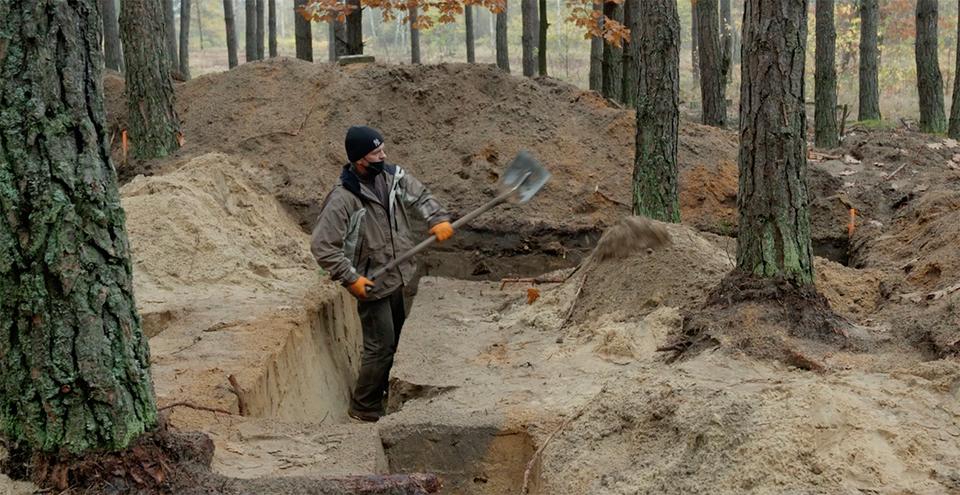
Not only is this an extraordinary "cope", it's your saddest take yet.As each pyre burnt down, the cremains and ashes were buried. The evidence of largely empty graves and this excavation, evidences that the burial of the cremains, was ad hoc, around Lager III, and not just dumping all cremains into the now cleared of corpses original mass graves;
[...]
It looks like as each pyre burned down and went out, it was spread around the site, in lots of smaller burials, not necessarily in the graves that had been dug May to September 1942. Then the site was planted over.
[...]
My conclusion is that it is impossible to estimate the volume of buried cremains, which is exactly what the Nazis intended. Therefore, other evidence has to be used, to establish how many were buried there.
but you (and ONLY you) insist that the ~250,000 Jews are somehow, someway buried at Camp III regardless. This is similar to the debate about the origin of life. For a long time, the best answer was that it originated in Earth's primitive ocean, but it was found that this water is practically poison for any living cell to thrive, meaning it can no longer be in seawater.Callafangers wrote: ↑Sat Dec 20, 2025 9:51 pm
Not only is this an extraordinary "cope", it's your saddest take yet.
You're now so down as to concede that the graves identified by Mazurek/Kola are "cleared of corpses"
Nessie, this is stupid. It's just sad at this point.
Mazurek said "In the case of grave no. 1... Third... suggest that that grave no. 1 originally had been completely or in large part filled with cremated human remains and emptied due to the Sonderaktion 1005." Neither he nor Kola suggest anything other than the corpses are buried at the camp. I agree with them.Callafangers wrote: ↑Sat Dec 20, 2025 9:51 pmNot only is this an extraordinary "cope", it's your saddest take yet.As each pyre burnt down, the cremains and ashes were buried. The evidence of largely empty graves and this excavation, evidences that the burial of the cremains, was ad hoc, around Lager III, and not just dumping all cremains into the now cleared of corpses original mass graves;
[...]
It looks like as each pyre burned down and went out, it was spread around the site, in lots of smaller burials, not necessarily in the graves that had been dug May to September 1942. Then the site was planted over.
[...]
My conclusion is that it is impossible to estimate the volume of buried cremains, which is exactly what the Nazis intended. Therefore, other evidence has to be used, to establish how many were buried there.
You're now so down as to concede that the graves identified by Mazurek/Kola are "cleared of corpses"
Nessie, this is stupid. It's just sad at this point.