Jankiel Wiernik

A revisionist safe space
p
pilgrimofdark
Posts: 402
Joined: Sat Aug 09, 2025 7:46 pm

Re: Jankiel Wiernik

Post by pilgrimofdark »

pilgrimofdark wrote: Wed Dec 24, 2025 2:24 pm Someone could almost write an article about "How Many Propagandists Does It Take to Write a Holocaust Eyewitness Account?" discussing the Wiernik/Krzepicki manuscripts.

If a third account shows up with multiple handwriting samples, the article will have to be written. "Two is coincidence, three is a pattern."
#3. Oskar Strawczynski

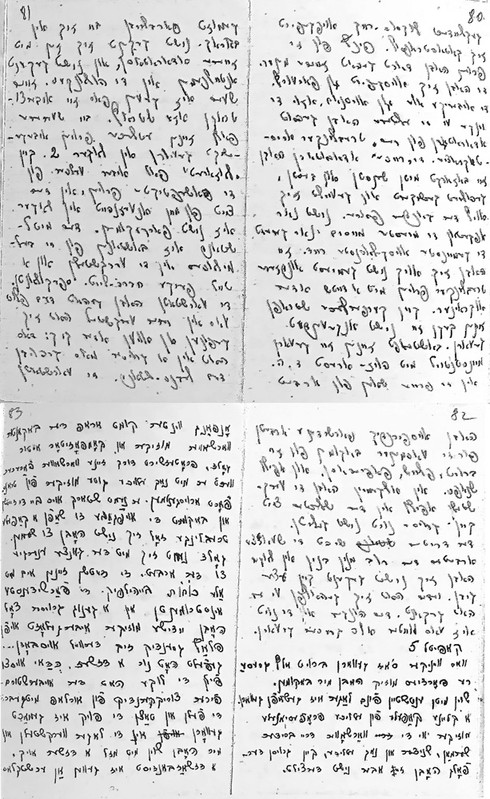
These are four pages from one of his several(?) memoirs, this one published in the book Escaping Hell in Treblinka, where his memoirs are included as "Ten Months in Treblinka."

The original is in Yiddish, and the book contains the page scans. I can't find this exact one online, but Yad Vashem has a few other memoirs attributed to him.

A footnote to the page scans says only a couple initial pages of the entire document were handwritten by Strawczynski, with the rest copied by a Hannah Fryszdorf. However, the handwriting on those early pages is different than these two other handwriting samples shown below, so at least three different hands?

Because it's in Yiddish, it reads right-to-left. Handwriting switches at the bottom of page 82 (bottom right page).

Image

edit: the Center for Jewish History has the full scan of the Yiddish document. Document pages 83-85 (handwritten 81-83) are ones to look at for the clear difference in handwriting style.

These aren't very straight scans, just what I could grab quickly from the paperback book.

The biggest difference is in the slanting of characters and how neat one handwriting is compared to the other. On the actual pages, there's a more noticeable difference in lightness of the ink between writers.

One person writes chapter headings as Roman numerals (I, II, III...), the other as Arabic (5, 6, 7...).

The handwriting switches like this several times in the full 165-page document.

Strawczynski doesn't play a huge role in the Treblinka history, but what he lacks in quality he makes up for in sheer quantity of testimonies and memoirs.

He was at the 1944 Soviet "One Year in Treblinka" Book Club, so he has "memories" of the Ringelblum-Wiernik material. I wonder where he got the inspiration to title his book "Ten Months in Treblinka."
Last edited by pilgrimofdark on Sun Feb 08, 2026 6:49 pm, edited 1 time in total.
User avatar
Stubble
Posts: 3355
Joined: Sun Dec 08, 2024 10:43 am
Location: 5th Circle of Hell

Re: Jankiel Wiernik

Post by Stubble »

Holy fucking shit!

How directly does this tie to the Warsaw dungeons and dragons quest writing guild? Is this from pandora's milk cans? If it is, I'm going to fall out of my chair!
If I were to guess why no t4 personnel were chosen to perform gassing that had experience with gassing, it would be because THERE WERE NONE.
p
pilgrimofdark
Posts: 402
Joined: Sat Aug 09, 2025 7:46 pm

Re: Jankiel Wiernik

Post by pilgrimofdark »

Stubble wrote: Sun Feb 08, 2026 2:05 am How directly does this tie to the Warsaw dungeons and dragons quest writing guild? Is this from pandora's milk cans? If it is, I'm going to fall out of my chair!
Not sure yet on the Strawczynski chronology.
  • 1942 - Treblinka report (Ringelblum)
  • 1944 June - Wiernik book
  • 1944 August-October - Soviet Treblinka investigations (Strawczynski interrogated twice, Wiernik book present)
  • 1945 - Polish investigation (Strawczynski, Wiernik, and Auerbach present)
  • sometime after the war - Strawczynski memoirs given to YIVO in New York
The intro for Escaping Hell in Treblinka says Strawczynski's is "one of the first two eyewitness accounts" of the uprising, so has to be after August 1943 (so not directly in the Ringelblum metal tins/milk cartons).

It's said that after the Treblinka uprising, he joined a partisan group and spent the time in the forest writing his memoirs. He encountered a group of Jewish Combat Organization (ZOB) fighters in the forest who had survived the Warsaw Ghetto uprising in April/May 1943.

He writes that the memoirs were written in the "spring and summer of 1944." However, if he wrote these memoirs after his 1944 Soviet interrogations, then he'd already been exposed to Wiernik's book as early as August.

And the memoirs weren't handed over to YIVO in New York until after the war by Hannah Fryszdorf, the "copyist."

Still some chronology to work out, and I haven't even fully read Strawczynski's memoirs yet.

Strawczynski didn't draw a map.
p
pilgrimofdark
Posts: 402
Joined: Sat Aug 09, 2025 7:46 pm

Re: Jankiel Wiernik

Post by pilgrimofdark »

I finished Strawczynski's memoirs that are published as "Ten Months in Treblinka" in Escaping Hell in Treblinka. I expected it to be a straight plagiarism of Wiernik, but it's more than that.

In this version of his memoirs, Strawczynski says he only spent time in the lower camp of T-II, so not the death camp.

In that context, he is a laborer. That's all. There's a typhus outbreak, the usual German atrocities, Barry/Bari the dog is biting genitals, "Lalka" is shooting people in the butt, etc.

What's interesting is that Strawczynski begins confabulating memories that come from Wiernik's book: he confuses memories of the T-II lower camp with the upper "death" camp. The same exact things happen in both camps -- Wiernik describes them happening in the upper camp, Strawczynski in the lower camp.

So unless someone is familiar with Wiernik's narrative, Strawczynski's sounds coherent enough. But there are numerous things Strawczynski shouldn't know, because he wasn't in the upper camp. He just transposes them into his narrative.

In a few instances, he says he got information later from survivors of the upper camp, but he clearly marks those. In many other instances, the question "how does he know that?" can most easily be answered with "he got it from Wiernik's book at the 1944 Soviet investigations."

Either the camps were kept separate and Strawczynski is confabulating, or the camps were not kept as separate as is commonly accepted.
p
pilgrimofdark
Posts: 402
Joined: Sat Aug 09, 2025 7:46 pm

Re: Jankiel Wiernik

Post by pilgrimofdark »

The Yiddish version of A Year in Treblinka has a slightly earlier date for when the book was smuggled out of Warsaw.
Here is what we know about him from the underground report of the "Bund," which was sent out from Warsaw on May 24, 1944...

- p. 5
The previous earliest date was June 6, 1944 when it was mentioned by Henryk Wolinski.

The rest of the introduction to the Yiddish version contains some biographical information about Wiernik. Probably worth checking if it's new information or already known or mythological.
p
pilgrimofdark
Posts: 402
Joined: Sat Aug 09, 2025 7:46 pm

Re: Jankiel Wiernik

Post by pilgrimofdark »

Some corruption in the translation from Yiddish, but mostly coherent. Nothing new that I can discern.

Introduction to the Yiddish version of A Year in Treblinka
Spoiler
Introductory word from the publisher

Herewith, we bring to the American Jewish reader in book form the description of Yankel Wiernik – "A Year in Treblinka". These are images that can make the blood boil in the veins and, like evil ghosts of fear, which come from some terrible sources, haunt the reader day and night. This is the source of horror and fear. These are the experiences of a single person, but they give a certain idea about the cruel murders, in which the Nazis and their helpers killed millions of our brothers and sisters in the death factories, which were built especially for this purpose.

Treblinka is one of about a tenth of the extermination camps that the Nazis set up to exterminate the Jewish population from Europe.

The mass slaughter of Jews began in the fall of 1941. As early as October 1941, the Nazis gassed the Jewish population of a number of towns around Lodz. These were the first attempts of science. On the basis of the experience of the first gas wagons in the forests of Helmna Kuyavar), the Nazis later set up killing factories in Treblinka (near Malkin), Majdanek (near Lublin), Sabidur (near Chelm), Belzice, Birkenau (south-west Poland), in the vicinity of Vilnius, in Estonia and some others. In the death camps, the Jews of all of occupied Europe were rounded up and slaughtered. According to the latest figures, the total number of Jews who were murdered by the Nazis in Poland, in the occupied territories of Russia and deported from Western Europe – the grand total of about six million. The description of Yankel Wiernik is thus transformed to a certain extent into a document, which gives for the coming generations at least a partial picture of the horrible death convulsions of six million innocent Jewish men and women, old and young, old and helpless.

The murder work was shrouded in a thick mystery. No one, except the murderers, allowed a survivor to leave the killing camp. This helped the Nazis hide their horrible crime from the world for years. This also helped them to seduce the victims in the death camps for a long time, without encountering any resistance. The author of "A Year in Treblinka," is one from Warsaw.

Here is what we know about him from an underground report from “Bund,” which was sent out from Warsaw on May 24, 1944: the author of “A Year in Treblinka,” a certain Yankel Wiernik, who had been in that death camp for a full year – later organized an uprising, which ended with the destruction of the camp, the burning of all its facilities, and the killing of the German-Ukrainian guard. A large number of those tortured in the camp were liberated. I had the opportunity – writes the sender of our underground report – to have a conversation with Wiernik. He told me that he had completed his elementary school education, as he put it, in 1904 and in the following years in Bundish, and his secondary school education" in the Bund's self-defense schools; later he was a craftsman, belonged to the Craftsmen's Chamber, and did not engage in political work.

It is well known that Yankel Wiernik was an excellent craftsman, who had, as you say, "golden hands", and that he lived with his family on Wolynska Street in Warsaw during the entire years of the Hitler occupation, until he was caught along with others during the deportations from the Warsaw Ghetto and taken to Treblinka.

Deportations from the Warsaw Ghetto began on July 22, 1942. Every day six to ten thousand Jews were taken out and sent in an unknown direction. A few weeks after the beginning of the deportations, Yankel Wiernik was arrested. He then spent a year in Treblinka, where he belonged to the lucky group of Jews who were not killed immediately, but were forced to perform various tasks in the death camp, mainly burying or burning the dead. After a year of such a nightmarish life, he managed to escape with a group of workers. A part of what Yankel Wiernik saw through the nightmarish years before him is further described here. As the author tells, he had only one hope in his life – the hope of having a chance to reveal to the world the fears that he was given to be a witness to them. He has now achieved his goal.

As soon as he ran away, he took to the pen. The Jewish Coordination Committee in Warsaw (of the "Alliance" and the Jewish National Committee) illegally published the booklet in Polish under Hitler. Copies of the book were received by the deputies of the Polish National Council, Dr. Emanuel Scherer and Dr. Eigen Schwarzbart. Through them, the book came to New York, where the description was already published in various daily newspapers.

But this is a document that must be preserved in the form of a book, this is a description that everyone who is suffering with the pain of the slaughtered six million must always have with them. This moved us to publish it in book form.

With the simple words in which Yankel Wiernik describes his experiences, the author produced one of the strongest works in the human language. He brings us the most fantastic document, which is strong with its cruel truth and naked horror. This is the biggest indictment in history against the Nazi beast-man, the most difficult indictment, because he portrays the heaviest and most incredible crime of Nazism.

The Nazis burned the dead bodies of the united, poisoned and in other ways murdered by them millions of Jews and non-Jews. They spread the ashes of the victims, fertilized fields with it, and planted fodder plants there for themselves and their animals. They killed every casual witness of their murderous work, and believed that they would thus cover up all the traces of their unheard of crime.

But the crime cries out from the ground, over which the ashes were spread. His echo is brought on the wings of all four winds, which cannot cease to carry the last cries of millions of innocent – tortured throughout the world. The echo of the crime spans the world in the many thousands of children's shoes that remain after those who died in the Maidan, and all this became possible due to the testimony of some accidental survivors of the murder, and, among others, also for the reason that the crime is united in the next document, which will become a single monument of Nazi brutality and shame – an inexhaustible source of hatred and will to fight against fascism in all its forms.

December, 1944.
p
pilgrimofdark
Posts: 402
Joined: Sat Aug 09, 2025 7:46 pm

Re: Jankiel Wiernik

Post by pilgrimofdark »

We have to invoke the name "Galewski" three times before Dean comes back. So here is Rachel Auerbach's Treblinka movie outline, where Galewski was to be the main character.

Wiernik also plays a role. Tanhum Grinberg is mentioned, who was interrogated by the Soviets in September 1944 and gave details he could only have gotten from Wiernik's book.

There are four printed copies of the outline, but all seem to be very similar, if not identical. There are also some handwritten Polish pages of the same script treatment.

They seem to be undated, so this is all more a curiosity than anything. Zabecki isn't mentioned at all, nor any photographs taken by Zygmunt Wierzbowski, so this may predate Zabecki handing it over in 1965.

If you were hoping for a stereotypical movie full of naked women, you'll be disappointed. Auerbach only includes a single scene of a naked man.
Spoiler
REBELLION IN TREBLINKA

(Screenplay content – in short)

A group of young people, kept alive to clean up the corpses and belongings of gassed Jews, reach an agreement under the most dangerous conditions and, after a number of unsuccessful attempts, finally carry out a plan to kill part of the German crew, burn down the extermination camp and escape.

Among the more important participants in the conspiracy is a former Czech captain who got there by accompanying his Jewish wife on an alleged "resettlement to the east" for "colonization".

Other conspirators:

The initiator of the escape plan, the fiery heart of the Jewish crew, Dr. Chorążycki, who manages to commit suicide when caught with money intended for the purchase of weapons; the Locksmith, who cunningly manages to make a key to the German crew's arsenal; the 15-year-old boy who steals grenades from the arsenal, has to bring them back when they turn out to have no fuses, until he finally supplies the conspirators with usable weapons; the Disinfector, who on a critical day sprays the barracks walls with a flammable liquid instead of carbolic acid; the man of the people, the shoemaker Tanchum, who lures them into his workshop and, at the decisive moment, kills the SS man on duty, losing his own life in the process. Wiernik, a carpenter, who, during the construction of a new barracks, establishes and then, using various tricks, maintains constant communication between Camp I, where transports are received, the condemned are undressed, and the belongings of gassed Jews are sorted, packed and sent to Germany, and Camp II, where the gassing and burial, and then the removal and burning of the bodies of murdered Jews take place.

The film will only show Camp I. The macabre reality of Camp II will be presented only as the subject of allusions, horror, and secret conversations between prisoners of Camp I.

Enemies in the foreground:

The camp's deputy commandant, a polished athlete, and an utterly cruel murderer and sadist, Franz, nicknamed "The Doll." The Jewish spy Kuba, the workshop director, a cross between a pederast and a sadist, and the teacher Zwetschke.

The backdrop depicts life in the barracks, workshops, and German and Ukrainian camps. The grounds include an idyllic, angelic flower garden, meticulously tended animals, and a Jewish orchestra composed of first-rate musicians from Warsaw's café orchestras, which provides musical accompaniment.

Supporting characters:

A young, pious Jew who prays Kaddish for the murdered every evening with others and sings Eil Mole Rachmin with a beautiful voice, to which the murderers listen with lyrical and musical delight. To allow them to savor this pleasure, they gave him the nominal office of kapo and kept him alive for a long time. The Jews call him Meir Kapo. Several German figures appear in the background, whom the Jews have given various nicknames, such as "Berish," "Kiwe," "Frankenstein," and so on.

x) It could possibly be a representative of another nation. In fact, two Czechs participated in the Treblinka conspiracy: Captain Zieło Bloch, of Jewish descent, and a native Czech whom Treblinka prisoners call Masaryk. He died, after a successful escape, only in 1944 as a result of denunciation. Whether his name was actually Massaryk, or whether his comrades gave him that nickname, is difficult to verify. He was supposedly from the family of President Massaryk.

-2-

Subsequent phases and plot twists:

The germination of a collective plan, preceded by two individual attacks. A young Jew from the transport, not allowed to say goodbye to his mother, attacks a Ukrainian with a penknife. A worker among the Jewish crew stabs an SS soldier to death during a selection. The German crew falls into panic and fear.

Dr. Chorążycki recruits the first participants in the conspiracy and stumbles upon a parallel thread of understanding. Both sides fear each other's provocations until they finally unite. The one they initially most closely monitor and suspect, accusing him of collusion with the German command – the Jewish camp director, Engineer Galewski – later becomes the main force, the most powerful mind, and the most powerful personality in the conspiracy. If there were to be a central character in the projected drama, it would be Engineer Galewski.

After Dr. Chorążycki's suicide, Galewski enlists the aid of a Czech captain and creates a sort of headquarters with whom he holds secret meetings. They set a date for the uprising; everything is prepared down to the smallest detail. The initiated await a signal, which is not given because the weapons prove unusable. Suicides occur among the participants, broken by the futile tension. Stasis, despair. Galewski does not give up, trying to keep the spirits of his comrades up. After a long break, a new transport arrives from Warsaw. News of fighting in the ghetto, brought by the few survivors, infuses the underground movement in the camp with new energy. New preparations, a new deadline. At the last minute, one link fails, and changes have to be made, bringing forward the moment of explosion by an hour. The fear is that this will result in everything falling apart. But the first German bodies have already been laid in the workshops; there is no turning back. These are three signal shots in Camp I. Will they be heard in Camp II? Will they understand? Deadly tension and—suddenly—flames from all sides. The inhuman shrieks of the crew and prisoners. The clamor of a short battle. The Jews are acquiring new weapons from the executioners, using their work tools – axes and shovels. They have cut the telephone connections, lured them downs with gold, and killed them. They have placed the Ukrainian machine gun crew on the roof of the main guardhouse, but they know all too well that their advantage may last only minutes. They must cut the barbed wire, destroy what they can, and escape... Half die in the fighting on the spot, but several hundred prisoners get past the barbed wire, disperse in groups, and run ahead into the fields, into the forest...

Some people sit down for a moment, looking out at the green, beautiful world. They have won freedom. Will they enjoy it for long?

Episodes:

Preparations for Himmler's arrival for inspection. A group of beautiful, young women were being prepared for his arrival, on whom the Reichsführer would be shown the gassing process from start to finish. One of them, disguised as a man, managed to slip into the line of workers. At great risk, the Jews smuggled her to the workshops and then to the laundry. She also survived to see the outbreak of the revolt.

The escape of the man underneath the clothes.

A naked man who managed to escape beyond the barbed wire.

A young boy from the liquidated group of workers, who crawls out wounded at night from under a pile of corpses, having obtained clothes, wanders around in search of water to clean his wound and, recognized by his wound as a "deserter" from the mass grave, is again led to the shooting with the order: "undress"!

The “Tarnungskommando,” returning from the forest, carrying branches to camouflage the camp, encounters on the way a group of Poles led by a priest, with their hands behind their backs, who are about to be shot.

A tiny, living infant, pulled from a transport of people who had suffocated in the train cars by a Jew tasked with clearing away the bodies. Carefully placed aside in its pillow, it comes to, whimpering pitifully and alone.

These and other episodes are available to choose from and are designed so as not to interrupt the action.

The commander of the Treblinka underground, Engineer Galewski, who was able to overwhelm even the Germans with his sheer force of will and his outstanding individuality, having completed his incredibly difficult task, achieved his goal, and regained relative freedom, breaks down at the first new danger. Seeing the Germans approaching his group from afar, he commits suicide.

It turns out that they are partisans disguised as Germans who, after burying Galewski, take with them the rest of his surviving comrades to continue fighting against the Germans.

- 3 -

This is where the film begins. With the image of an escape, equipped with all the necessary means, and the attack pressing in from all sides. Police, the gendarmerie, auxiliary units, SS relay, and a number of peasants, enticed by the hope of plunder and the promise of reward. We see individual escapees and entire groups rushing in. We also see a peasant tending to a wounded Jew, feeding him, shaving him, giving him a clean shirt, and showing him a place to hide.

A detachment of partisans with Galewski's closest companions arrives at their base. After rest and a meal, the Czech captain, camped in the forest, begins to recount the above-summarized course of action.

By framing the action within the memories of a Czech Treblinka prisoner, greater distance and perspective are achieved. A certain necessary softening of the horrors of the extermination camp is achieved. The flashback allows for a doubly attenuated and, as it were, duplication of the horrific reality of what happened in Treblinka and other extermination camps. First, because these are the memories of a survivor, and second, because the narrator is not a Jew.

However, this tale of a terrible time cannot be turned into a gentle fairy tale for adults. The monstrous action cannot be provided with even the shadow of a happy ending, which in reality was only a very rare exception, confirming the rule, which was, sooner or later, annihilation.

So the film ends where it began: with a raid.

A group camping in the forest is suddenly surrounded by Germans, unfortunately this time real ones. The narrator also dies, his only consolation being that he traded the ignominious death at Treblinka for a death with a weapon in his hand, having managed, before drawing his last breath, to kill one of the loathsome reptiles from the Treblinka garrison.

That German, too, who is mortally wounded, dies at the hands of his Jewish comrade, who closes the Czech man's eyes.

The fighting has shifted to the side. There are no longer any partisans or Germans nearby. The Jew looks around with primal fear at the world that has become a jungle. Then he grabs the dead man's gun, checks if it's loaded, and, having moved away from that spot, not knowing whether to move right or left, he races onward. Like a primitive man, like a hunted animal, across the wild expanses of the fields. He races on.

The screenplay is based on the true story of a successful revolt at the extermination camps in Treblinka and Sobibór. Also in Auschwitz, an organized revolt took place by the Jewish Sonderkommando, who were employed in operating the crematoria and clearing away the belongings of the murdered. Some of the names mentioned above are historical figures.
Post Reply