Iran Attack

Do you have a hot take on the Peloponnesian War? Do share.
User avatar
Wahrheitssucher
Posts: 759
Joined: Mon May 19, 2025 2:51 pm

Re: USrael’s Illegal attack against Iran

Post by Wahrheitssucher »

.
PROGRESS REPORT FROM A WELL-INFORMED, IMPARTIAL PERSPECTIVE

… Iran is no longer playing games, and is no longer willing to compromise.
They have won the momentum and the military, political, and propaganda initiative and are now pushing their advantage.
It is now the evil and lawless US regime (that is controlled by zionists) that is now secretly attempting to trick Iran — via intermediaries — toward coming back to the negotiations table. That is because now the US has recognised the disaster of its own making that is unfolding across the region.
According to the news reports, Iran has brusquely REJECTED all such USrael tricks which deceitfully claim to want to “negotiate”. Instead it has doubled down into all out conflict.
Iran’s leaders appear to have recognized much the same thing as Russia’s did during the course of the Ukraine war: that a ‘temporary’ ceasefire is useless, as it merely gives your enemy breathing room to restock and reload for Round 2 against you.

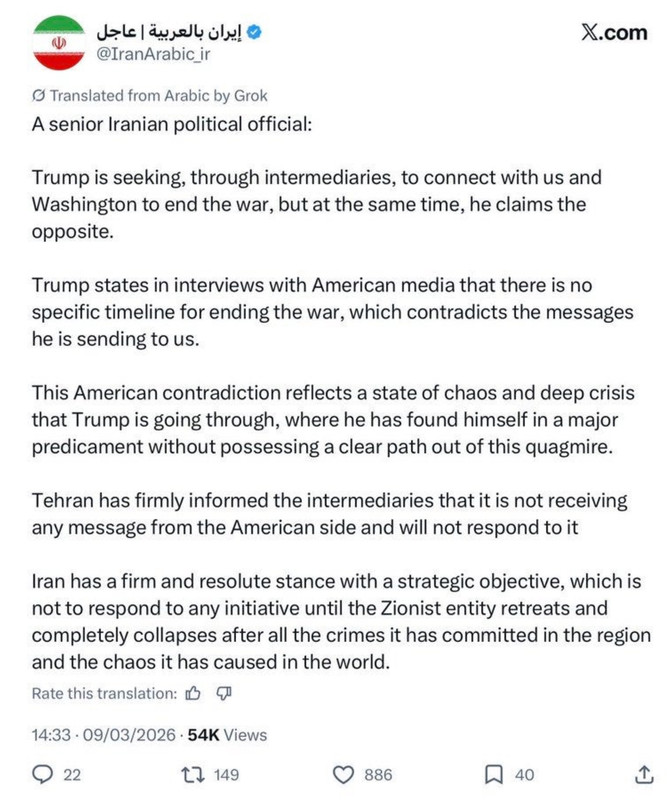
Iran says the United States is pleading for a ceasefire.
Ali Larijani, head of Iran’s Supreme National Security Council, stated:

“Tonight, we received messages from U.S. President Donald Trump through the Omani mediator, asking us to negotiate a ceasefire.
Our response is that we will not accept any negotiations as long as an entity called Israel exists.”
Image

The whole region is now aflame, with US troops pulling out of bases, Arab oil economies being shut down, and no one seemingly able to figure out how to stop the Iranian juggernaut.
All internal rumours point to neither the Israeli nor the US side having anticipated the Iranian “regime” surviving so intact.

One of the reasons for this is that in the wake of the last ‘12 Day War’ you may recall Iran carried out a massive purge of Mossad assets throughout the country, with hundreds of agents apprehended, thousands of pieces of sabotage equipment confiscated, etc. After the Mossad network was neutered, it seems the threat of colour revolutions and destabilization of the leadership was no more.

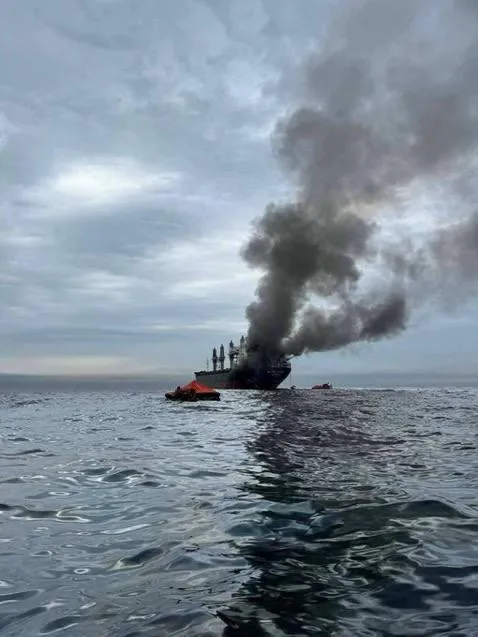
But as stated in the opening, all focus has now turned on the Strait of Hormuz. It’s clear there is a kind of de facto blockade, wherein Iran is allowing some friendly assets to pass while blowing up the rest. Just today alone multiple hits were reported on various ships:
Image

Satellite photos appear to show the strait empty of traffic, with lined up ships sitting on each opposing side of it, awaiting a resolution or building up courage.

Sailors from various countries in the region have become unwitting witnesses to Iran’s massive destruction of port facilities in UAE, Oman, Kuwait, and elsewhere. First video from Port Salalah, Oman, second from Fujairah oil storage facility in UAE, wherein you can clearly see Iranian ballistics bypassing the shoddy American-supplied air defences.

The biggest development revolves around Iran reportedly beginning to deploy naval mines in the strait, although there is some contention regarding this. The US appears to be trying to minimize the panic by claiming Iran has only deployed “10 mines” and that the US has been destroying Iranian minelayers. All the while, the IRGC has released videos showing they can lay mines via rockets fired from inland.

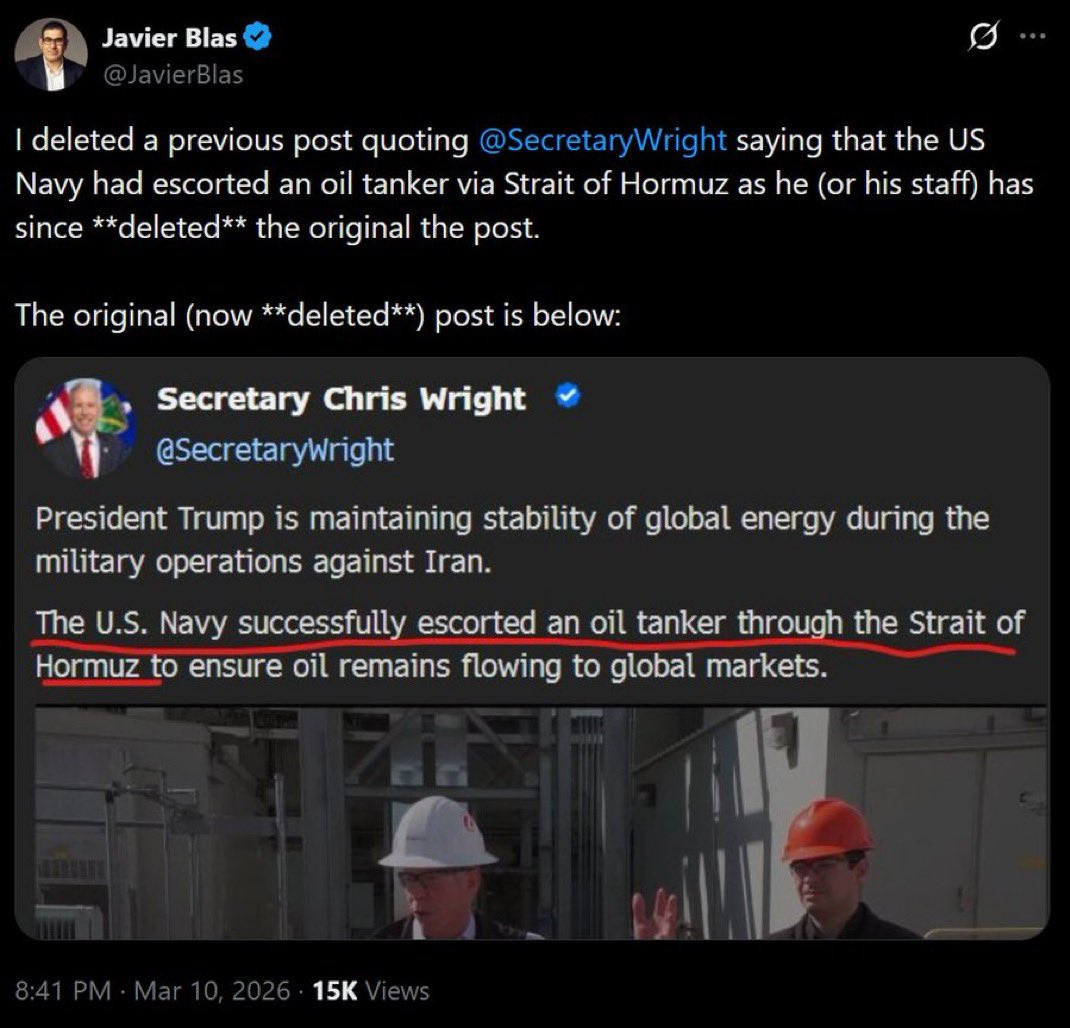
The US has even begun making up lies about escorting tankers through the strait, only for them to be humiliatingly retracted.
Image

There is a kind of fog of war over the straits at the moment, which is designed to benefit both sides for different reasons. For Trump, it’s obvious, he wants to maintain the illusion that the US is in control. Iran, on the other hand, wants to pretend it has not fully committed to its highest escalatory levers just yet, despite it already ‘testing the waters’ of using them. That’s not to mention that for simple strategic reasons, it’s within Iran’s interests to not announce or telegraph its every intention, and keep the enemy in as much confusion as possible.

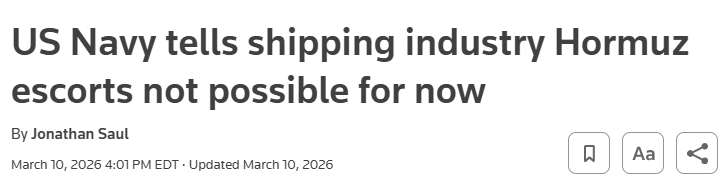
…while the US Navy continues to pretend it has the situation under control, it has openly declared that reopening the strait is beyond its mythical powers:
Image

Let that sink in: the supposedly most powerful navy in history is admitting they cannot retain freedom of navigation through one of the most important maritime choke points in the world.

The reason is simple — Iran’s ability to take out US carriers, and any US ship. Most Iranian anti-ship assets have a 300km max range. As long as US ships stay out of this range, they have relative safety. But the closer they move into the kill zone, the greater the risk becomes. At 200-300km range they risk anti-ship ballistics and longer range cruise missiles. At 25-50km they risk a much wider variety of smaller, cheaper anti-ship cruise missiles and drones. At 30km or so, they risk Iranian naval drones.

IRGC Brigadier General Fadavi claims that no US ship is anywhere within 700km of Iran’s shores:
Iranian military commander General Fadavi:
Not a single American vessel is within 700 kilometers of Iran. The US Navy has fled because it knows we have a special plan for sinking their aircraft carrier.
Today he also boasted that Iran is only the second country on earth after Russia to possess “underwater missiles”, or high speed torpedoes, which he says go in excess of 100m/s. His description of it narrows it down to the Soviet Shkval torpedo, which reaches nearly 250mph using a highly advanced form of ‘supercavitation’.

As of this writing Brent crude oil has again spiked above $100. US assets all over the region are being blown to smithereens:

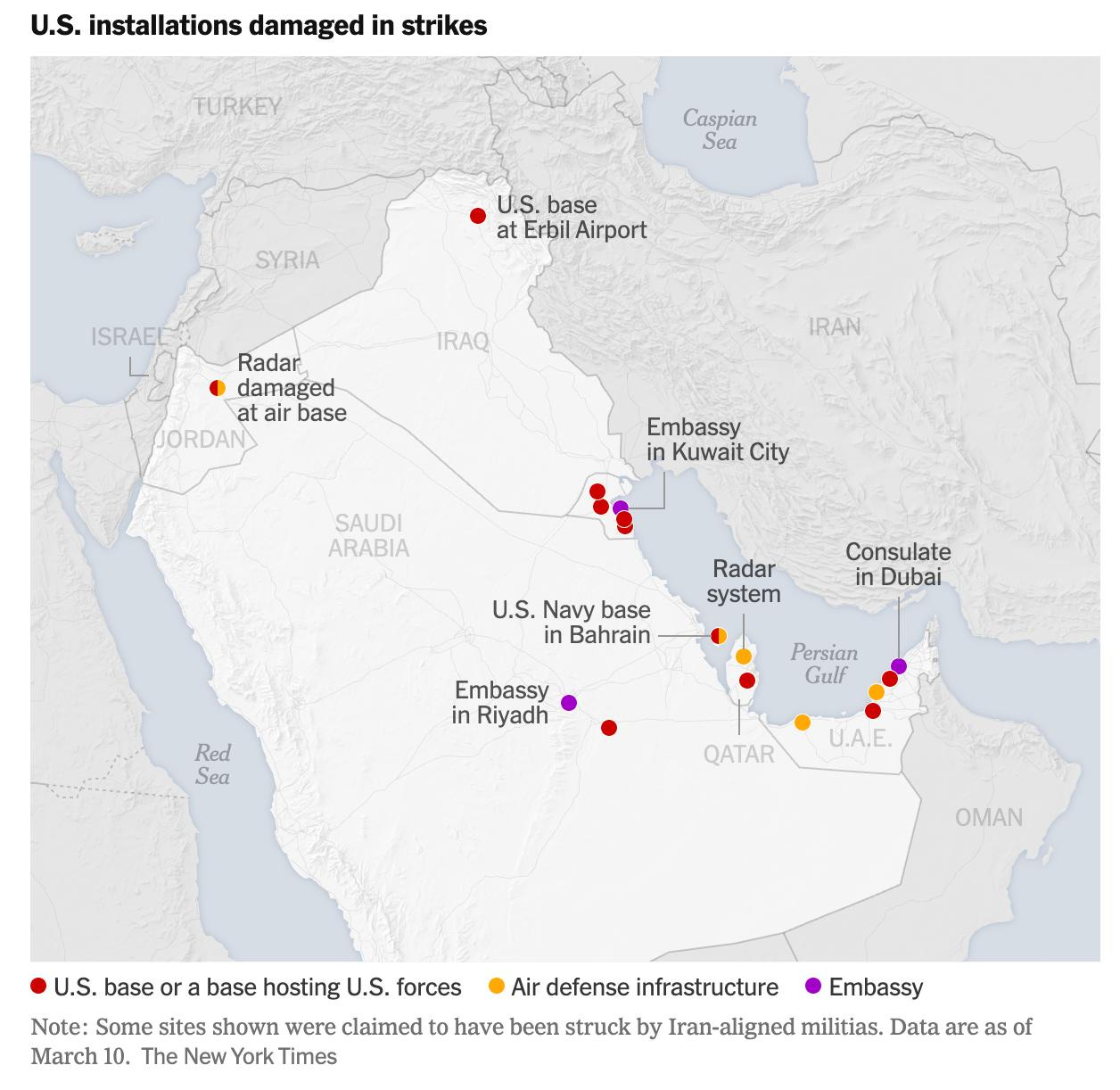
At least 17 American facilities in the Middle East were damaged due to Iran’s strikes — NYT
▪️According to a Pentagon assessment presented to Congress, one of the most costly strikes was carried out on February 28 against the headquarters of the US Navy’s Fifth Fleet in Bahrain — the damage is estimated at approximately 200 million dollars.

▪️The US military notes that the scale of the retaliatory attacks shows that Iran was better prepared for the conflict than expected by Donald Trump’s administration.

▪️According to US officials, Iran has already launched thousands of missiles and drones at US military facilities and their allies in the region.

▪️Most of the targets, it is claimed, were intercepted, but at least 11 American bases and facilities were damaged — almost half of all US infrastructure in the region.

▪️One of the most costly losses was the elements of air defence systems: Iran is striking radars and communication nodes, including components of the THAAD missile defense system.
Image

Trump continues to schizophrenically signal contradictory positions — both that: a.) he may soon pull out of the war due to already having “won”, and b.) that the US is committed to a long term campaign.
This translates most readily as Trump wanting to pull out as overwhelming domestic pressure mounts on him, but pressure from Israel continues edging him forward.
So far, he’s letting Israeli pressure win.

His recent press conferences are a testament to the type of direction-less waffling he’s resigned to amidst a disastrous failure of a military campaign.

See full article here:
https://simplicius76.substack.com/p/ira ... open=false
A ‘holocaust’ believer’s problem is not technical, factual, empirical or archeological — their problem is psychological.
User avatar
Wahrheitssucher
Posts: 759
Joined: Mon May 19, 2025 2:51 pm

Re: Iran Attack

Post by Wahrheitssucher »

.
And here’s another, interesting, recent assessment.
Summary: Netanyahu and Jared Kushner (Trump’s handler/advisor) misjudged EXTREMELY badly:
…the Islamic Republic of Iran was targeted by the United States–Israel alliance across nearly half a century of:
- sanctions,
- covert operations,
- proxy warfare,
- assassinations of Iranian officials and nuclear scientists,
- and repeated military confrontations across West Asia.
Iranian strategic doctrine therefore evolved under the assumption that any direct confrontation with the United States and Israel would occur under conditions of technological asymmetry and military imbalance. Iranian planners responded by developing a doctrine based on attrition, economic disruption, and geographic leverage designed to impose intolerable costs on technologically superior adversaries. The present war demonstrates the practical execution of that doctrine.
Iranian strategic thinking rests on the premise that conventional battlefield victory against the United States remains improbable in the short term but that strategic victory becomes possible by increasing the cost of conflict beyond the tolerance threshold of Western political systems. Robert Pape’s work on coercion and asymmetric conflict emphasises that weaker states frequently pursue strategies which target an adversary’s political will rather than its military capability (Pape, Bombing to Win, University of Chicago Press). Iranian planning therefore prioritised economic disruption and prolonged attrition over rapid battlefield dominance.

Iran’s leadership understood that the United States and Israel would deploy their most advanced offensive and defensive systems early in the conflict. Iranian planning therefore assumed an initial period of heavy bombardment directed against Iranian infrastructure, command centres, and air defence networks. Iranian planners also anticipated that the United States and Israel would rely heavily on expensive missile interceptors and precision strike systems that cannot be replaced rapidly under wartime conditions. Iranian doctrine therefore emphasised endurance during the opening phase followed by escalation once Western stockpiles began to decline.
Iranian missile and drone production reflects that doctrine.

Shahed drones represent a simple technological platform described in technical assessments as “basically a fiberglass body with a motor, basic guidance, and explosives, meaning they can be assembled at a speedboat-repair facility.” The simplicity of the design allows mass production across dispersed industrial sites, making interdiction difficult even under sustained aerial bombardment. Western interceptor systems impose far greater financial and logistical burdens. Patriot PAC-3 interceptors cost roughly four million dollars per unit while THAAD interceptors cost more than twelve million dollars each. Iranian planners therefore constructed a battlefield equation where large volumes of inexpensive drones and missiles gradually exhaust expensive defensive systems.

The Iranian Aerospace Force recently declared a shift in missile doctrine reflecting the transition from endurance to escalation. IRGC Aerospace Force Commander Majid Mousavi announced that “after neutralizing US air defense layers in the region, Iran is transitioning to a new missile doctrine. From now on, no missiles carrying warheads lighter than 1 ton will be used. Waves of missile attacks will be more frequent and more widespread.” The Kheibar Shekan medium-range ballistic missile represents a central element of this doctrine. The system possesses a range of approximately 1,450 kilometres and can be launched from road-mobile platforms within thirty minutes. Terminal manoeuvring capability enables zig-zag evasive trajectories during re-entry at speeds approaching Mach 10 according to Iranian claims.

Iranian strategic planners also emphasised the economic dimension of war. Energy markets represent the central vulnerability of the global economic system, particularly for industrial economies dependent on imported petroleum. The Strait of Hormuz therefore occupies a pivotal position in Iranian war planning. Approximately twenty percent of global oil supply transits through the narrow maritime corridor connecting the Persian Gulf to the Indian Ocean (U.S. Energy Information Administration). Although the waterway measures roughly twenty-one miles across at its narrowest point, commercial shipping lanes measure only a few miles wide in each direction.

Iranian planners therefore identify oil prices as the decisive strategic variable. The IRGC articulated the objective clearly. “$200 per barrel. That’s the number. That’s the mission. That’s how Iran declares victory, not by shooting down an F-35, but by making the price of oil so painful, so unbearable, so devastating to the global economy, that President Trump starts getting 50 phone calls a day from world leaders begging him to stop.” Economic warfare therefore operates as the central instrument of Iranian strategy rather than a secondary battlefield effect.

Economic disruption quickly generates international political pressure. European economies remain heavily dependent on energy imports while Asian economies such as China, India, Japan, and South Korea rely extensively on Gulf oil transported through the Strait of Hormuz. Gulf Cooperation Council states also face direct economic exposure because regional instability threatens both export infrastructure and investor confidence. Rising energy prices therefore transmit economic shock across the global system.

Classical geopolitical theory often emphasises the relationship between geography and strategic leverage. Halford Mackinder argued that control over key geographic chokepoints and transport corridors provides disproportionate influence over global economic systems. Iranian planners apply similar reasoning to the Persian Gulf energy corridor. Temporary disruption of shipping through Hormuz generates global consequences that extend far beyond the immediate battlefield.

The resulting economic pressure produces diplomatic consequences. Governments facing rising energy prices confront domestic inflation, industrial disruption, and public dissatisfaction. Global leaders therefore seek rapid de-escalation once energy markets destabilise. Iranian planners anticipated this response and incorporated it into their war planning. Economic pain imposed on the global system becomes a tool for diplomatic leverage against Washington and its allies.

Iranian leadership also articulates political objectives beyond battlefield operations. Conditions proposed for a ceasefire illustrate Tehran’s strategic demands. These include removal of sanctions, release of frozen Iranian assets, recognition of Iran’s right to enrich uranium domestically, compensation for war damages, and dismantling of United States military bases across West Asia. Such demands reflect a broader objective of restructuring the regional security architecture which has constrained Iran since the 1979 revolution.

Iranian officials express open hostility toward ceasefire proposals that leave the underlying strategic confrontation unresolved. Foreign Minister Abbas Araghchi declared that “Negotiations with the United States are no longer on the agenda.” Parliamentary Speaker Mohammad Ghalibaf expressed a similar position stating, “We are absolutely NOT seeking a ceasefire. We believe the aggressor must be struck in the mouth so that it learns a lesson and never again even thinks of attacking dear Iran.” Iranian leadership therefore frames the conflict as a decisive confrontation rather than a temporary escalation.

Israel entered the conflict with different strategic expectations. Israeli planners initially believed that intensive air strikes combined with economic pressure would destabilise the Iranian political system. The strategy assumed that sustained military pressure might trigger internal dissent leading to political fragmentation inside Iran. Such expectations influenced Israeli operational planning during the early phase of the war.

The Israeli Air Force achieved several tactical successes against Iranian infrastructure during the initial campaign. Military analysts acknowledge that the scale of the air campaign exceeded many pre-war expectations. Tactical destruction of missile sites, command facilities, and logistics infrastructure produced measurable battlefield results. Tactical success, however, did not produce the anticipated political consequences inside Iran.

Iranian political institutions remained stable despite sustained bombardment. Internal dissent failed to develop into a significant political challenge to the Iranian government. Israeli strategists therefore confronted a strategic dilemma where battlefield achievements failed to produce decisive political outcomes. Military operations destroyed infrastructure yet failed to alter the strategic balance.
Israeli planners also confronted unexpected resilience among Iranian allied organisations across the region. Hezbollah continued launching drones and missiles despite leadership losses and sustained air strikes. Israeli communities near the northern border remained under pressure from persistent attacks. Military planners therefore faced the prospect of prolonged conflict across multiple fronts.
Domestic vulnerabilities also became visible within Israel. Security disruptions affecting Ben-Gurion International Airport exposed structural fragility within the Israeli economy. Closure or interruption of the country’s primary aviation hub produced economic shock and public anxiety. War expenditures also generated fiscal pressure as the government diverted approximately NIS 28 billion toward military operations. Social programmes and infrastructure spending faced suspension, generating domestic political tension.

Diplomatic expectations regarding regional support also proved unrealistic. Israeli leadership anticipated strong backing from Gulf states that share concerns about Iranian regional influence. Instead Gulf governments prioritised regional stability and economic continuity. Regional leaders expressed concern that continued escalation would threaten energy infrastructure and economic development across the Gulf.
American political calculations further complicated Israeli strategy. Israeli planners expected sustained American military and political support during a prolonged confrontation with Iran. Signals emerging from Washington suggested a different trajectory. American political leadership expressed increasing interest in rapid de-escalation as economic consequences of the conflict spread across global markets.

Iranian strategic planners also anticipate that the United States may ultimately seek an off-ramp that preserves domestic political credibility while temporarily halting the conflict. In this scenario Washington could declare the degradation of Iranian capabilities as a strategic success and disengage militarily while framing the outcome as a victory for deterrence. Such a withdrawal would not necessarily represent the end of the confrontation but rather a pause in a longer strategic cycle. Iranian analysts frequently argue that the United States and Israel may then attempt to exploit the post-war economic damage inflicted on Iran by encouraging internal unrest or political fragmentation in the years following the conflict. From Tehran’s perspective this reinforces the logic of refusing temporary ceasefires that leave the underlying confrontation unresolved. Iranian leadership therefore emphasises the necessity of imposing sufficiently high economic costs on the United States and Israel to force a settlement that fundamentally restructures the regional security order rather than merely postponing the next round of confrontation.

Israeli leadership therefore faces a strategic paradox recognised within its own policy community. Tactical battlefield successes coexist with deteriorating strategic conditions. Military operations degrade Iranian capabilities yet simultaneously intensify regional hostility and economic disruption. Israeli strategists increasingly fear that the war may produce long-term geopolitical consequences unfavourable to Israel despite short-term battlefield gains.

Political leadership therefore attempts to maintain a narrative of success while exploring pathways toward de-escalation. Public messaging emphasises tactical victories and destruction of enemy infrastructure. Private diplomatic channels simultaneously explore ceasefire arrangements capable of stabilising the regional environment without acknowledging strategic defeat.

Game theory provides a useful framework for understanding the strategic interaction between Iran and the United States–Israel alliance. Iran pursues a strategy designed to raise the cost of continued conflict beyond the acceptable threshold for Western political systems. Western governments face pressure from economic disruption, domestic politics, and global diplomatic backlash. Rational actors operating within this framework may eventually prefer negotiated settlement to continued escalation.
Iranian strategy therefore attempts to shift the payoff structure of the conflict. Victory becomes defined not by territorial conquest but by altering the cost-benefit calculations of adversaries. Energy markets, shipping corridors, and economic infrastructure become instruments of strategic coercion. Israel and the United States therefore confront a dilemma where military superiority does not automatically translate into favourable political outcomes.

Global reactions increasingly reflect the economic consequences of prolonged conflict. Rising oil prices generate inflationary pressure across industrial economies while supply disruptions threaten manufacturing and transport sectors. Governments facing domestic economic pressure increasingly advocate diplomatic solutions capable of stabilising energy markets.

The conflict therefore demonstrates a classical geopolitical principle recognised throughout strategic history. Military power alone rarely determines political outcomes when economic systems and global markets become central theatres of war. Iranian strategy seeks precisely that transformation by converting a regional military confrontation into a global economic crisis.

Strategic equilibrium therefore depends on whether economic pressure forces diplomatic compromise before military escalation produces irreversible consequences. Iranian leadership appears prepared for prolonged confrontation designed to reshape the regional security environment. Israeli leadership increasingly confronts the challenge of concluding the conflict while maintaining the appearance of strategic success.
A ‘holocaust’ believer’s problem is not technical, factual, empirical or archeological — their problem is psychological.
User avatar
Wahrheitssucher
Posts: 759
Joined: Mon May 19, 2025 2:51 pm

Re: USrael’s illegal and wicked Iran Attack

Post by Wahrheitssucher »

A ‘holocaust’ believer’s problem is not technical, factual, empirical or archeological — their problem is psychological.
User avatar
Wahrheitssucher
Posts: 759
Joined: Mon May 19, 2025 2:51 pm

Re: USrael’s illegal and wicked Iran Attack

Post by Wahrheitssucher »

.
Here is the recent message from the new leader of Iran, for anyone interested in what is actually going down now, instead of the lies and misinfo that our corrupt, zio-controlled MSM are feeding us.

The commentary afterwards might also be of interest to those who’ve completely bought into the islamaphobic, hatred-of-muslims that the zios have been conditioning us with for decades.

A ‘holocaust’ believer’s problem is not technical, factual, empirical or archeological — their problem is psychological.
Post Reply