
Regarding the debate over the Kula column. The witnesses are clearly describing the same thing and that some mention a bucket or cannister and others do not, is explained here (my bold);
https://phdn.org/archives/holocaust-his ... o-columns/
"In 1981, historian Gerald Fleming spoke to former SS-Sergeant Major Josef Houstek, who had changed his name to Josef Erber after serving at Auschwitz. Erber described the columns as appearing slightly different:
In each of these gassing areas [of the crematoria [II and III] in Birkenau] were two ducts: in each duct, four iron pipes ran from the floor to the roof. These were encased with steel mesh wire and inside there was a tin canister with a low rim. Attached to this tin was a wire by which it could be pulled up to the roof. When the lids were lifted, one could pull up the tin canister and shake the gas crystals into it. Then the canister was lowered, and the lid closed. 6
6. Prisoner Josef Erber to author, 14 September 1981.
The "four iron pipes" are presumably the four corners around which the outside mesh was wrapped. The tin canister lowered by a wire may be an earlier, or later, version of the inside "wire basket" described by Kula."
Nit picking over small details, to try and point score in a debate, is one way how the revisionists here try to justify their beliefs. Fact is Erber corroborates Tauber and Kula. Corroboration between witnesses who would not normally cooperate, is very strong corroboration.
Comments on other threads.
Re: Comments on other threads.
Sanity Check - "Thus, currently revisionists can console themselves by affirming their incredulity..."

Re: Comments on other threads.
No. You are telling a deliberate falsehood. Kula does not describe a tin can lowered on a wire.Nessie wrote: ↑Fri Mar 20, 2026 11:46 am Regarding the debate over the Kula column. The witnesses are clearly describing the same thing and that some mention a bucket or cannister and others do not, is explained here (my bold);
https://phdn.org/archives/holocaust-his ... o-columns/
"In 1981, historian Gerald Fleming spoke to former SS-Sergeant Major Josef Houstek, who had changed his name to Josef Erber after serving at Auschwitz. Erber described the columns as appearing slightly different:
In each of these gassing areas [of the crematoria [II and III] in Birkenau] were two ducts: in each duct, four iron pipes ran from the floor to the roof. These were encased with steel mesh wire and inside there was a tin canister with a low rim. Attached to this tin was a wire by which it could be pulled up to the roof. When the lids were lifted, one could pull up the tin canister and shake the gas crystals into it. Then the canister was lowered, and the lid closed. 6
6. Prisoner Josef Erber to author, 14 September 1981.
The "four iron pipes" are presumably the four corners around which the outside mesh was wrapped. The tin canister lowered by a wire may be an earlier, or later, version of the inside "wire basket" described by Kula."
Nit picking over small details, to try and point score in a debate, is one way how the revisionists here try to justify their beliefs. Fact is Erber corroborates Tauber and Kula. Corroboration between witnesses who would not normally cooperate, is very strong corroboration.
Pressac's drawing, based on Kula's statement. Rudolf renders it differently but both agree that he is not describing a can on a wire.
Incredulity Enthusiast
Re: Comments on other threads.
Borjastick;
https://www.codohforum.com/viewtopic.php?p=23292#p23292
https://www.codohforum.com/viewtopic.php?p=23292#p23292
That the chambers had gas tight doors is corroborated by documents and eyewitnesses. That they were described as similar to the delousing chamber doors, but with additional reinforcement, makes sense.So where did the original doors go or is this another one of those things where we have to believe them and trust what they say?
The alleged lack of evidence, as the Auschwitz museum believes there is a surviving gas chamber door, is due to Nazi destruction of evidence.Odd that whenever questions are asked about the gas chambers and other key parts of the fable they wriggle and get shirty about the lack of evidence...
Your questions are easily answered.... and cannot answer simple and most legitimate questions.
Sanity Check - "Thus, currently revisionists can console themselves by affirming their incredulity..."
Re: Comments on other threads.
I did not read the bold sentence to mean Kula was describing a tin can lowered on wire. I read it as, there was a different version of the column Kula described, that had the cannister. Kula describes a version without a cannister/tin can. Other eyewitnesses describe a version with a cannister/tin can. Flemming is suggesting there was more than one version of the column.Archie wrote: ↑Fri Mar 20, 2026 4:08 pmNo. You are telling a deliberate falsehood. Kula does not describe a tin can lowered on a wire.Nessie wrote: ↑Fri Mar 20, 2026 11:46 am Regarding the debate over the Kula column. The witnesses are clearly describing the same thing and that some mention a bucket or cannister and others do not, is explained here (my bold);
https://phdn.org/archives/holocaust-his ... o-columns/
"In 1981, historian Gerald Fleming spoke to former SS-Sergeant Major Josef Houstek, who had changed his name to Josef Erber after serving at Auschwitz. Erber described the columns as appearing slightly different:
In each of these gassing areas [of the crematoria [II and III] in Birkenau] were two ducts: in each duct, four iron pipes ran from the floor to the roof. These were encased with steel mesh wire and inside there was a tin canister with a low rim. Attached to this tin was a wire by which it could be pulled up to the roof. When the lids were lifted, one could pull up the tin canister and shake the gas crystals into it. Then the canister was lowered, and the lid closed. 6
6. Prisoner Josef Erber to author, 14 September 1981.
The "four iron pipes" are presumably the four corners around which the outside mesh was wrapped. The tin canister lowered by a wire may be an earlier, or later, version of the inside "wire basket" described by Kula."
Nit picking over small details, to try and point score in a debate, is one way how the revisionists here try to justify their beliefs. Fact is Erber corroborates Tauber and Kula. Corroboration between witnesses who would not normally cooperate, is very strong corroboration.
Pressac's drawing, based on Kula's statement. Rudolf renders it differently but both agree that he is not describing a can on a wire.
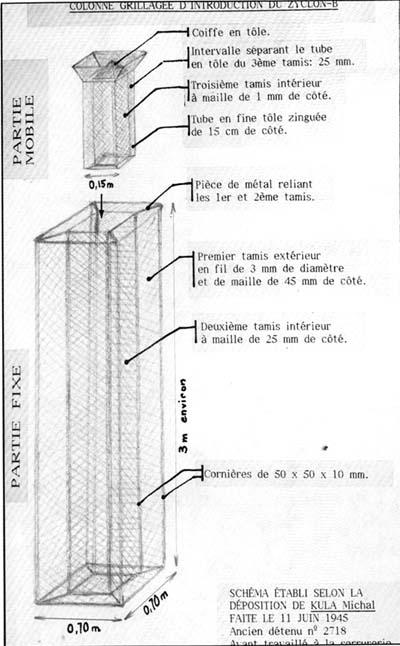
Kula's description was when it was built in the workshop. Tauber and Erber describe it in use in the Kremas. It is entirely possible it was modified once it was put into use.
Sanity Check - "Thus, currently revisionists can console themselves by affirming their incredulity..."
Re: Comments on other threads.
Ok, so let's see if I understand your position. In your attempt to resolve this contradiction, your proposal is that Kula describes an earlier design but this was later modified (why?) to incorporate a can on a wire. So in your view there is no contradiction, but rather the witnesses are merely describing two different points in the evolution of the "Kula column." Interesting theory. But isn't it customary to design something before you manufacture it? They were really shooting from the hip, eh? Usually you have engineers design the thing first, then they give the specs to someone to manufacture the thing. That way you have some assurance it will work as intended rather than just make random stuff, hope it works, and then have to jerry-rig something different when it doesn't.Nessie wrote: ↑Fri Mar 20, 2026 4:21 pm I did not read the bold sentence to mean Kula was describing a tin can lowered on wire. I read it as, there was a different version of the column Kula described, that had the cannister. Kula describes a version without a cannister/tin can. Other eyewitnesses describe a version with a cannister/tin can. Flemming is suggesting there was more than one version of the column.
Kula's description was when it was built in the workshop. Tauber and Erber describe it in use in the Kremas. It is entirely possible it was modified once it was put into use.
Question: if you believe in the story that says the pellets were collected in the can during the gassing (in your hypothetical "later" version of the column), would you not agree that this would greatly limit the amount of exposed surface area of the pellets and would slow the evaporation of the gas? And wouldn't the distribution of the gas throughout the 210 sq m room be very poor?
Incredulity Enthusiast
Re: Comments on other threads.
It is not my attempt, it comes from the historian Gerald Fleming.Archie wrote: ↑Fri Mar 20, 2026 11:12 pmOk, so let's see if I understand your position. In your attempt..Nessie wrote: ↑Fri Mar 20, 2026 4:21 pm I did not read the bold sentence to mean Kula was describing a tin can lowered on wire. I read it as, there was a different version of the column Kula described, that had the cannister. Kula describes a version without a cannister/tin can. Other eyewitnesses describe a version with a cannister/tin can. Flemming is suggesting there was more than one version of the column.
Kula's description was when it was built in the workshop. Tauber and Erber describe it in use in the Kremas. It is entirely possible it was modified once it was put into use.
Chronologically the theory works. The columns were are completely original design. Why do you think the designer would get it right first time? Would it not be quite common for something that is brand new, to need a modification once it has been put into use? The obvious reason why the column would need modifying, was because pellets were falling out and had to be swept up. Hence, the introduction of the canister/basket.... to resolve this contradiction, your proposal is that Kula describes an earlier design but this was later modified (why?) to incorporate a can on a wire. So in your view there is no contradiction, but rather the witnesses are merely describing two different points in the evolution of the "Kula column." Interesting theory. But isn't it customary to design something before you manufacture it? They were really shooting from the hip, eh? Usually you have engineers design the thing first, then they give the specs to someone to manufacture the thing. That way you have some assurance it will work as intended rather than just make random stuff, hope it works, and then have to jerry-rig something different when it doesn't.
I have no idea. The difference between historians and other investigators and revisionists, is that revisionists alone, think that something is only proved if they can figure out how it worked. You have banned discussion about the obvious flaw in that way of thinking.Question: if you believe in the story that says the pellets were collected in the can during the gassing (in your hypothetical "later" version of the column), would you not agree that this would greatly limit the amount of exposed surface area of the pellets and would slow the evaporation of the gas? And wouldn't the distribution of the gas throughout the 210 sq m room be very poor?
Evidentially, the use of the columns is corroborated by multiple eyewitnesses, Jewish and SS and it is referred to in an inventory document. That the descriptions vary, is to be expected and why some refer to a canister/basket and others do not, is uncertain, but that uncertainty does not act as evidence to prove there was no column and all the witnesses lied.
Sanity Check - "Thus, currently revisionists can console themselves by affirming their incredulity..."
Re: Comments on other threads.
Archie wants it both ways;
viewtopic.php?p=23312#p23312
viewtopic.php?p=23312#p23312
They get criticised for varying descriptions and for the same descriptions. Why does Archie think that way? The answer is that he is looking for any excuse to dismiss the witnesses as liars.Does Tauber give the exact same dimensions that Kula does? If so, I would agree that would strongly suggest direct borrowing.
Evidentially, it has been proven that both were prisoners at A-B and were in places to have seen the columns. It is best that witnesses do not discuss what they saw with each other prior to giving their testimony, but when people have worked in the same place, spoke the same language and saw the same thing, it is impossible to rule that out. Collusion is not ideal, but it does not necessarily prove lying.Both witnesses were interviewed at around the same time as part of the Jan Sehn investigation. So why do you rule out cross-pollination here?
Yes, all the witnesses have mixed hearsay with what they saw. That is quite normal. It does not prove lying.Clearly he's repeating garbled versions of stories he's heard.
Sanity Check - "Thus, currently revisionists can console themselves by affirming their incredulity..."
Re: Comments on other threads.
Mengelemyth;
viewtopic.php?p=23290#p23290
It was not a Soviet reconstruction, it was a Polish one. The Soviets were not in the slightest bit interested in the plight of the Jews. Once Auschwitz was liberated, responsibility for the camp was given to the Poles. It was they, not the Soviets who had originally reported on the use of death camps to mass murder Jews. The Poles conducted the majority of the postwar Holocaust investigations and evidence gathering.
The revisionists here try to claim that Poland the SU was one and the same, but, in 1945, Poland got its independence back, unlike other countries such as Ukraine. Whilst the Poles and Soviets were aligned, there was a deep undercurrent of mistrust and many Poles, often in exile, were opponents of Communism and Soviet influence. That was driven by political ideology and because of how the Soviets had treated the Poles during WWII. Remember, in 1939, the Soviets also invaded and in 1940, they had conducted the Katyn Massacre. It was revolution in Poland that finally caused the collapse of Communism and the end of the Soviet Union in the late 1980s.
Revisionists like to frame the Soviets as the driving force behind the Holocaust, as they have a history of atrocity stories and hoaxes. It does not work to frame the Poles as the driving force, as even the most die hard conspiracist cannot bring themselves to believe that Poland fooled the world and hoax the Holocaust.
viewtopic.php?p=23290#p23290
The other place I post on Holocaust denial, is X and it is full of people who think that the wooden door with the window is presented as the original door into the gas chamber. It acts as a useful guide to idiocy, gullibility and intelligence. Someone who can be fooled into thinking it was a gas chamber door, can be easily fooled into believing Holocaust denial.Honestly I’m surprised people would even cite this door as a gotcha on this forum? That’s some old ass David Cole shit. I guess things have not progressed since then. Auschwitz museum openly admits this door was related to a botched soviet reconstruction. Auschwitz does not claim that this was a door used on a gas chamber.
It was not a Soviet reconstruction, it was a Polish one. The Soviets were not in the slightest bit interested in the plight of the Jews. Once Auschwitz was liberated, responsibility for the camp was given to the Poles. It was they, not the Soviets who had originally reported on the use of death camps to mass murder Jews. The Poles conducted the majority of the postwar Holocaust investigations and evidence gathering.
The revisionists here try to claim that Poland the SU was one and the same, but, in 1945, Poland got its independence back, unlike other countries such as Ukraine. Whilst the Poles and Soviets were aligned, there was a deep undercurrent of mistrust and many Poles, often in exile, were opponents of Communism and Soviet influence. That was driven by political ideology and because of how the Soviets had treated the Poles during WWII. Remember, in 1939, the Soviets also invaded and in 1940, they had conducted the Katyn Massacre. It was revolution in Poland that finally caused the collapse of Communism and the end of the Soviet Union in the late 1980s.
Revisionists like to frame the Soviets as the driving force behind the Holocaust, as they have a history of atrocity stories and hoaxes. It does not work to frame the Poles as the driving force, as even the most die hard conspiracist cannot bring themselves to believe that Poland fooled the world and hoax the Holocaust.
Sanity Check - "Thus, currently revisionists can console themselves by affirming their incredulity..."
Re: Comments on other threads.
Stubble believes the wooden doors would not hold;
viewtopic.php?p=23321#p23321
https://forum.axishistory.com/viewtopic.php?f=6&t=82890
"It was a wooden door, made of two layers of short pieces of wood arranged like parquet. Between these layers there was a single sheet of material sealing the edges of the door and the rabbets of the frame were also fitted with sealing strips of felt. At about head height for an average man this door had a round glass peephole. On the other side of the door, i.e. on the gas chamber side, this opening was protected by a hemispherical grid. This grid was fitted because the people in the gas chamber, feeling they were going to die, used to break the glass of the peep-hole. But the grid still did not provide sufficient protection and similar incidents recurred. The opening was blocked with a piece of metal or wood. The people going to be gassed and those in the gas chamber damaged the electrical installations, tearing the cables out and damaging the ventilation equipment. The door was closed hermetically from the corridor side by means of iron bars which were screwed tight."
The elderly woman, or child, whist they are dying of HCN poisoning, has to somehow kick there way through a multiple layered wooden door that is secured on the outside with iron bars.
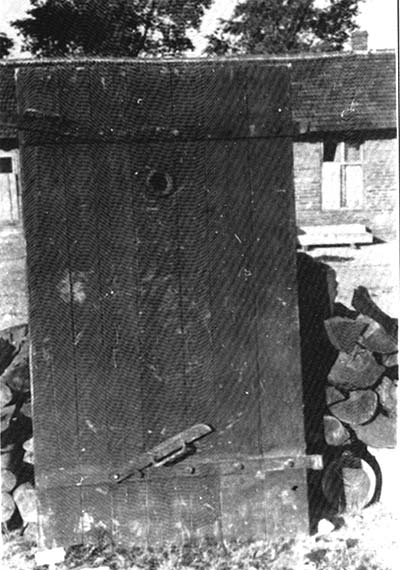
At least someone else recognises the flaw in Stubble's argument;
viewtopic.php?p=23321#p23321
Tauber's description is the most detailed;Look, the timbers are thin, the 'locks' are a joke, and the screen on the peephole doesn't seem to be for 'panic proofing'. If it were, it would not be setup in such a way for it to potentially be ripped off the door.
I'm eager to mock one of these doors up so it can be kicked by an elderly woman or a child so you can see how flimsy the 'lock' setup is.
https://forum.axishistory.com/viewtopic.php?f=6&t=82890
"It was a wooden door, made of two layers of short pieces of wood arranged like parquet. Between these layers there was a single sheet of material sealing the edges of the door and the rabbets of the frame were also fitted with sealing strips of felt. At about head height for an average man this door had a round glass peephole. On the other side of the door, i.e. on the gas chamber side, this opening was protected by a hemispherical grid. This grid was fitted because the people in the gas chamber, feeling they were going to die, used to break the glass of the peep-hole. But the grid still did not provide sufficient protection and similar incidents recurred. The opening was blocked with a piece of metal or wood. The people going to be gassed and those in the gas chamber damaged the electrical installations, tearing the cables out and damaging the ventilation equipment. The door was closed hermetically from the corridor side by means of iron bars which were screwed tight."
The elderly woman, or child, whist they are dying of HCN poisoning, has to somehow kick there way through a multiple layered wooden door that is secured on the outside with iron bars.
At least someone else recognises the flaw in Stubble's argument;
Yes, Stubble, your incredulity is insufficient and you do need to prove that elderly women and children would have no difficulty forcing open that door whilst they are dying.Personally I think a demonstration is in order as you consider my assessment simply incredulity and not based on experience working with wood and iron.
Sanity Check - "Thus, currently revisionists can console themselves by affirming their incredulity..."
Re: Comments on other threads.
I was replying to bombsaway who argued that cross-pollination of stories between Kula and Tauber was impossible. If you believe the above, then you agree with me that it is very possible.
Incredulity Enthusiast
Re: Comments on other threads.
Can you evidence that they communicated or met up somewhere before the 24th May 1945, when Tauber gave his statement to the Polish investigation, or the 11th June 1945, when Kola gave his statement?
Even if they did collude, whilst it is not ideal, it is not evidence of lying. Just as much of what you claim is evidence of lying, is in fact not. The problem is that you have programmed yourself to find excuses to dismiss all the eyewitnesses as liars. That is why you mistakenly think that variations in descriptions of the column is evidence they both lied.
Sanity Check - "Thus, currently revisionists can console themselves by affirming their incredulity..."
Re: Comments on other threads.
Now you are demanding extensive "behind-the-scenes" records that are generally not available. They were witnesses for the same investigation and gave statements only weeks apart, so it is foolish to assume as bombsaway does that cross-pollination was impossible. Moreover they would not even need to talk to each other. Both merely need to have heard the general idea of wire-mesh columns with layers. There are accounts mentioning this feature at least as early as Aug 1944.Nessie wrote: ↑Sat Mar 21, 2026 5:22 pmCan you evidence that they communicated or met up somewhere before the 24th May 1945, when Tauber gave his statement to the Polish investigation, or the 11th June 1945, when Kola gave his statement?
Even if they did collude, whilst it is not ideal, it is not evidence of lying. Just as much of what you claim is evidence of lying, is in fact not. The problem is that you have programmed yourself to find excuses to dismiss all the eyewitnesses as liars. That is why you mistakenly think that variations in descriptions of the column is evidence they both lied.
Given the contradictions in the statements, I would assume that Kula did NOT directly rely on Tauber's statement. If he had, the descriptions would not likely contain that major contradiction about the can on the wire. More likely he was aware of the story more generally and gave more precise measurements to be consistent with his supposed role as the man who manufactured the columns (measurements which he later contradicted).
Incredulity Enthusiast
Re: Comments on other threads.
With no evidence, you assume they heard about, or jointly made up a story about a metal column being used to introduce the Zyklon B pellets, in just two of the Kremas.Archie wrote: ↑Sat Mar 21, 2026 6:10 pmNow you are demanding extensive "behind-the-scenes" records that are generally not available. They were witnesses for the same investigation and gave statements only weeks apart, so it is foolish to assume as bombsaway does that cross-pollination was impossible. Moreover they would not even need to talk to each other. Both merely need to have heard the general idea of wire-mesh columns with layers. There are accounts mentioning this feature at least as early as Aug 1944.Nessie wrote: ↑Sat Mar 21, 2026 5:22 pmCan you evidence that they communicated or met up somewhere before the 24th May 1945, when Tauber gave his statement to the Polish investigation, or the 11th June 1945, when Kola gave his statement?
Even if they did collude, whilst it is not ideal, it is not evidence of lying. Just as much of what you claim is evidence of lying, is in fact not. The problem is that you have programmed yourself to find excuses to dismiss all the eyewitnesses as liars. That is why you mistakenly think that variations in descriptions of the column is evidence they both lied.
Even if they did collude, or hear about the column, which could have been in 1944, by the time they gave their statements, it is entirely possible mistakes of memory had crept in. Your beliefs on memory and recall are based purely on your desire to disbelieve the witnesses, rather than being based on study and experimentation. Why do you reject the scientific study of witness evidence and memory?Given the contradictions in the statements, I would assume that Kula did NOT directly rely on Tauber's statement. If he had, the descriptions would not likely contain that major contradiction about the can on the wire. More likely he was aware of the story more generally and gave more precise measurements to be consistent with his supposed role as the man who manufactured the columns (measurements which he later contradicted).
The bottom line, for any genuine investigator, is their claim corroborated? They are corroborated by SS staff. When enemies agree, that is strong corroboration. They are also corroborated by the inventory that records a mesh slide in device and wooden covers. That Kula described the column when it was constructed and Tauber and Erber described it when it had been installed and was in use, is a chronological and reasonable cause for the description to vary. We will never know for sure why some witnesses describe a canister and another does not. The inconsistency does not prove a lie.
You do not act like a standard investigator, whose aim is to produce a corroborated chronology of events. Instead, you find little details that do not make sense to you and claim that is evidence of fabrication. But, your beliefs, opinion and assumptions have no evidential value. Corroboration and chronology do.
Sanity Check - "Thus, currently revisionists can console themselves by affirming their incredulity..."
Re: Comments on other threads.
Stubble's fantasies about being able to escape from the gas chambers become increasingly desperate;
viewtopic.php?p=23344#p23344
viewtopic.php?p=23344#p23344
Get a mother to lift a car off a child, or someone to kick open a metal reinforced wooden door with their bare feet, or a crowd to push out a brick wall, WHEN THEY ARE DYING FROM ACUTE HCN POISONING.When death is on the line, people are capable of incredible feats anyhow. Mothers have lifted cars off of their children, for example.
I'm not saying that these feats defy physics or anything, just that most people underestimate what they are capable of, and when the adrenaline hits, and the nerves fade that tell you 'don't do that, it will hurt', you can rip a muscle off the bone firing it really, really hard.
Even with that to the side however, the life span of this rather flimsy door would have been next to no time. It is not uncommon for people to kick in a metal door in a metal frame. Granted, they aren't barefoot, but, it also isn't life or death...
The idea that these people were complicit in their own murder, spitting in the face of the Germans and singing 'international' while walking in, is just utterly ridiculous.
Another point, unless I'm mistaken, a crowd of around 75 people should have been sufficient to push the brick wall out into the vestibule, even if you grant the door is made from impossibilityum.
Sanity Check - "Thus, currently revisionists can console themselves by affirming their incredulity..."
Re: Comments on other threads.
Bombsaway on Archie;
viewtopic.php?p=23350#p23350
Archie does have in inner monologue that is screaming conspiracy and he needs to feed it, or a large part of his identity and something he has strong opinions on, collapses. He either does not know how to evidence Tauber was lying due to his lack of any relevant training, or he knows there is no evidence, so, instead, he has to find reasons to believe he lied.
viewtopic.php?p=23350#p23350
The difference between Archie and the revisionists and others such as bombsaway and I, is that the former are driven by their opinion and personal beliefs, whereas the latter are driven by evidencing.No there are way more possible reasons than that, like the witness had imperfect recall or couldn't properly describe an intricate mechanism. When you say "The only way " this reveals your fundamental unreasonableness. You treat the possibility of Tauber struggling to describe the mechanism and using imprecise language as one so remote it doesn't merit consideration. You really don't know much about people do you, or you don't want to know, because something deep within you is screaming LIAR CONSPIRACY etc . probably.
Archie does have in inner monologue that is screaming conspiracy and he needs to feed it, or a large part of his identity and something he has strong opinions on, collapses. He either does not know how to evidence Tauber was lying due to his lack of any relevant training, or he knows there is no evidence, so, instead, he has to find reasons to believe he lied.
Sanity Check - "Thus, currently revisionists can console themselves by affirming their incredulity..."