.
I have just watched a one hour interview of Albert Speer that was conducted in English in 1971 in a Munich TV studio and filmed in colour.
Speer was interviewed by three men:
- American diplomat and banker George Ball;
- British historian and war-time intelligence officer Hugh Trevor-Roper;
- British writer and BBC broadcaster Michael Charlton.
I didn’t know who George Ball was and he came across as not very intelligent and rather arrogantly ignorant. He perhaps only asked two actual questions and everything else he said was more an expression of his own opinion on the replies of Speer.
That struck me as a bizarre waste of an opportunity to ask and learn from the only surviving high-ranking official of the Third Reich.
So I was surprised to discover afterwards that George Ball was considered a ‘wise man’.
I also learnt that he had played a key role in assessing the impact of the WW2 mass-murder of non-combatant civilians in the Allied ‘carpet bombing’ of towns and cities of Germany. Therefore had Germany won the war I presume he would have expected to have been tried and judged as a prominent war criminal.
Ball was also a founding member in 1954 of the Bilderberg group, an infamous, international clique of powerful, unelected Europeans and Americans.
Early in the hour long interview, the first question that George Ball asked Speer, stated and started from the premise that: a.) Hitler started WW2 and b.) that he did so because he wanted and sought “world dominance”?
I’ve always understood that ‘world domination’ was a rather ridiculous accusation that only ignorant Americans believe and repeat, as I have never heard anyone of any other nationality state it, but I have heard numerous Americans state it and I’ve seen it repeated as factual in American films and TV programmes.
So first of all I was greatly surprised that a presumably well-informed, middle-aged American believed in it so much that he stated it in a question to Albert Speer in 1971.
I was even more surprised when Albert Speer didn’t contest it, and answered the question AS IF that premise was established fact.
I was so surprised I questioned whether I myself might be in the wrong on that point. So I asked an Ai engine “what is the evidence supporting the belief that Hitler wanted and sought ‘world dominance’?”
It couldn’t provide any evidence and acknowledged that numerous distinguished historians don’t believe it.
CONCLUSIONS:
1. That I think demonstrates how the vanquished felt it necessary for a comfortable, hassle-free life, to go along with nonsense but commonly-held beliefs of their vanquishers, and felt it necessary to continue to do so even 26 years after the war was over.
2. Whether it was ‘world dominance’ or ‘genocide of jews by mass-gassing’, Albert Speer appeared to have decided to STILL not contest firmly-held Allied self-justifications, nor to point out the moral hypocrisy of the one’s asking such false-premised questions.
Third reich officials’ acceptance post-war of false allegations
Online
-
Wahrheitssucher

- Posts: 1007
- Joined: Mon May 19, 2025 2:51 pm
Third reich officials’ acceptance post-war of false allegations
A ‘holocaust’ believer’s problem is not technical, factual, empirical or archeological — their problem is psychological.
Online
-
Wahrheitssucher
- Posts: 1007
- Joined: Mon May 19, 2025 2:51 pm
Re: Third reich officials’ acceptance post-war of false allegations
.
Another basic but unspoken assumption that informs that whole interview (‘interrogation’) of Albert Speer in 1971 is this: ‘the German Third Reich was very obviously intrinsically evil so how could an apparently intelligent, reasonable, moral person like you Speer have “gone along with it”? And how could you have “gone along with it” for sooooooo looooooonnnnnnng! ?
That was the basic assumption that informed all the questioning from the two Brits Trevor-Roper and Charlton.
They apparently genuinely could not see the utter hypocrisy of Brits asking that after three centuries of invasion, conquest, occupation, mass-murder and pillage of 2/3rds of the globe.
Since the European industrial revolution Brits and Yanks have never stopped exporting war around the world and massacring non-white natives. Here’s a news report of a fairly recent example:
https://english.almayadeen.net/news/pol ... afghanista
And Yanks are still targeting and mass-murdering civilians as we speak in Iran.
Yet Speer decided to not contest either a.) the inaccuracy of this unspoken assumption nor b.) the hypocrisy if it.
I think that speaks volumes about the state of WW2 history both then and still now.
. . .
The other question I remember from the yank George Ball to Speer was based on the assumption that Himmler’s role in the Third Reich was control in Germany by exerting a rule of “terror” over EVERYONE.
Which again I believe is an inaccurate war-time propaganda narrative.
But maybe I’m wrong there?
Did everyone in Germany fear Himmler and the SS?
I’m genuinely asking for any evidence supporting that view.
Another basic but unspoken assumption that informs that whole interview (‘interrogation’) of Albert Speer in 1971 is this: ‘the German Third Reich was very obviously intrinsically evil so how could an apparently intelligent, reasonable, moral person like you Speer have “gone along with it”? And how could you have “gone along with it” for sooooooo looooooonnnnnnng! ?
That was the basic assumption that informed all the questioning from the two Brits Trevor-Roper and Charlton.
They apparently genuinely could not see the utter hypocrisy of Brits asking that after three centuries of invasion, conquest, occupation, mass-murder and pillage of 2/3rds of the globe.
Since the European industrial revolution Brits and Yanks have never stopped exporting war around the world and massacring non-white natives. Here’s a news report of a fairly recent example:
https://english.almayadeen.net/news/pol ... afghanista
And Yanks are still targeting and mass-murdering civilians as we speak in Iran.
Yet Speer decided to not contest either a.) the inaccuracy of this unspoken assumption nor b.) the hypocrisy if it.
I think that speaks volumes about the state of WW2 history both then and still now.
. . .
The other question I remember from the yank George Ball to Speer was based on the assumption that Himmler’s role in the Third Reich was control in Germany by exerting a rule of “terror” over EVERYONE.
Which again I believe is an inaccurate war-time propaganda narrative.
But maybe I’m wrong there?
Did everyone in Germany fear Himmler and the SS?
I’m genuinely asking for any evidence supporting that view.
A ‘holocaust’ believer’s problem is not technical, factual, empirical or archeological — their problem is psychological.

Re: Third reich officials’ acceptance post-war of false allegations
Bear in mind that those Brits had a government that deliberately incinerated 100.000s of civilians at the time. For them to continue to support it and the cause they fought in World War 2, it must have been vital to believe that they fought a 'regime that was very obviously intrinsically evil' and hence them talking to Speer was in the same vein.Wahrheitssucher wrote: ↑Sat May 30, 2026 9:12 am .
Another basic but unspoken assumption that informs that whole interview (‘interrogation’) of Albert Speer in 1971 is this: ‘the German Third Reich was very obviously intrinsically evil so how could an apparently intelligent, reasonable, moral person like you Speer have “gone along with it”? And how could you have “gone along with it” for sooooooo looooooonnnnnnng! ?
That was the basic assumption that informed all the questioning from the two Brits Trevor-Roper and Charlton.....
That German officials may have thought the same then they did is apparently above them.
And it was rather plausible, given that the British had some sort of "World Domination" for decades already then, which makes it more odd using that as an accusation
Re: Third reich officials’ acceptance post-war of false allegations
This sort of thing stumps me as well. Typically the opposition would say "that's evidence revisionism is wrong, they're just telling their experiences", but here Speer is wrong on a universally agreed upon fact. At this point I don't think any serious historian on either side claims Hitler wanted world domination. Speer had to have been lying, perhaps under duress. I guess it will have to remain a mystery unless someone else has more knowledge on him.

Re: Third reich officials’ acceptance post-war of false allegations
It doesn't seem all that mysterious to me. At Nuremberg, Speer played the part of the cultured, repentant Nazi and claimed he wasn't involved with and did not know about any atrocities. He ended up getting a relatively light sentence of 20 years, so his defense was overall amazingly successful. After his release he wrote his memoir (most of the proceeds of which were given to Jewish organizations).billybob wrote: ↑Sat Sep 19, 2026 12:33 am This sort of thing stumps me as well. Typically the opposition would say "that's evidence revisionism is wrong, they're just telling their experiences", but here Speer is wrong on a universally agreed upon fact. At this point I don't think any serious historian on either side claims Hitler wanted world domination. Speer had to have been lying, perhaps under duress. I guess it will have to remain a mystery unless someone else has more knowledge on him.
Statements at Nuremberg should always be interpreted in light of legal strategy. And statements after the war should similarly be analyzed in terms of incentives. Speer had it pretty good after the war, all things considered. It would have been the height of stupidity to ruin a good thing by defending Hitler.Without having read the German manuscript, Ritner wrote to Speer warning him that the American response to the book could depend on how directly Speer confronted his own responsibility in the Final Solution. Ritner's intuition was correct. Speer had not made much of that aspect in the book, because he had not personally been much concerned with Nazi anti-Semitism. Ritner insisted that the issue must not be scanted. Speer grew more introspective, and became convinced that he had been at least morally associated with the murder of the Jews. Finally he decided on a characteristic self-condemnation. (NYT Book Review, 23 Aug 1970, pg. 16)
Incredulity Enthusiast
Re: Third reich officials’ acceptance post-war of false allegations
When I wrote that, I had Speer's sentence confused with Rudolf Hess'. If it was a life sentence, then it would seem like he'd would have little to lose in speaking the truth. Come to think of it, I can't find any post-war interviews of Rudolf Hess.Archie wrote: ↑Sat Sep 19, 2026 4:09 amIt doesn't seem all that mysterious to me. At Nuremberg, Speer played the part of the cultured, repentant Nazi and claimed he wasn't involved with and did not know about any atrocities. He ended up getting a relatively light sentence of 20 years, so his defense was overall amazingly successful. After his release he wrote his memoir (most of the proceeds of which were given to Jewish organizations).billybob wrote: ↑Sat Sep 19, 2026 12:33 am This sort of thing stumps me as well. Typically the opposition would say "that's evidence revisionism is wrong, they're just telling their experiences", but here Speer is wrong on a universally agreed upon fact. At this point I don't think any serious historian on either side claims Hitler wanted world domination. Speer had to have been lying, perhaps under duress. I guess it will have to remain a mystery unless someone else has more knowledge on him.
Re: Third reich officials’ acceptance post-war of false allegations
Hess was held in Spandau Prison until his death in 1987. Once Speer was released in 1966, Hess was the only prisoner, resulting in a ridiculous situation of dedicating an entire prison (with capacity for hundreds of prisoners) to guard one old man. Visits and correspondence were strictly limited. Prisoners were not allowed to write memoirs or give interviews. Speer published his memoirs after his release. So your idea that Hess should have set the record straight from Spandau is not realistic.billybob wrote: ↑Sat Sep 19, 2026 5:01 pmWhen I wrote that, I had Speer's sentence confused with Rudolf Hess'. If it was a life sentence, then it would seem like he'd would have little to lose in speaking the truth. Come to think of it, I can't find any post-war interviews of Rudolf Hess.Archie wrote: ↑Sat Sep 19, 2026 4:09 amIt doesn't seem all that mysterious to me. At Nuremberg, Speer played the part of the cultured, repentant Nazi and claimed he wasn't involved with and did not know about any atrocities. He ended up getting a relatively light sentence of 20 years, so his defense was overall amazingly successful. After his release he wrote his memoir (most of the proceeds of which were given to Jewish organizations).billybob wrote: ↑Sat Sep 19, 2026 12:33 am This sort of thing stumps me as well. Typically the opposition would say "that's evidence revisionism is wrong, they're just telling their experiences", but here Speer is wrong on a universally agreed upon fact. At this point I don't think any serious historian on either side claims Hitler wanted world domination. Speer had to have been lying, perhaps under duress. I guess it will have to remain a mystery unless someone else has more knowledge on him.
I would also question the idea that there's "little to lose in speaking the truth." For one, in Hess's case, as noted, he wasn't allowed to say much of anything, so it's a moot point. But even with someone like Speer, I think it's pretty obvious which way the incentives were pointing. The reality is that most people will submit to whoever is in authority and are not that keen to defend a lost cause.
Incredulity Enthusiast
Re: Third reich officials’ acceptance post-war of false allegations
Have not listened to this interview yet, but overall George Ball was not too bad a guy imo. He was one of the most outspoken critics of the Israel lobby in Washington and wrote an entire book dedicated to the topic, The Passionate Attachment: America's Involvement With Israel, 1947 to the Present.Wahrheitssucher wrote: ↑Fri May 29, 2026 9:24 pm I didn’t know who George Ball was and he came across as not very intelligent and rather arrogantly ignorant.
He's featured in this old 60 Minutes segment on AIPAC.
Incredulity Enthusiast
-
Eye of Zyclone

- Posts: 585
- Joined: Fri Apr 04, 2025 3:12 pm
Re: Third reich officials’ acceptance post-war of false allegations
Reminds me of the German anti-Nazi general Franz Halder, whose postwar character-assassination activities against Hitler were no surprise given his deeply anti-Nazi background. Just a continuation of his wartime assassination attempts after all.
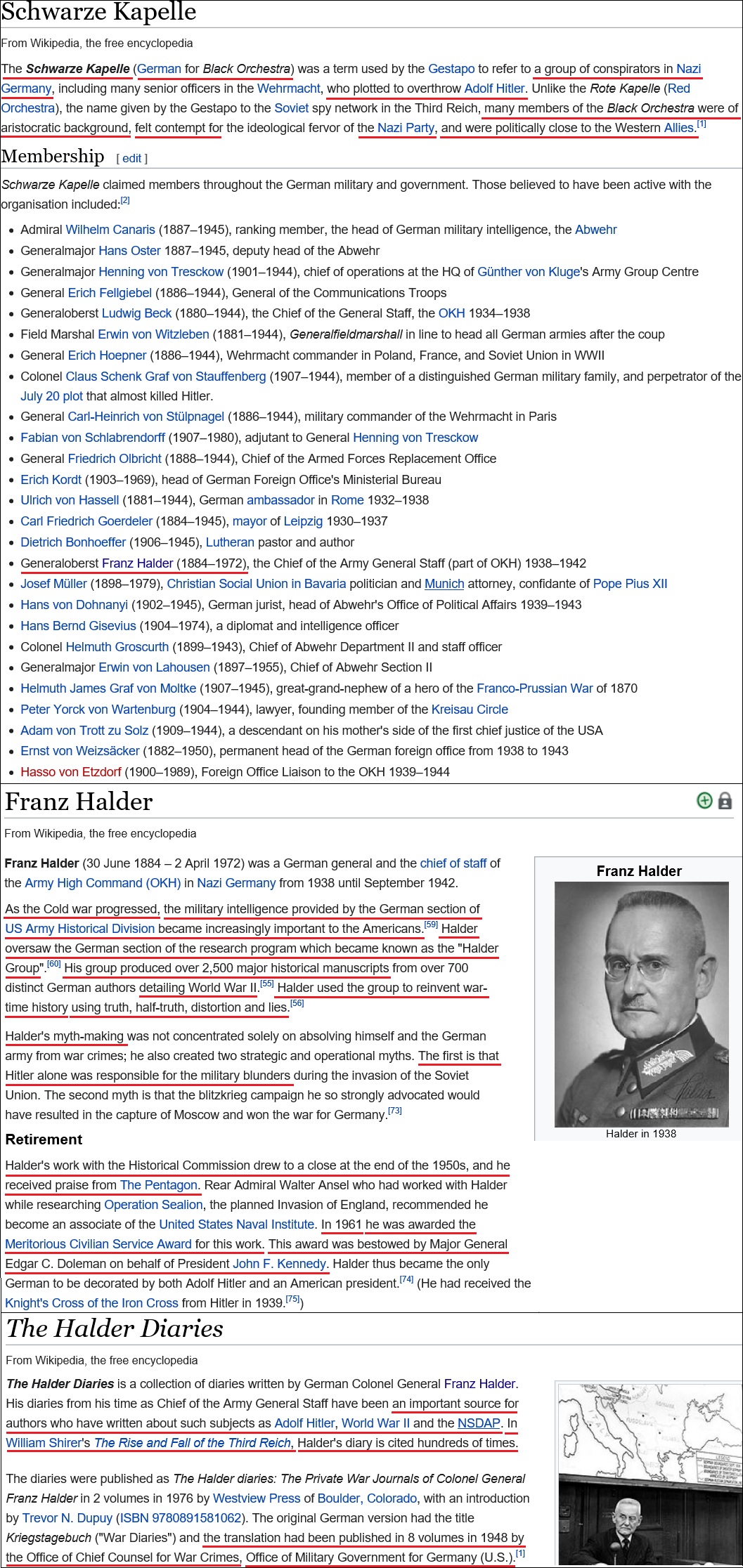
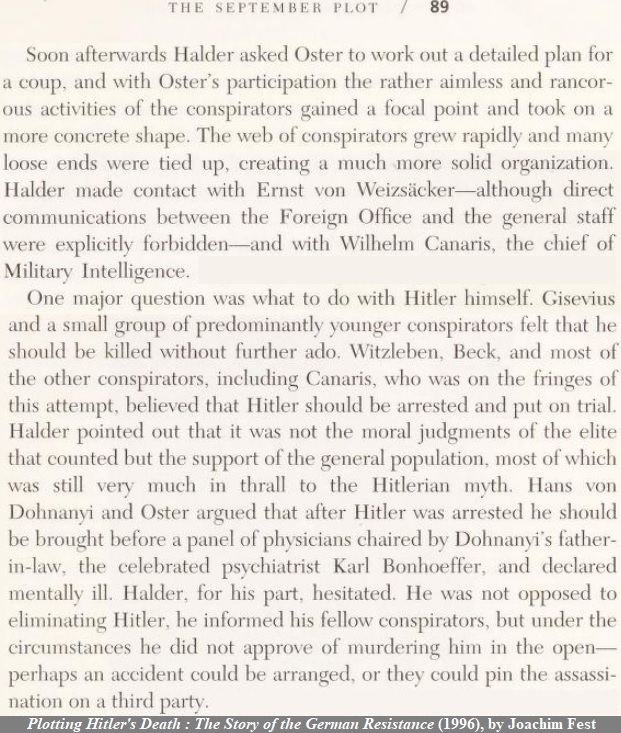
One has to know and keep in mind that many WW2 German officers were anti-Nazi & pro-Allied soldiers --- NOT the Nazi insiders finally "spilling the beans" portrayed by the victors' propaganda for deceptive purposes --- because National Socialist concepts like the Volksgemeinschaft (people's community) had never appealed to their aristocratic worldview and interests in the 1st place. A classless society was certainly not their biggest dream for obvious reasons.
One has to know and keep in mind that many WW2 German officers were anti-Nazi & pro-Allied soldiers --- NOT the Nazi insiders finally "spilling the beans" portrayed by the victors' propaganda for deceptive purposes --- because National Socialist concepts like the Volksgemeinschaft (people's community) had never appealed to their aristocratic worldview and interests in the 1st place. A classless society was certainly not their biggest dream for obvious reasons.
"Holocaust deniers are very slick people. They justify everything they say with facts and figures."