Wetzelrad wrote: ↑Tue Apr 14, 2026 9:11 am
Nessie wrote: ↑Thu Apr 02, 2026 6:47 am
Revisionist methodology is opinion driven, designed to reach a conclusion that all the witnesses lied, there were no gas chambers, and it cannot produce a history of events. Revisionists use their opinion to assess witnesses.
Probably this is a projection of what you do, but so what? When people take an interest in highly politicized tales of this sort, they do tend to credit or discredit the witnesses according to their political side. We see this in such contemporary examples as the Epstein story, and the ongoing Israeli attacks in the West Bank, and the accusations against Ben Roberts-Smith. People may also assess the witnesses' credibility separate from personal bias. Both occur all the time.
Your mistake is thinking Holocaust historians are somehow not opinion driven. All evidence shows the opposite.
Holocaust historians have gathered the evidence left behind by the Nazis to determine the narrative of what took place, from identification of Jews, their arrests, deportation to camps and ghettos and use as slave labourers and murder. That evidence has come from eyewitnesses, documents, physical items, imagery, archaeology, forensics and circumstances. Their opinion has had little to do with the narrative. It is an indisputable fact that Nazi ideology was anti-Semitic and they saw the Jews as enemies of the Reich. Opinions may vary as to how that affected the enforcement of Nazi policy and what individual intentions were, but the primary narrative of the mass removal of Jews from Nazi occupied territory is proven. It is also an indisputable fact that hundreds of thousands of Jews were transported to the AR camps. Opinions vary on how many hundreds of thousands, but the primary narrative of mass transports is proven.
Nessie wrote: ↑Thu Apr 02, 2026 6:47 am
The historian's methodology is evidence based and designed to produce a history of events and reach a proven conclusion. They assess witnesses using the studies of memory, recall and estimation and corroboration.
Totally ridiculous. In all the narrative-aligned Holocaust history books I've read and referenced, I haven't seen a single one make an assessment of that kind. I realize this is one of your favorite talking points, but where is it in the literature? Which historians have you seen cite a study about memory, estimation, or corroboration?
A history of the Holocaust is not going to include details about methodology, as that is a separate subject. I have seen revisionists quoting historians who have commented on the credibility of certain witnesses. Historians tend not to use certain witnesses, such as Elie Wiesel, due to credibility issues. Kurt Gerstein is another who is widely acknowledged by historians to have credibility issues. That is because their recollection of events is not considered to be that accurate, or reliable. They are not necessarily lying, but they cannot be trusted on the details.
Instead, I would say most of the historians were utterly irresponsible with their witness assessments. Hilberg for example repeatedly cited Hoss and Gerstein without so much as a caution about the known falsehoods they perpetrated or the fraudulent nature of their interrogations. He left out these uncomfortable details because he knew it would help to better persuade the reader toward his conclusion.
Hoess is another witness whom, you correctly identify, as presenting credibility issues. What you then fail to take into account, is that Hoess and Gerstein are corroborated. Their descriptions of mass murder in gas chambers, are backed up by evidence that is independent of them, from other witnesses and sources. A witness who is not credible or accurate, is not necessarily a witness who is lying. It just means they cannot be trusted on the accuracy of the details they describe.
If the historians actually had a witness assessment methodology, the most important aspects of it would be considerations of bias and credibility. For example, does a witness that is Jewish have an ethnic grievance against who he testifies against? Does a Pole? Does a communist have a political grievance? Does a convicted criminal? And what is the credibility of a person who errs or contradicts himself or others on major aspects of the crimes he attests to? These questions are almost universally ignored by historians (with a notable exception in the marginalized JC Pressac), which goes to show their histories are more opinion based than evidence based.
The most important aspects are;
1 - corroboration. Is what the witness claims supported by other evidence independent of them? For example, are Gerstein's descriptions of the use of gas chambers supported by other evidence? The answer is yes, he is supported by everyone else who worked at the camps he visited, documents recording mass arrivals and the circumstances around the operation of AR.
2 - credibility, accuracy and reliability. How accurate and reliable are the claims made by the witness? Have they made mistakes, such as Gerstein thinking a diesel engine was used for the gassings? How accurate are their estimations? The more accurate and reliable a witness is, and they less they contradict, the more credible they are.
3 - bias. Has the witness got a reason to lie? Why would Gerstein lie about gassings? What would his motive be and can that motive be proved?
Of those, corroboration is the most important, as it removes opinion from the assessment. When Gerstein is corroborated about gassings inside chambers, that is not an opinion. It is a fact derived from multiple sources of evidence.
Nessie wrote: ↑Tue Apr 14, 2026 7:30 am
Revisionist rejection of the evidence of gas chambers, revolves around their disbelief that German engineers could make gas chambers that functioned as witnesses recollected them, suggesting that means all the witnesses lied and there were no gas chambers.
[...]
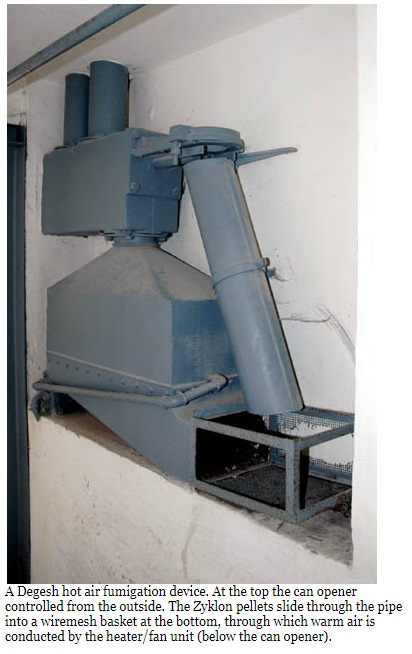
It is baffling that revisionists do not believe the witness descriptions, when they accept that of course German engineers could build gas chambers, to delouse clothing.
You don't understand revisionism at all. What is merely possible to be built is not nearly as relevant as what was built, but you are forced to argue in the realm of possibilities because what was actually built obviously falls short. The stark comparison to delousing chambers makes that deficiency all the more obvious.
Revisionists take witness claims about the gas chambers, over how many people fitted inside, what gas was used, how long the process took and the limited information we have about the ventilation and declare the gas chambers were a physical impossibility, the witnesses lied. They ignore the evidenced fact that the Nazis did build and operate numerous gas chambers for delousing clothing, so it stands to reason they could build one that could be used to kill people.
As for witness descriptions, if you yourself believed them then you would defend them directly instead of constantly reverting back to these nonsensical blanket statements.
I have just defenced Gerstein as a witness and explained that he is corroborated and that he is not reliable or credible on the details, as he made mistakes. I can do the same with any other witness you care to name.