Re: The Testimony and Statements of Konrad Morgan
Posted: Mon Mar 09, 2026 5:54 am
Where Myths Meet Their Demise
https://www.codohforum.com/
Stubble wrote: ↑Sun Mar 08, 2026 6:04 amI know.Wahrheitssucher wrote: ↑Sun Mar 08, 2026 5:48 amHere is Morgen’s very first answers to the very first questions put to him — so is his “initial” trial testimony.
This took place at Nürnberg on 7th Aug. 1946.
MORGEN: I investigated Weimar-Buchenwald, Lublin [Majdanek], Auschwitz, Sachsenhausen, Oranienburg, Hertogenbosch, Krakow; Plaszow, Warsaw, and the Concentration Camp Dachau. And others were investigated after my time.
HERR PELCKMANN: Did you have any opportunity of gaining personal insight into the conditions in concentration camps?
MORGEN: Yes, because I had authority to visit concentration camps. Only a very few persons had this permission. Before beginning an investigation, I examined the concentration camp in question in all its details very closely, inspecting especially those arrangements which seemed particularly important to me. I visited them repeatedly and without notice. I was working mostly in Buchenwald itself for 8 months and have lived there. I was in Dachau for one or two months.
HERR PELCKMANN: Since so many visitors to concentration camps say they were deceived, do you consider it possible that you, too, were a victim of such deceit?
MORGEN: I have just pointed out that I was not a mere visitor to a concentration camp but I had settled down there for a long residence, I might almost say I established myself there. It is almost impossible to be deceived for such a long time. In addition, the commissions from the Reich Criminal Police Department worked under my instructions, and I placed them directly in the concentration camps themselves. I do not mean to say that in spite of these very intensive efforts I was able to learn of all the crimes, but I believe that there was no deception in regard to what I did learn.
HERR PELCKMANN: Did you gain the impression — and at what time — that the concentration camps were places for the extermination of human beings?
MORGEN: I did not gain this impression. A concentration camp is not a place for the extermination of human beings.
I must say that my first visit to a concentration camp — I mentioned the first one was Weimar-Buchenwald — was a great surprise to me. The camp is situated on wooded heights, with a wonderful view. The installations were clean and freshly painted. There was much lawn and flowers. The prisoners were healthy, normally fed, sun-tanned, working...
PRESIDENT: When are you speaking of? When are you speaking of?
MORGEN: I am speaking of the beginning of my investigations in July 1943.
…MORGEN: The installations of the camp were in good order, especially the hospital. The camp authorities, under the Commander Diester, aimed at providing the prisoners with an existence worthy of human beings. They had regular mail service. They had a large camp library, even books in foreign languages. They had variety shows, motion pictures, sporting contests and even had a brothel.
Nearly all the other concentration camps were similar to Buchenwald.Bit of a non sequitur though.Spoiler
Stubble wrote: ↑Sat Mar 07, 2026 12:57 pm Bombsaway: asks for the testimony and statements of Konrad Morgen.
Also Bombsaway: I don't know the point of this...
Regarding my being a fanatic, please do excuse my being skeptical about some of the contents of his testimony. If you could kindly explain to me the process of cremating a body with no fuel developed by Wirth, that would be helpful. There is also the question of what gas he refers to, it doesn't seem to be engine exhaust. Another problem here is he describes a ventilation being done at the Bug River camps after gassing. Anybody else ever talk about venting the homicidal gas chambers at those camps? There's a lot of testimony, right, and witness statements? Anybody else? Anyone at all?
I'm also surprised he didn't go with steam chambers as that is what is in the expert report from the Polish Government in Exile the Americans submitted to The Tribunal...
The guy said what he was told to say or he repeated atrocity propaganda rumors, point blank. He did so to dodge the noose. He also, you know, mentions being tortured and beaten in John Toland's 'Adolf Hitler' c1976 p845.
You can not square this. He executed 2 separate men for unauthorized killings of a handful of inmates, and yet, turned a blind eye to the murder of millions? It doesn't make any sense.
RE: He never denied the existence of gas chambers...
There is also his testimony, I assume about Wirths, but, perhaps Mengele;Spoiler
HERR PELCKMANN: Since so many visitors to concentration camps say they were deceived, do you consider it possible that you, too, were a victim of such deceit?
MORGEN: I have just pointed out that I was not a mere visitor to a concentration camp but I had settled down there for a long residence, I might almost say I established myself there. It is almost impossible to be deceived for such a long time. In addition, the commissions from the Reich Criminal Police Department worked under my instructions, and I placed them directly in the concentration camps themselves. I do not mean to say that in spite of these very intensive efforts I was able to learn of all the crimes, but I believe that there was no deception in regard to what I did learn.
HERR PELCKMANN: Did you gain the impression, and at what time, that the concentration camps were places for the extermination of human beings?
MORGEN: I did not gain this impression. A concentration camp is not a place for the extermination of human beings. I must say that my first visit to a concentration camp-I mentioned the first one was Weimar-Buchenwald-was a great surprise to me. The
489
7 Aug. 46
camp is situated on wooded heights, with a wonderful view. The installations were clean and freshly painted. There was much lawn and flowers. The prisoners were healthy, normally fed, sun-tanned, working ...
PRESIDENT: When are you speaking of? When are you speaking of?
MORGEN: I am speaking of the beginning of my investigations in July 1943.
HERR PELCKMANN: What crimes did you discover?
MORGEN: Pardon me, I had not-may I continue?
HERR PELCKMANN: Please, be more brief.
MORGEN: The installations of the camp were in good order, especially the hospital. The camp authorities, under the Commander Diester, aimed at providing the prisoners with an existence worthy of human beings. They had regular mail service. They had a large camp library, even books in foreign languages. They had variety shows, motion pictures, sporting contests and even had a brothel. Nearly all the other concentration camps were similar to Buchenwald.
PRESIDENT: What was it they even had?
MORGEN: A brothel.
You can see that the preservation of life was important to the good doctor, not the extermination of it. How one squares this with his supposed observations of the homicidal gassings, I can not say, and yet, those on the other side of this issue do.Spoiler
HERR PELCKMANN: Did you speak to the doctor of the Concentration Camp Auschwitz?
MORGEN: Yes. When I arrived, the doctor showed me the mortality figures at the time he took over. He pointed out with a gleam in his eye how since his transfer to Auschwitz these huge figures had dropped precipitately through extensive hygienic measures and changes. In this connection he came to talk about Grabner. Grabner had expected him to kill pregnant Polish women. The doctor had refused since it was irreconcilable with his professional duties. Thereupon Grabner had reproached him for not realizing the importance of his, Grabner's, tasks. The doctor did not give in and a quarrel arose which was carried on before the commander, and neither Hoess nor Grawitz said anything. Thus the doctor, at the time when I met him by accident, was in a distressed frame of mind and said "What shall I do?" I said to him "What you have done so far, absolute refusal, is quite in order, and tomorrow I will arrest Grabner."
In July of '43, conditions in the camps were good (barring the odd calamity of epidemic here or there), internees were healthy, tanned and working. It wasn't until the collapse that living conditions became problematic.
Again, this is the issue.
Stubble wrote: ↑Sun Mar 08, 2026 4:17 amThis was the bone of contention.Wahrheitssucher wrote: ↑Sat Mar 07, 2026 4:10 am No he didn’t. Now you are blatantly lying. At his first appearance in court in Nuremburg he first denied any gassings. Then (curiously) on subsequent appearances he gave very little detail but narrated being aware of gassings at Auschwitz-Monowitz. Something that is not accepted as factual.
As you can see, he said stuff about 'Lublin', 'in the woods'. Didn't mention the Bug River though, so, maybe the 2,000,000 really did die at Majdanek, not the Bug River camps. Guys, we've been looking for the dead in the wrong spot all along, Korherr and Morgen and the Soviet all have the same number for Lublin, around Majdanek.Spoiler
We've solved Aktion Rhinehardt Murder Mills, and established that the Homicidal Gas Chambers were at Monowitz!
We've explained the lack of evidence for the holy h, people just didn't look at the primary sources!I know.Wahrheitssucher wrote: ↑Sun Mar 08, 2026 5:48 amHere is Morgen’s very first answers to the very first questions put to him — so is his “initial” trial testimony.
This took place at Nürnberg on 7th Aug. 1946.
MORGEN: I investigated Weimar-Buchenwald, Lublin [Majdanek], Auschwitz, Sachsenhausen, Oranienburg, Hertogenbosch, Krakow; Plaszow, Warsaw, and the Concentration Camp Dachau. And others were investigated after my time.
HERR PELCKMANN: Did you have any opportunity of gaining personal insight into the conditions in concentration camps?
MORGEN: Yes, because I had authority to visit concentration camps. Only a very few persons had this permission. Before beginning an investigation, I examined the concentration camp in question in all its details very closely, inspecting especially those arrangements which seemed particularly important to me. I visited them repeatedly and without notice. I was working mostly in Buchenwald itself for 8 months and have lived there. I was in Dachau for one or two months.
HERR PELCKMANN: Since so many visitors to concentration camps say they were deceived, do you consider it possible that you, too, were a victim of such deceit?
MORGEN: I have just pointed out that I was not a mere visitor to a concentration camp but I had settled down there for a long residence, I might almost say I established myself there. It is almost impossible to be deceived for such a long time. In addition, the commissions from the Reich Criminal Police Department worked under my instructions, and I placed them directly in the concentration camps themselves. I do not mean to say that in spite of these very intensive efforts I was able to learn of all the crimes, but I believe that there was no deception in regard to what I did learn.
HERR PELCKMANN: Did you gain the impression — and at what time — that the concentration camps were places for the extermination of human beings?
MORGEN: I did not gain this impression. A concentration camp is not a place for the extermination of human beings.
I must say that my first visit to a concentration camp — I mentioned the first one was Weimar-Buchenwald — was a great surprise to me. The camp is situated on wooded heights, with a wonderful view. The installations were clean and freshly painted. There was much lawn and flowers. The prisoners were healthy, normally fed, sun-tanned, working...
PRESIDENT: When are you speaking of? When are you speaking of?
MORGEN: I am speaking of the beginning of my investigations in July 1943.
…MORGEN: The installations of the camp were in good order, especially the hospital. The camp authorities, under the Commander Diester, aimed at providing the prisoners with an existence worthy of human beings. They had regular mail service. They had a large camp library, even books in foreign languages. They had variety shows, motion pictures, sporting contests and even had a brothel.
Nearly all the other concentration camps were similar to Buchenwald.Bit of a non sequitur though.Spoiler
Stubble wrote: ↑Sat Mar 07, 2026 12:57 pm Bombsaway: asks for the testimony and statements of Konrad Morgen.
Also Bombsaway: I don't know the point of this...
Regarding my being a fanatic, please do excuse my being skeptical about some of the contents of his testimony. If you could kindly explain to me the process of cremating a body with no fuel developed by Wirth, that would be helpful. There is also the question of what gas he refers to, it doesn't seem to be engine exhaust. Another problem here is he describes a ventilation being done at the Bug River camps after gassing. Anybody else ever talk about venting the homicidal gas chambers at those camps? There's a lot of testimony, right, and witness statements? Anybody else? Anyone at all?
I'm also surprised he didn't go with steam chambers as that is what is in the expert report from the Polish Government in Exile the Americans submitted to The Tribunal...
The guy said what he was told to say or he repeated atrocity propaganda rumors, point blank. He did so to dodge the noose. He also, you know, mentions being tortured and beaten in John Toland's 'Adolf Hitler' c1976 p845.
You can not square this. He executed 2 separate men for unauthorized killings of a handful of inmates, and yet, turned a blind eye to the murder of millions? It doesn't make any sense.
RE: He never denied the existence of gas chambers...
There is also his testimony, I assume about Wirths, but, perhaps Mengele;Spoiler
HERR PELCKMANN: Since so many visitors to concentration camps say they were deceived, do you consider it possible that you, too, were a victim of such deceit?
MORGEN: I have just pointed out that I was not a mere visitor to a concentration camp but I had settled down there for a long residence, I might almost say I established myself there. It is almost impossible to be deceived for such a long time. In addition, the commissions from the Reich Criminal Police Department worked under my instructions, and I placed them directly in the concentration camps themselves. I do not mean to say that in spite of these very intensive efforts I was able to learn of all the crimes, but I believe that there was no deception in regard to what I did learn.
HERR PELCKMANN: Did you gain the impression, and at what time, that the concentration camps were places for the extermination of human beings?
MORGEN: I did not gain this impression. A concentration camp is not a place for the extermination of human beings. I must say that my first visit to a concentration camp-I mentioned the first one was Weimar-Buchenwald-was a great surprise to me. The
489
7 Aug. 46
camp is situated on wooded heights, with a wonderful view. The installations were clean and freshly painted. There was much lawn and flowers. The prisoners were healthy, normally fed, sun-tanned, working ...
PRESIDENT: When are you speaking of? When are you speaking of?
MORGEN: I am speaking of the beginning of my investigations in July 1943.
HERR PELCKMANN: What crimes did you discover?
MORGEN: Pardon me, I had not-may I continue?
HERR PELCKMANN: Please, be more brief.
MORGEN: The installations of the camp were in good order, especially the hospital. The camp authorities, under the Commander Diester, aimed at providing the prisoners with an existence worthy of human beings. They had regular mail service. They had a large camp library, even books in foreign languages. They had variety shows, motion pictures, sporting contests and even had a brothel. Nearly all the other concentration camps were similar to Buchenwald.
PRESIDENT: What was it they even had?
MORGEN: A brothel.
You can see that the preservation of life was important to the good doctor, not the extermination of it. How one squares this with his supposed observations of the homicidal gassings, I can not say, and yet, those on the other side of this issue do.Spoiler
HERR PELCKMANN: Did you speak to the doctor of the Concentration Camp Auschwitz?
MORGEN: Yes. When I arrived, the doctor showed me the mortality figures at the time he took over. He pointed out with a gleam in his eye how since his transfer to Auschwitz these huge figures had dropped precipitately through extensive hygienic measures and changes. In this connection he came to talk about Grabner. Grabner had expected him to kill pregnant Polish women. The doctor had refused since it was irreconcilable with his professional duties. Thereupon Grabner had reproached him for not realizing the importance of his, Grabner's, tasks. The doctor did not give in and a quarrel arose which was carried on before the commander, and neither Hoess nor Grawitz said anything. Thus the doctor, at the time when I met him by accident, was in a distressed frame of mind and said "What shall I do?" I said to him "What you have done so far, absolute refusal, is quite in order, and tomorrow I will arrest Grabner."
In July of '43, conditions in the camps were good (barring the odd calamity of epidemic here or there), internees were healthy, tanned and working. It wasn't until the collapse that living conditions became problematic.
This is the issue;Perhaps if I repeat myself.Stubble wrote: ↑Sun Mar 08, 2026 4:17 amThis was the bone of contention.Wahrheitssucher wrote: ↑Sat Mar 07, 2026 4:10 am No he didn’t. Now you are blatantly lying. At his first appearance in court in Nuremburg he first denied any gassings. Then (curiously) on subsequent appearances he gave very little detail but narrated being aware of gassings at Auschwitz-Monowitz. Something that is not accepted as factual.
As you can see, he said stuff about 'Lublin', 'in the woods'. Didn't mention the Bug River though, so, maybe the 2,000,000 really did die at Majdanek, not the Bug River camps. Guys, we've been looking for the dead in the wrong spot all along, Korherr and Morgen and the Soviet all have the same number for Lublin, around Majdanek.Spoiler
We've solved Aktion Rhinehardt Murder Mills, and established that the Homicidal Gas Chambers were at Monowitz!
We've explained the lack of evidence for the holy h, people just didn't look at the primary sources!
Bro, just quote me !!!
I think I may be starting to see part of the problem here.Wahrheitssucher wrote: ↑Mon Mar 09, 2026 6:11 amBro, just quote me !!!
Just quote my actual wording where you think it was incorrect, then make crystal clear what you think was wrong.
And give a link to the post. (sheesh).
Yeah Wahrheitssucher , you can see I quote from the testimony above, putting the "denial" in bold, as well as the part where he says Jews were gassed. This is an uncensored, single days testimony. Do you see where you went wrong now?bombsaway wrote: ↑Mon Mar 09, 2026 6:02 amSpoiler
HERR PELCKMANN: Did you gain the impression, and at what time, that the concentration camps were places for the extermination of human beings?
MORGEN: I did not gain this impression. A concentration camp is not a place for the extermination of human beings. I must say that my first visit to a concentration camp-I mentioned the first one was Weimar-Buchenwald-was a great surprise to me. The
489
7 Aug. 46
camp is situated on wooded heights, with a wonderful view. The installations were clean and freshly painted. There was much lawn and flowers. The prisoners were healthy, normally fed, sun-tanned, working ...
PRESIDENT: When are you speaking of? When are you speaking of?
MORGEN: I am speaking of the beginning of my investigations in July 1943.
HERR PELCKMANN: What crimes did you discover?
MORGEN: Pardon me, I had not-may I continue?
HERR PELCKMANN: Please, be more brief.
MORGEN: The installations of the camp were in good order, especially the hospital. The camp authorities, under the Commander Diester, aimed at providing the prisoners with an existence worthy of human beings. They had regular mail service. They had a large camp library, even books in foreign languages. They had variety shows, motion pictures, sporting contests and even had a brothel. Nearly all the other concentration camps were similar to Buchenwald.
PRESIDENT: What was it they even had?
MORGEN: A brothel.
HERR PELCKMANN: What crimes did you learn about?
MORGEN: As I said before, the investigations were based on a suspicion of corrupt practices. In time however, I was obliged to come to the conclusion that besides those crimes, killings had also occurred.
HERR PELCKMANN: How did you reach the suspicion that killings had occurred?
MORGEN: I learned that the starting point for the corruption was the assignment of Jews to the camps after the action of 1938. I made it a point to learn all the possible facts about this action, and in doing so I found that the majority of the prisoners who were suspected of knowing something about these cases of corruption, had died. This peculiar frequency of killings was noticeable; it struck me because other prisoners who were not in any key positions remained in Buchenwald for years in the best of health, and were still there, so that it was rather remarkable that it was just certain prisoners who might have been possible witnesses who had died. I thereupon examined the files concerning these deceased prisoners. The files themselves offered no clues to suspect illegal killings. The dates of the deaths were years apart and in each case different causes of death were given. But it struck me that the majority of these deceased, prisoners had been put into the camp
490
7 Aug. 46
hospital or in arrest shortly before their death. This aroused my suspicion for the first time that in these two places murders of prisoners might possibly have occurred. Thereupon I appointed a special official, whose sole task was to investigate the suspicious circumstances, and follow up the rumors which were circulating about the detention quarters, the so-called "Bunker," regarding this killing of prisoners. This very zealous and able detective had to report again and again that he had not found the faintest clue for my suspicions. After two weeks of completely unsuccessful activity, the detective refused further services and asked me ironically whether I myself believed that such rumors of illegal killing of prisoners could be true. Much later, and only by chance did I hit upon the first clue; it struck me that the names of certain prisoners were listed at the same time in the rolls of the camp prison as well as in those of the hospital. In the prison rolls, for example, it said, "Date of release 9 May, 12 o'clock." In the hospital register, "Patient died 9 May, 9:15 a.m." I said to myself, this prisoner cannot be in the camp prison and at the same time a patient in the hospital. False entries must have been made here. I therefore concentrated my efforts on this and I succeeded in getting behind this system, for it was a system, under Commander Koch.
The prisoners were taken to a secret place and were killed there, mostly in a cell of the camp prison, and sick reports and death certificates were prepared for the files. They were made out so cleverly that any unprejudiced reader of the documents would get the impression that the prisoner concerned had actually been treated and had died of the seri6us illness which was indicated.
HERR PELCKMANN: Then what did you do after learning of these facts?
MORGEN: I found out that the medical officer at Buchenwald, SS Hauptsturmfuehrer Dr. Hoven, was principally responsible and I had him arrested. I informed my investigating commission in the concentration camps, with which we had to deal, of these cunning forgeries and directed their particular attention to investigating systematically whether in other concentration camps such murders had also taken place. We satisfied ourselves at the time of the investigation-and I am speaking of the second half of 1943-that in the Concentration Camps Buchenwald, Sachsenhausen, and Dachau to the best of our knowledge no such killings occurred. In the other concentration camps, however, such cases were found. The persons believed to be guilty were accused, arrested, and charged.
HERR PELCKMANN: Why was this not done earlier?
MORGEN: I have already said that these deceptive measures were so cunningly contrived that it was not possible to discover them earlier. Above all there was no possibility of clearing up the
491
7 Aug. 46
matter, and then those things-were always done without witnesses. These cases should at all events have been investigated by the SS courts and they were investigated, for every unnatural death of a prisoner had to be reported by teletype to the central offices. Besides that, the specially sworn-in court officer who was in the camp had to go immediately to the place of the occurrences to question the witnesses; sketches and photographs had to be made of the scene and it was a regulation that an autopsy had to take place in every such case of unnatural death. These reports of unnatural deaths, or of deaths suspected of being unnatural, were sent regularly to the SS and Police court; but as I have already said, these reports were so cunningly contrived and the files were in such good order, that even an expert could not have suspected an illegal killing. Of course, proceedings against members of the concentration camp personnel were frequently instituted, some followed by sentences, even death sentences. But these criminal acts seemed to be within range of the usual army rate of 0.5 percent to 3 percent.
If nothing at all had been reported to the SS courts from the concentration camps, or if numerous reports had been made, then it would of course have seemed suspicious. But it was a normal average and nobody could suspect that the concentration camps were a hotbed of such dangerous crimes. It was only through my investigation, which as I said was caused by accident, that we received our first insight into the true state of affairs.
HERR PELCKMANN: How did you come onto the track of mass killings? You have just spoken of individual killings.
MORGEN: I found traces of mass destructions also by chance. At the end of 1943, 1 discovered two trails at the same time, one leading to Lublin and the other to Auschwitz.
HERR PELCKMANN: Please describe the Lublin trail first.
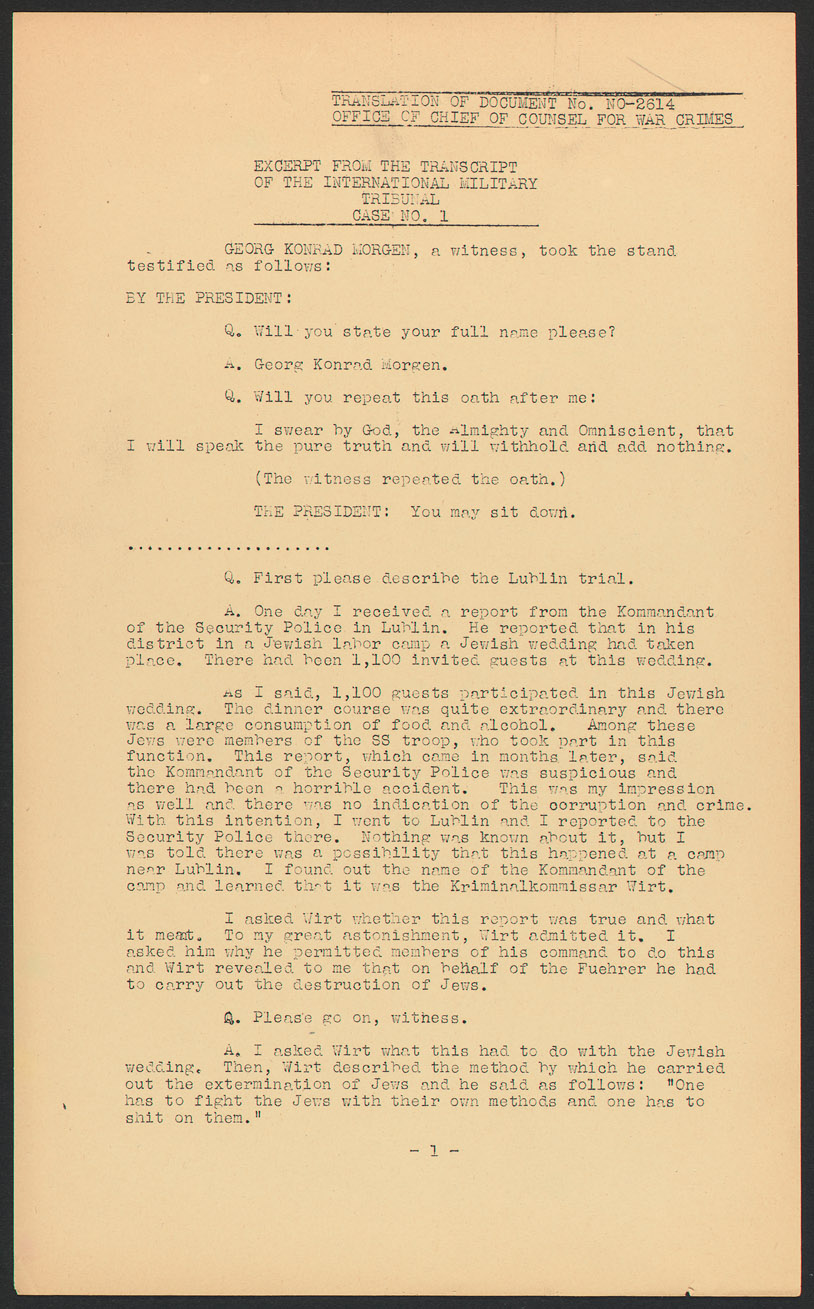
MORGEN: One day I received a report from the commander of the Security Police in Lublin. He reported that in a Jewish labor camp in his district a Jewish wedding had taken place. There had been 1,100 invited guests at this wedding
HERR PELCKMANN: Go on witness, a little faster.
MORGEN: As I said before, 1,100 guests participated in this Jewish wedding. What followed was described as quite extraordinary owing to the gluttonous consumption of food and alcoholic drinks. Among these Jews were members of the camp guard, that is to say some SS men, who joined in this revelry. This report only came into my hands in a roundabout way, some months later, due to the fact that the Commander of the Security Police suspected that the circumstances indicated that some criminal acts had occurred. This was my impression as well, and I thought that this
492
7 Aug. 46
report would give me a clue to another big case of criminal corruption. With this in mind, I went to Lublin and called at the Security/ Police there, but all they would tell me was that the events happened at a camp of the Deutsche Ausrustungswerke. But nothing was known there. I was told it might possibly be a rather odd and shrouded (this was the actual term used) camp in the vicinity of Lublin. I found out the camp and the commander, who was Kriminalkommissar Wirth.
I asked Wirth whether this report was true or what it meant. To my great astonishment, Wirth admitted it. I asked him why he permitted members of his command to do such things and Wirth then revealed to me that on the Fuehrer's orders he had to carry out the destruction of Jews.
HEIRR PELCKMANN: Please go on, Witness, to describe your investigations.
MORGEN: I asked Wirth what this had to do with the Jewish wedding. Then, Wirth described the method by which he carried out the extermination of Jews, and he said something like this: "One has to fight the Jews with their own weapons, that is to say "pardon me for using this expression-"one has to cheat them."
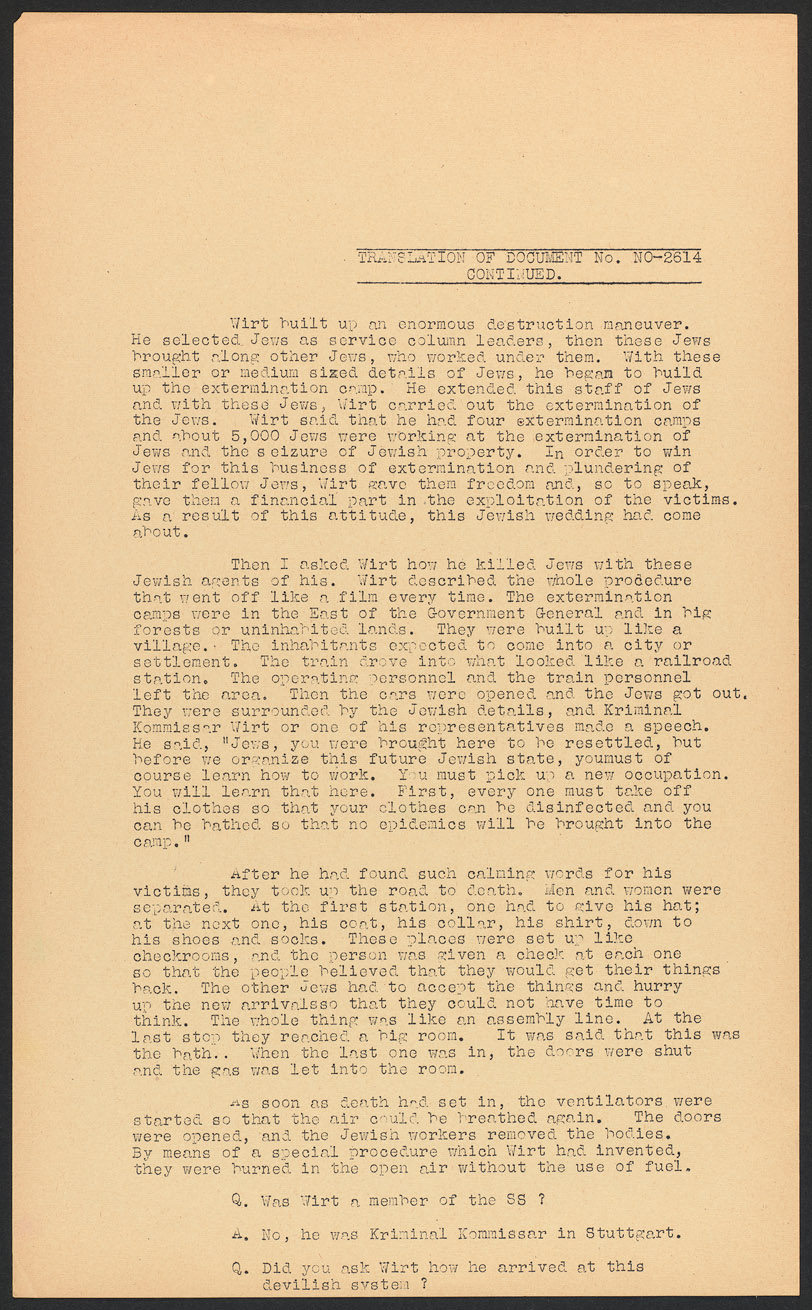
Wirth staged an enormous deceptive maneuver. He first selected Jews who would, he thought, serve as column leaders, then these Jews brought along other Jews, who worked under them. With that smaller or medium-sized detachment of Jews, he began to build up the extermination camps. He extended this staff of Jews, and with these Jews Wirth himself carried out the extermination of the Jews.
Wirth said that he had four extermination camps and that about 5,000 Jews were working at the extermination of Jews and the seizure of Jewish property. In order to win Jews for this business of extermination and plundering of their brethren of race and creed, Wirth gave them every freedom and, so to speak, gave them a financial interest in the spoliation of the dead victims. As a result of this attitude, this sumptuous Jewish wedding had come about.
Then I asked Wirth how he killed Jews with these Jewish agents of his. Wirth described the whole procedure that went off like a film every time. The extermination camps were in the east of the Government General, in big forests or uninhabited wastelands. They were built up like a Potemkin village. The people arriving there had the impression of entering a city or a township. The train drove into a dummy railroad station. After the escorts and the train personnel had left the area, the cars were opened and the Jews got out. They were surrounded by these Jewish labor detachments, and Kriminalkommissar Wirth or one of his representatives made a speech. He said, "Jews, you were brought here to be resettled, but
493
7 Aug. 46
before we organize this future Jewish State, you must of course learn how to work. You must learn a new trade. You will be taught that here. Our routine here is, first, every one must take off his clothes so that your clothing can be disinfected, and you can have a bath so that no epidemics will be brought into the camp."
After he had found such calming words for his victims, they started on the road to death. Men and women were separated. At the first place, one had to deliver the hat; at the next one, the coat, collar, shirt, down to the shoes and socks. These places were faked cloakrooms, and the person was given a check at each one so that the people believed that they would get their things back. The other Jews had to receive the things and hurry up the new arrivals so that they should not have time to think. The whole thing was like an assembly line. After the last stop they reached a big room, and were told that this was the bath. When the last one was in, the doors were shut and the gas was let into the room.
Holy moly!Stubble wrote: ↑Mon Mar 09, 2026 6:16 amI think I may be starting to see part of the problem here.Wahrheitssucher wrote: ↑Mon Mar 09, 2026 6:11 amBro, just quote me !!!
Just quote my actual wording where you think it was incorrect, then make crystal clear what you think was wrong.
And give a link to the post. (sheesh).
That red eye, it is called a 'spoiler'. Click it.


No, I don’t see that.

So… You were wrong. He did NOT only deny gassings at Buchenwald. INSTEAD he initially denied exterminations at ALL the concentration camps he had just stated he had extensively investigated!!!
^is this really so hard for you to understand?Stubble wrote: ↑Sun Mar 08, 2026 4:17 amThis was the bone of contention.Wahrheitssucher wrote: ↑Sat Mar 07, 2026 4:10 amNo he didn’t. Now you are blatantly lying. At his first appearance in court in Nuremburg he first denied any gassings. Then (curiously) on subsequent appearances he gave very little detail but narrated being aware of gassings at Auschwitz-Monowitz. Something that is not accepted as factual.
As you can see, he said stuff about 'Lublin', 'in the woods'. Didn't mention the Bug River though, so, maybe the 2,000,000 really did die at Majdanek, not the Bug River camps. Guys, we've been looking for the dead in the wrong spot all along, Korherr and Morgen and the Soviet all have the same number for Lublin, around Majdanek.Spoiler
We've solved Aktion Rhinehardt Murder Mills, and established that the Homicidal Gas Chambers were at Monowitz!
We've explained the lack of evidence for the holy h, people just didn't look at the primary sources!
At Auschwitz, the extermination camp was located some kilometers away from the actual concentration camp. The internal security of this extermination camp was likewise entrusted to Jewish supervisory units armed with cudgels. The external security outside the barbed wire was ensured by the Ukrainians and Baltic SS volunteers.
In the previously warmed room, the gas was very quickly disengaged and killed everybody in a few minutes.
Again, this is his affidavit from 13 July 1946. And his attempt to segregate the extermination camps is very calculated.The cooperation of the SS members, therefore, restricted itself to the commandant, the doctor, the motorists, the man who gassed the prisoners, and the guards. On the commandant, the doctor and the man who gassed the prisoners were generally Germans.
Wahrheitssucher wrote: ↑Sat Mar 07, 2026 4:10 amNo he didn’t. Now you are blatantly lying. At his first appearance in court in Nuremburg he first denied any gassings. Then (curiously) on subsequent appearances he gave very little detail but narrated being aware of gassings at Auschwitz-Monowitz. Something that is not accepted as factual.
I said: “…he FIRSTdenied any gassings”.
Alright.
Wellllll… actually …. I DID NOT call him a liar for pointing out “the Lublin statement exists…”
Apologies for my part in that.

That is in my view an over-simplification.
Why? That isn’t impossible. Merely menacing eye-contact or a discreet hand-sign from a known interrogator/torturer could easily do that.Archie wrote: ↑Mon Mar 09, 2026 2:26 pm This was part of the defense strategy. The idea was to excuse many of the SS at the concentration camps proper, which he described relatively favorably.
There was no about-face, and they could not very well have forced him to "change his tune" during the same Aug 7 session in any case.
I was not familiar with that.Archie wrote: ↑Mon Mar 09, 2026 2:26 pm Moreover, there is also an affidavit from Morgen (Doc number: SS-65) dated 13 Jul 1946 which predates his appearance in court (multiple, actually).
https://nuremberg.law.harvard.edu/docum ... igation?en
In the affidavit, he says
At Auschwitz, the extermination camp was located some kilometers away from the actual concentration camp. The internal security of this extermination camp was likewise entrusted to Jewish supervisory units armed with cudgels. The external security outside the barbed wire was ensured by the Ukrainians and Baltic SS volunteers.In the previously warmed room, the gas was very quickly disengaged and killed everybody in a few minutes.Again, this is his affidavit from 13 July 1946. And his attempt to segregate the extermination camps is very calculated.The cooperation of the SS members, therefore, restricted itself to the commandant, the doctor, the motorists, the man who gassed the prisoners, and the guards. On the commandant, the doctor and the man who gassed the prisoners were generally Germans.
Or he was very familiar and deliberately introduced nonsense that his interlocutors wouldn’t recognise BUT posterity would.Archie wrote: ↑Mon Mar 09, 2026 2:26 pm It is interesting that the affidavit does talk about the extermination camp being some distance from the concentration camp, but in court Morgen interpreted this to refer to Monowitz and added description of its industrial character. Perhaps he was not familiar with Birkenau and that was his confusion.
Archie wrote: ↑Mon Mar 09, 2026 2:26 pm In his 1964 Frankfurt testimony, Morgen claimed to have personally visited Birkenau.
https://www.auschwitz-prozess.de/zeugen ... en-Konrad/
You're less wrong. However accuracy is important and your last post has slight error.Wahrheitssucher wrote: ↑Tue Mar 10, 2026 10:22 amWahrheitssucher wrote: ↑Sat Mar 07, 2026 4:10 amNo he didn’t. Now you are blatantly lying. At his first appearance in court in Nuremburg he first denied any gassings. Then (curiously) on subsequent appearances he gave very little detail but narrated being aware of gassings at Auschwitz-Monowitz. Something that is not accepted as factual.I said: “…he FIRSTdenied any gassings”.
Alright.
Thanks for the exact quote.
Yes! You are right.
That was incorrect to say “on subsequent appearances”.
And incorrect to omit him discussing gassings at Lublin (Majdanek) in that first appearance at Nürnberg.
Thanks for pointing out the error so clearly.
I was wrong and stand corrected.
But …I have already replied to this. I explained what I meant, to you, here:
viewtopic.php?p=22943#p22943
Didn’t you read that?
Whatever,…
to continue with your correction…
You then wrote!Wellllll… actually …. I DID NOT call him a liar for pointing out “the Lublin statement exists…”
I never contested it exists. I only incorrectly remembered that it came on subsequent appearances (I remembered incorrectly that it was after an adjournment — I incorrectly thought it was same day, but not same appearance.
What you just wrote is clearly NOT Bombsaway’s wording!
So you have slightly distorted what he said AND therefore what exactly I contested.
Which is why going back to exact quotes can clear up misunderstandings.
(plus I’ve already replied to that here: viewtopic.php?p=22949#p22949 )
But thankyou for persevering and identifying so clearly to me what my actual error is/was.
Appreciate it.
Day 1 he referred to the Reinhardt campsStubble wrote: ↑Tue Mar 10, 2026 2:05 pm
You're lass wrong. However accuracy is important and your last post has slight error.
Day 1 Morgen said that concentration camps were not for the destruction of human beings. He then said people were gassed at Auschwitz-Monowitz.
Day 2 he described gassings 'in Lublin' in the woods.
Bombsaway can be referred to as incorrect when he says 'Aktion Rhinehardt Camps', but that is an extreme technicality. Morgen was likely referring to the bug river camps.
Hopefully this is finally crystal clear.
it's obvious Wahrheit is very wrong and had a total meltdown which I would attribute to his fanaticism. Your bias (and fanaticism) shines through when you label this a slight mistake.No he didn’t. Now you are blatantly lying. At his first appearance in court in Nuremburg he first denied any gassings.bombsaway wrote: ↑Fri Mar 06, 2026 4:38 pm
Morgen gave extensive information on gassings at the Reinhardt camps.
Page 492, day one. Apologies. You are correct.bombsaway wrote: ↑Tue Mar 10, 2026 4:20 pmDay 1 he referred to the Reinhardt campsStubble wrote: ↑Tue Mar 10, 2026 2:05 pm
You're lass wrong. However accuracy is important and your last post has slight error.
Day 1 Morgen said that concentration camps were not for the destruction of human beings. He then said people were gassed at Auschwitz-Monowitz.
Day 2 he described gassings 'in Lublin' in the woods.
Bombsaway can be referred to as incorrect when he says 'Aktion Rhinehardt Camps', but that is an extreme technicality. Morgen was likely referring to the bug river camps.
Hopefully this is finally crystal clear.
"The extermination camps were in the east of the Government General, in big forests or uninhabited wastelands. They were built up like a Potemkin village. The people arriving there had the impression of entering a city or a township."
"Wirth's camps"
Initial exchange with Wahrheitssucher here viewtopic.php?p=22834#p22834
it's obvious Wahrheit is very wrong and had a total meltdown which I would attribute to his fanaticism. Your bias (and fanaticism) shines through when you label this a slight mistake.No he didn’t. Now you are blatantly lying. At his first appearance in court in Nuremburg he first denied any gassings.bombsaway wrote: ↑Fri Mar 06, 2026 4:38 pm
Morgen gave extensive information on gassings at the Reinhardt camps.