What actually happened at the Hadamar Institute?
Posted: Wed Apr 01, 2026 10:56 pm
From another thread:
The film in question can be viewed here (timestamp 14:06):
https://en.wikipedia.org/wiki/Nazi_Conc ... mps_(film)
Another film, sharing some of the same footage but with different narration, is labelled a "Universal Studios Newsreel", and it can be viewed here (timestamp 01:02):
https://archive.org/details/1945-04-26_ ... rder_Mills
Yet another film from the same material is Death Mills, but it is not worth watching over the others (timestamp 10:43):
https://en.wikipedia.org/wiki/Death_Mills
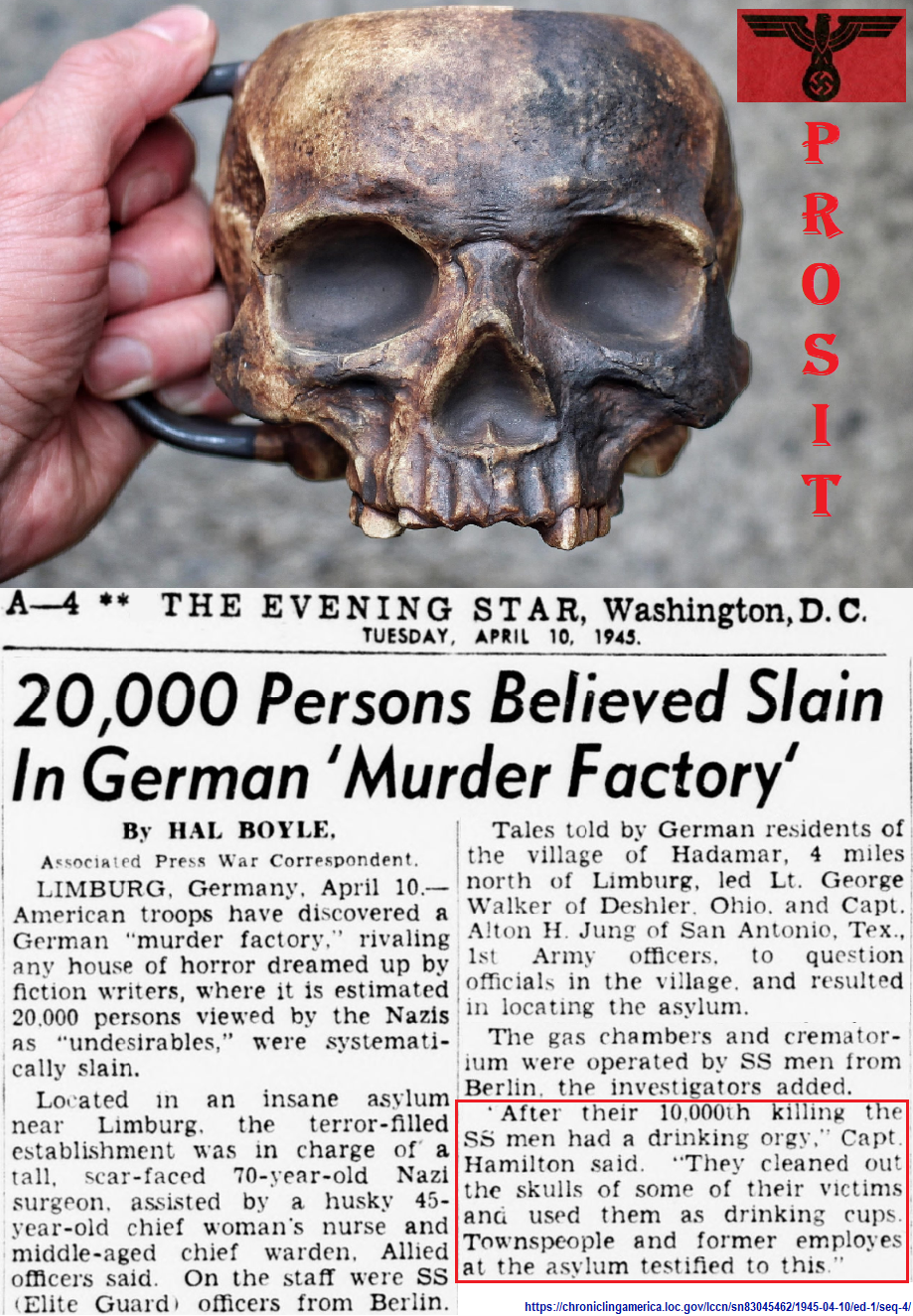
I should also add that there are some newspaper stories about Hadamar from this era. One written by Andy Rooney is covered in this revisionist film (timestamp 06:21). According to Rooney, the Nazis held a celebration for their 10,000th gassing victim where they "actually drank wine from the preserved skulls of some of their victims". This gives us a sense of the extremes American propaganda went to at this time.
Gallius's questions make sense. I would add a question 4 to ask how the narrator knew "20,000 [bodies] are buried here"? In fact the claim of 35,000 murdered can only be a crude exaggeration, at best, as today Wikipedia claims a total of around 15,000. The number of victims gassed at 15,000 is also an exaggeration compared to the present claim of only 10,072.
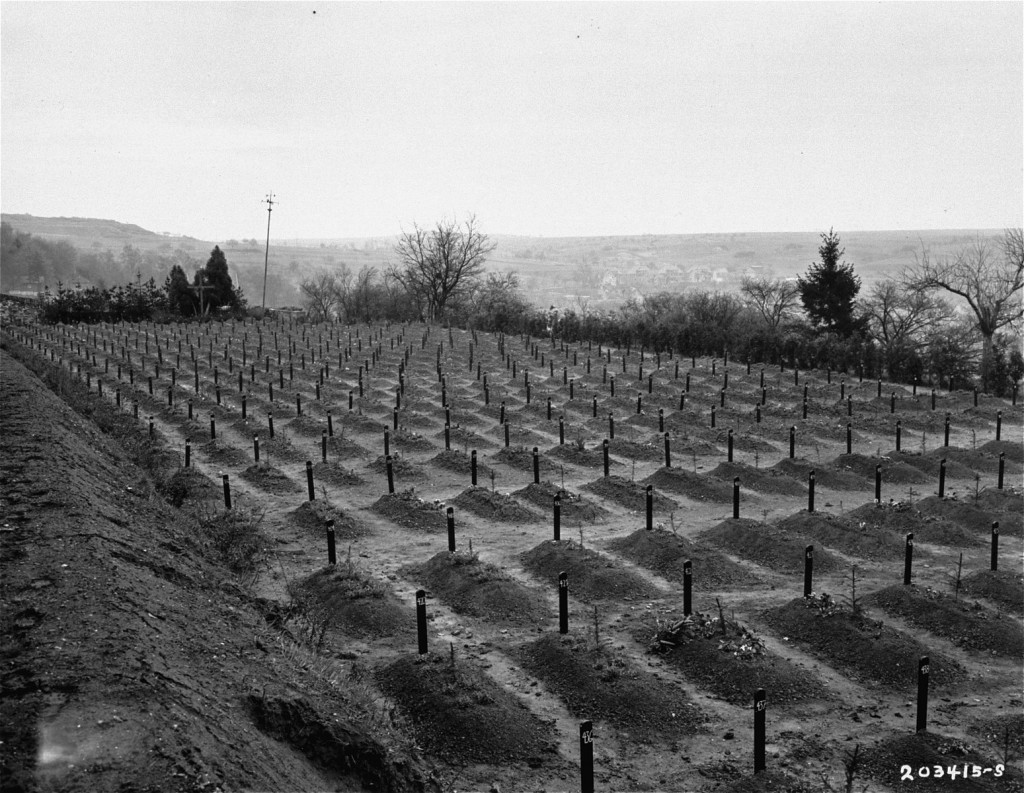
The footage we are shown shows a cemetery of single graves being dug up, situated in a grid of perhaps 17 x 25. Also photographed here. That makes 425 buried, well short of 5,000 or 20,000.
The Hadamar website tells us how many bodies were actually exhumed for examination: "several".
The US Army film claimed that autopsies were performed, but the Hadamar website tells us these bodies were merely "examined by forensic experts". The Universal film claimed, "Autopsies showed overdoses of morphine and quick-acting poisons in many cases." Nothing shown in the film evinces this information. Did they take samples or perform tests? Did they observe symptoms? We aren't told or shown. Perhaps we know morphine was used not from autopsies but rather from confessions, but then we aren't allowed to hear a single word spoken from the confession footage. (The narrator in Death Mills, over this same footage of Hadamar, claimed that the Allies had performed "thousands of autopsies" across Europe which proved "slow suffocation" and "poison injections", but this is contradicted by Dr. Charles Larson who in fact proved the contrary.)
The general structure of the narrative for Hadamar is that gassing (with carbon monoxide) was used in 1941 until as late as August, but after that only lethal injection (with a common medicine like morphine) was used. Wikipedia describes this as a first and second phase. What's remarkable about this is that it suggests gas chambers were not needed and could simply be replaced by lethal injection. Why then would the Germans build any gas chambers after August 1941?
The Army narrator claimed that, "As many as 17 at a time died from the morphine injections." I would guess this is meant to indicate the scale of the killing. Moments later he gives different numbers, saying that, "All were hustled off to the graveyard and buried in piles of 20 to 24." This is probably false since no mass graves were shown. That aside, these numbers suggest a scale of 17 to 24 deaths at a time, considerably less than later claims of "102 to 173 patients" killed daily (quoted in Mattogno's Inside the Gas Chambers, p.50). If the Army narrator had heard that over a hundred people were being killed daily, he would have said that in lieu of these stories of lesser scale.
The Universal narrator claimed that the Hadamar Institute's victims were "Poles, Greeks, Russians, any non-Germans". The Army narrator similarly claimed the 35,000 dead were "Poles, Russians, and Germans". Contradicting this, Wikipedia claims its victims were predominantly German, with only 476 (~3%) being Poles or Russians.
The Army narrator claimed these victims were "sent here [to be killed] mainly for political and religious considerations." I see nothing to justify this statement. Contradicting this, Wikipedia tells us the victims were "those with physical and mental disabilities". The Poles and Russians had tuberculosis. Which religion is tuberculosis?
Overall, these sources demonstrate a climate in which lying with reckless abandon was totally permissible. I'm not confident that the subsequent Hadamar trial and other proceedings would be any more honest. Still today, Wikipedia does not make any attempt to inform the viewer that the US Army film was made for propaganda and loaded with falsities. Instead it's presented as a real documentary film.
Moving on, Gallius asked about the gas chamber. Perhaps the reason it isn't shown in the footage is that there was nothing to see. The fixtures which would have identified it as a gas chamber were supposedly removed in 1941. By 1945 it was a simple tiled room with a floordrain. Numerous photographs and videos can be found online.
An amateur historian made a few videos on-site. This one gives a decent look approaching from the east side:
https://youtu.be/tqV8Awm6fxo?t=1061
The deathcamps website, known for being more oriented toward physical evidence, also has two short pages with photos and additional info, though it lacks citations:
http://www.deathcamps.org/gas_chambers/ ... damar.html
http://www.deathcamps.org/euthanasia/hadamar.html
Let's consider this photograph of the southwest corner of the supposed gas chamber:
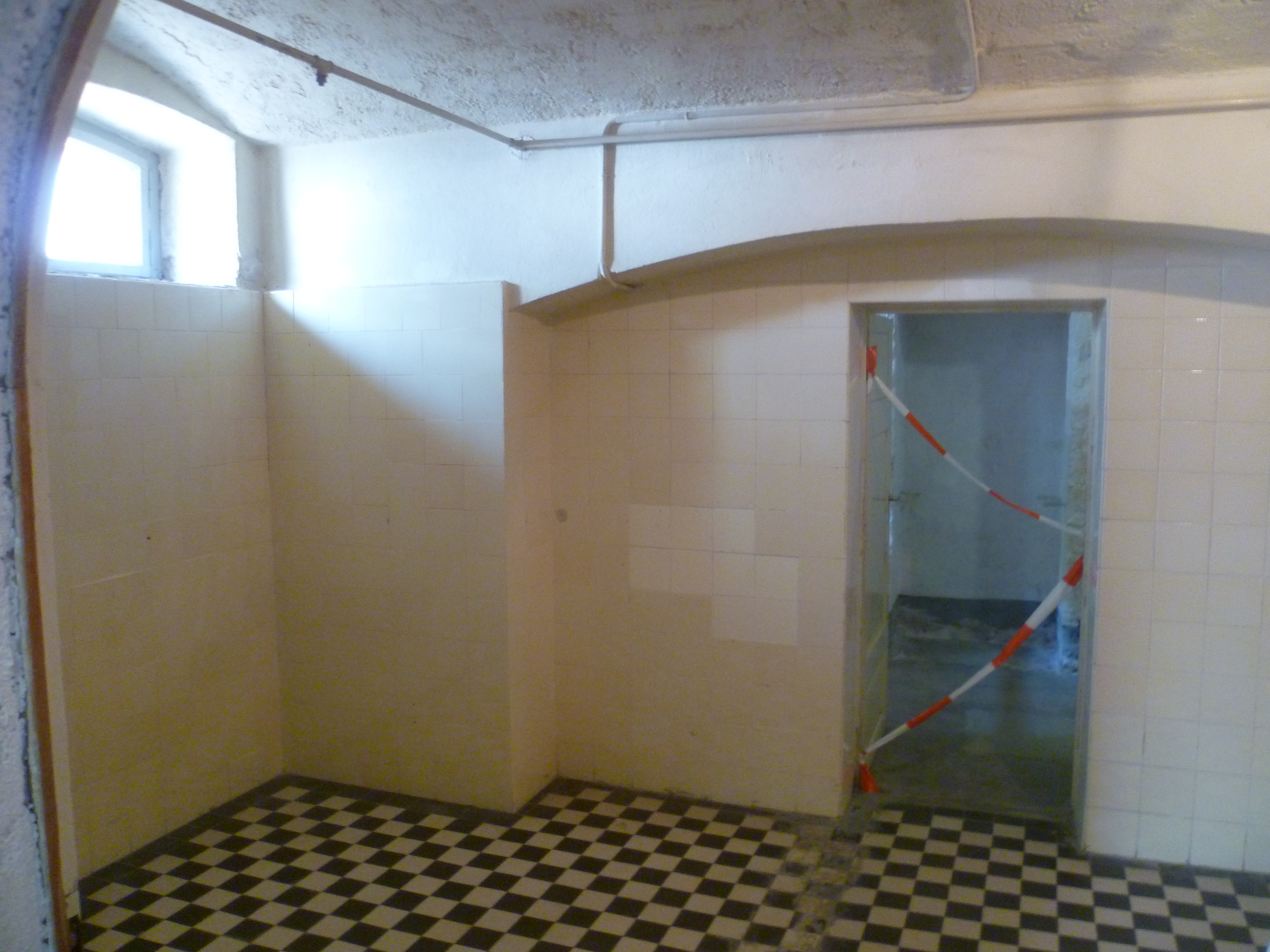
I can't see anything that would identify this as a gas chamber as opposed to a morgue, a shower, or a medical room of any kind. This corner of the room should have a pipe or hole for gas to be piped into the room, but nothing like that is visible. It should also have a pipe or hole near the ceiling for the "ventilation device" (ItGC p.52), but it can't be seen. Possibly the big ducts on the opposite side of the room are supposed to be that ventilation pipe, in which case it wasn't removed. The doorway is supposed to have a peephole next to it, but no photos of the peephole exist. It is completely invisible inside the room because it doesn't even go through the wall. More likely there was something mundane there like a lightswitch. The window would be accessible if one patient got on the shoulders of another. I can't see where the fake shower fixtures are supposed to have been. You would expect those to leave marks behind in the ceiling, if nothing else. Another matter is the doors, which I am not able to analyze.
Possibly there is more convincing evidence for all of the above, but I would have to see someone actually attempt to present it.
Mattogno has also raised some questions about the cremation ovens (ItGC pp.39, 49-51). There is so little known about them that even the manufacturer is not known. We're supposed to believe that this is because the Nazis covered up their crimes, but then they did us the favor of leaving us their "death books", and supposedly it is those documents that prove the number killed. If so, why didn't they burn the books? According to the Army narrator, they were "found hidden in the wine cellar of the Hadamar Institution", i.e. the same basement where all these rooms were.
I remain skeptical.
I can't find any revisionist work that deals with Hadamar really substantially, and I'm approaching this as an amateur, but here are my general observations.Gallius wrote: ↑Thu Mar 26, 2026 4:29 pm I invite edification, this time regarding quirks in Nazi Concentration Camps, the 1945 film by George Stevens.
[...]
Earlier in the film (~14:00 minutes in) we are shown the Hadaman Concentration Camp where viewers are told. “Under the guise of an insane asylum, this has been the headquarters for the systematic murder of 35,000 Poles, Germans and Russians…”
Okay, maybe. Go on.
“Meanwhile at the graveyard attached to the [Hadaman mental] institution, bodies are exhumed for autopsy. Twenty thousand are buried here. Fifteen thousand who died in a lethal gas chamber, were cremated and their ashed interred.”
STOP. Back up. Questions:
1. How did they know the ashes they recovered were the remains of 15,000 (fifteen thousand) people? Counting teeth, death reports, or by what means is this number corroborated?
2. How did they know those alleged 15,000 bodies had been killed by lethal gassing?
3. Where or where did all the autopsy reports go?
Clearly, this film does not suffice to resolve these sorts of questions. They do not even bother to show the gas chamber alleged at this site. Just more dead bodies. Many more dead bodies. Were gas chambers in the raw footage and edited out? Why or why not? What gives? Show the murder weapon.
Again, I welcome and expect edification because there must be ready answers to such simple questions.
The film in question can be viewed here (timestamp 14:06):
https://en.wikipedia.org/wiki/Nazi_Conc ... mps_(film)
Another film, sharing some of the same footage but with different narration, is labelled a "Universal Studios Newsreel", and it can be viewed here (timestamp 01:02):
https://archive.org/details/1945-04-26_ ... rder_Mills
Yet another film from the same material is Death Mills, but it is not worth watching over the others (timestamp 10:43):
https://en.wikipedia.org/wiki/Death_Mills
I should also add that there are some newspaper stories about Hadamar from this era. One written by Andy Rooney is covered in this revisionist film (timestamp 06:21). According to Rooney, the Nazis held a celebration for their 10,000th gassing victim where they "actually drank wine from the preserved skulls of some of their victims". This gives us a sense of the extremes American propaganda went to at this time.
Gallius's questions make sense. I would add a question 4 to ask how the narrator knew "20,000 [bodies] are buried here"? In fact the claim of 35,000 murdered can only be a crude exaggeration, at best, as today Wikipedia claims a total of around 15,000. The number of victims gassed at 15,000 is also an exaggeration compared to the present claim of only 10,072.
The footage we are shown shows a cemetery of single graves being dug up, situated in a grid of perhaps 17 x 25. Also photographed here. That makes 425 buried, well short of 5,000 or 20,000.
The Hadamar website tells us how many bodies were actually exhumed for examination: "several".
The US Army film claimed that autopsies were performed, but the Hadamar website tells us these bodies were merely "examined by forensic experts". The Universal film claimed, "Autopsies showed overdoses of morphine and quick-acting poisons in many cases." Nothing shown in the film evinces this information. Did they take samples or perform tests? Did they observe symptoms? We aren't told or shown. Perhaps we know morphine was used not from autopsies but rather from confessions, but then we aren't allowed to hear a single word spoken from the confession footage. (The narrator in Death Mills, over this same footage of Hadamar, claimed that the Allies had performed "thousands of autopsies" across Europe which proved "slow suffocation" and "poison injections", but this is contradicted by Dr. Charles Larson who in fact proved the contrary.)
The general structure of the narrative for Hadamar is that gassing (with carbon monoxide) was used in 1941 until as late as August, but after that only lethal injection (with a common medicine like morphine) was used. Wikipedia describes this as a first and second phase. What's remarkable about this is that it suggests gas chambers were not needed and could simply be replaced by lethal injection. Why then would the Germans build any gas chambers after August 1941?
The Army narrator claimed that, "As many as 17 at a time died from the morphine injections." I would guess this is meant to indicate the scale of the killing. Moments later he gives different numbers, saying that, "All were hustled off to the graveyard and buried in piles of 20 to 24." This is probably false since no mass graves were shown. That aside, these numbers suggest a scale of 17 to 24 deaths at a time, considerably less than later claims of "102 to 173 patients" killed daily (quoted in Mattogno's Inside the Gas Chambers, p.50). If the Army narrator had heard that over a hundred people were being killed daily, he would have said that in lieu of these stories of lesser scale.
The Universal narrator claimed that the Hadamar Institute's victims were "Poles, Greeks, Russians, any non-Germans". The Army narrator similarly claimed the 35,000 dead were "Poles, Russians, and Germans". Contradicting this, Wikipedia claims its victims were predominantly German, with only 476 (~3%) being Poles or Russians.
The Army narrator claimed these victims were "sent here [to be killed] mainly for political and religious considerations." I see nothing to justify this statement. Contradicting this, Wikipedia tells us the victims were "those with physical and mental disabilities". The Poles and Russians had tuberculosis. Which religion is tuberculosis?
Overall, these sources demonstrate a climate in which lying with reckless abandon was totally permissible. I'm not confident that the subsequent Hadamar trial and other proceedings would be any more honest. Still today, Wikipedia does not make any attempt to inform the viewer that the US Army film was made for propaganda and loaded with falsities. Instead it's presented as a real documentary film.
Moving on, Gallius asked about the gas chamber. Perhaps the reason it isn't shown in the footage is that there was nothing to see. The fixtures which would have identified it as a gas chamber were supposedly removed in 1941. By 1945 it was a simple tiled room with a floordrain. Numerous photographs and videos can be found online.
An amateur historian made a few videos on-site. This one gives a decent look approaching from the east side:
https://youtu.be/tqV8Awm6fxo?t=1061
The deathcamps website, known for being more oriented toward physical evidence, also has two short pages with photos and additional info, though it lacks citations:
http://www.deathcamps.org/gas_chambers/ ... damar.html
http://www.deathcamps.org/euthanasia/hadamar.html
Let's consider this photograph of the southwest corner of the supposed gas chamber:
I can't see anything that would identify this as a gas chamber as opposed to a morgue, a shower, or a medical room of any kind. This corner of the room should have a pipe or hole for gas to be piped into the room, but nothing like that is visible. It should also have a pipe or hole near the ceiling for the "ventilation device" (ItGC p.52), but it can't be seen. Possibly the big ducts on the opposite side of the room are supposed to be that ventilation pipe, in which case it wasn't removed. The doorway is supposed to have a peephole next to it, but no photos of the peephole exist. It is completely invisible inside the room because it doesn't even go through the wall. More likely there was something mundane there like a lightswitch. The window would be accessible if one patient got on the shoulders of another. I can't see where the fake shower fixtures are supposed to have been. You would expect those to leave marks behind in the ceiling, if nothing else. Another matter is the doors, which I am not able to analyze.
Possibly there is more convincing evidence for all of the above, but I would have to see someone actually attempt to present it.
Mattogno has also raised some questions about the cremation ovens (ItGC pp.39, 49-51). There is so little known about them that even the manufacturer is not known. We're supposed to believe that this is because the Nazis covered up their crimes, but then they did us the favor of leaving us their "death books", and supposedly it is those documents that prove the number killed. If so, why didn't they burn the books? According to the Army narrator, they were "found hidden in the wine cellar of the Hadamar Institution", i.e. the same basement where all these rooms were.
I remain skeptical.