Page 1 of 2
AI usecase - image generation
Posted: Fri May 29, 2026 11:42 am
by HansHill
Unsure if this topic has been initiated before, apologies if it has.
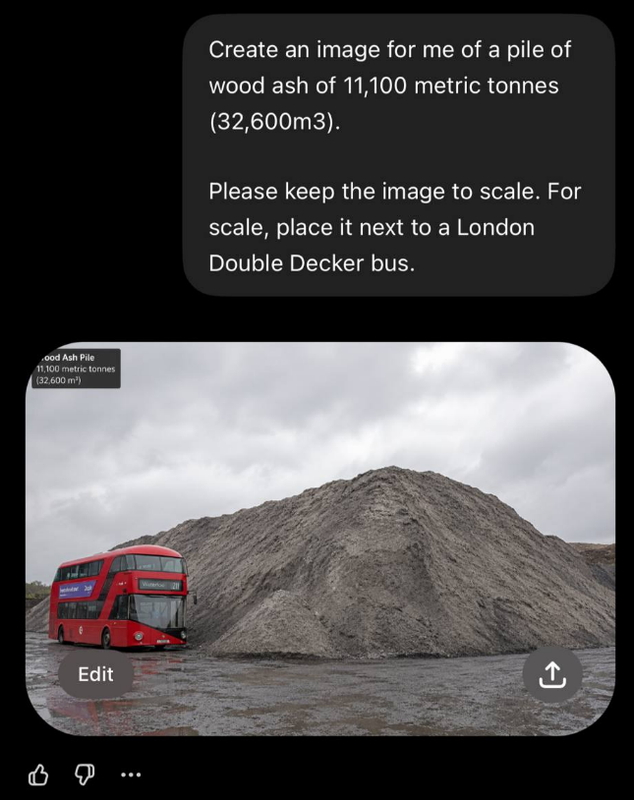
I have been experimenting with the usecase for AI image generation for Holocaust Revisionist purposes, this is a good example. Interested to see where this could be taken, and the possible implications for this approach used at scale!
This is a render of the alleged wood ash expected at Treblinka given certain assumptions - inputs taken from Mattogno. I think the image speaks for itself
Re: AI usecase - image generation
Posted: Fri May 29, 2026 12:37 pm
by Archie
When we were debating the Kula columns with bombsaway and he was trying to explain his Rube Goldberg theories, it got me wondering whether we could simulate some of this stuff visually with AI tools. A lot of times with these debates, I think a lot of us can "see" the issues in our heads, but when explaining it to others in language everything is not always as clear as it should be.
viewtopic.php?t=774
In Denierbud's videos, one of his main techniques was simply to portray the story visually. This is very effective. But it's also hard to do and labor intensive. As this gets easier and easier, we should be able to take better advantage of visuals.
Re: AI usecase - image generation
Posted: Fri May 29, 2026 4:26 pm
by pilgrimofdark
Colorizing old b&w photos helps expose details that can be difficult to discern otherwise.
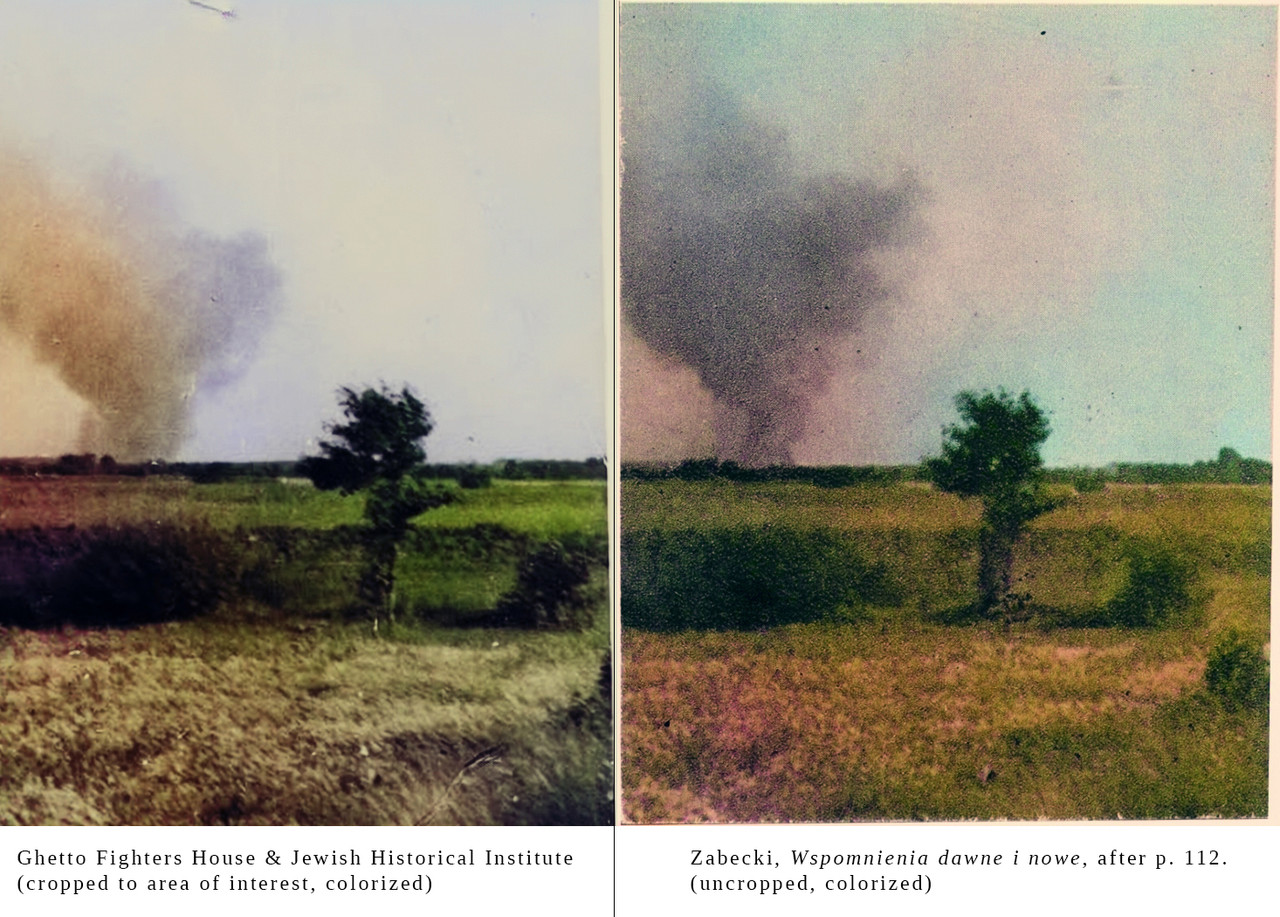
"Treblinka" "revolt" photo taken by Zygmunt Wierzbowski (a random person no one knows anything about)
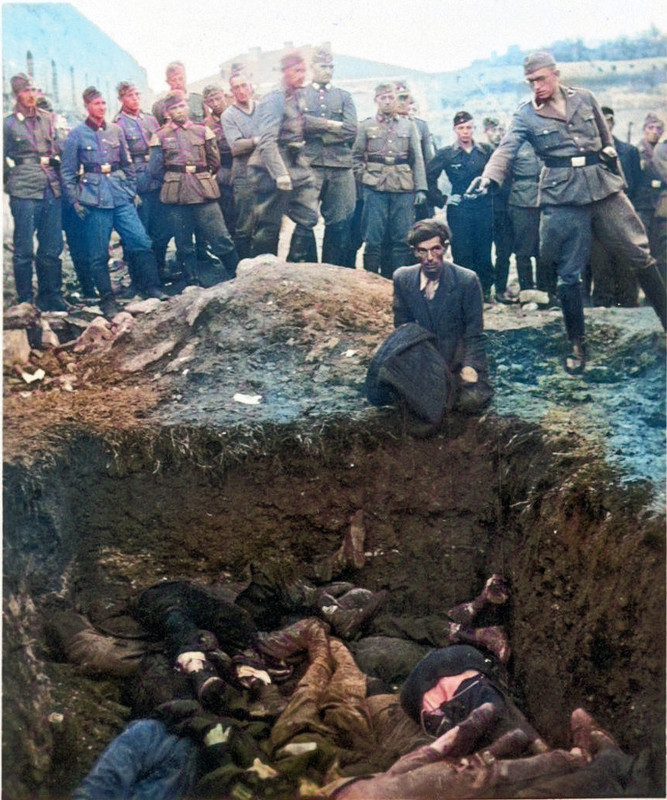
"Last" Jew of "Vinnitsa" (actually Berdychiv)
Archie wrote: ↑Fri May 29, 2026 12:37 pm
In Denierbud's videos, one of his main techniques was simply to portray the story visually. This is very effective. But it's also hard to do and labor intensive. As this gets easier and easier, we should be able to take better advantage of visuals.
Rachel Auerbach wrote a "screenplay outline" of the Treblinka Revolt, as well as a radio play that could be turned into a series of photos/videos. I haven't played around with AI image generation for story boarding a project like that.
Portraying literal interpretations of eyewitness accounts could expose the schlock inherent in some of them. Attempting to connect them all together would also highlight the contradictions.
- Himmler's visit to a single camp, reported in every single month for seven straight months
- wild beatings and shouting, followed by calming speeches for which Jews applaud, followed by wild beatings, followed by orderly handing over of currency in exchange for a receipt, followed by merciless beatings and shouting, followed by a calming speech, followed by shouting and beatings
- a band drowning out the sound of wild beatings and shoutings, screaming bathhouse victims, the relentless sound of excavators digging up the ground, and giant burning mounds of corpses
With how much nudity is in them, though, I'm not sure where they could be posted. And nudity is such a consistent theme in eyewitness testimony that it couldn't be entirely excluded.
Probably why most death camp hagiographies only quote a sentence or two at a time from each witness.
Re: AI usecase - image generation
Posted: Fri May 29, 2026 5:22 pm
by Wetzelrad
HansHill wrote: ↑Fri May 29, 2026 11:42 am
This is a render of the alleged wood ash expected at Treblinka given certain assumptions - inputs taken from Mattogno. I think the image speaks for itself
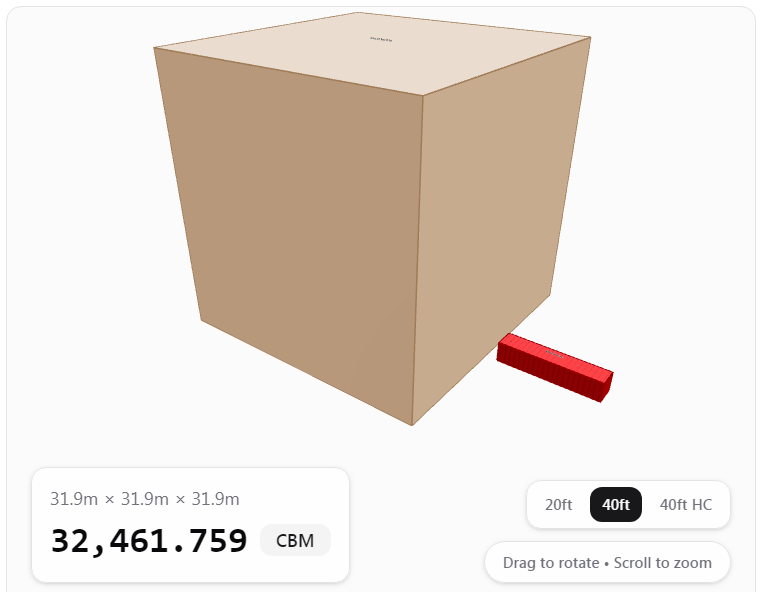
In my opinion that volume would be much bigger than the AI drew it. Here is the same volume visualized next to a standard 40ft shipping container, which is about the same length as a London red bus, using
CBM Calculator.
- shipping container.png (31.32 KiB) Viewed 5734 times
The square volume is 12x the container's height. Or about 7x the height of a London red bus.
Therefore I think the pile of ashes in your AI depiction is too small. By rough estimate, it should be 3x bigger than shown.
Re: AI usecase - image generation
Posted: Fri May 29, 2026 5:31 pm
by Wetzelrad
A group called Truth Nuke Media has done some work with AI-generated video recently. They put out a series of videos on Holocaust absurdities.
These are decidedly less serious and less technical than what we discuss here. Still, it's a good proof of how AI can work.
Re: AI usecase - image generation
Posted: Sat May 30, 2026 6:45 pm
by HansHill
Archie wrote: ↑Fri May 29, 2026 12:37 pm
In Denierbud's videos, one of his main techniques was simply to portray the story visually. This is very effective. But it's also hard to do and labor intensive. As this gets easier and easier, we should be able to take better advantage of visuals.
Agreed - one of the best parts from the One Third documentary was the demonstration of the pig carcass cremation. I have clip-farmed it for showing others how preposterous the claims are!
https://holocausthandbooks.com/video/on ... holocaust/
Wetzelrad wrote: ↑Fri May 29, 2026 5:22 pm
Therefore I think the pile of ashes in your AI depiction is too small. By rough estimate, it should be 3x bigger than shown.
Very interesting. Its possible the AI either generated a typical hallucination as we know can tend to happen, or more sinister, the key variables of the prompt triggered a holocaust guardrail, for example by recognizing the inputs from the source material, and purposely lowballed the pile size in the image. If i had to guess, i tend to favor the former. The latter would likely be met with outright refusal rather than a lowballed ash pile - it's damning enough, even if it's understated!
I have re-run it again using different models and it gives ash piles of slightly different sizes but nothing on the scale of your model!
Re: AI usecase - image generation
Posted: Sat May 30, 2026 7:07 pm
by Wetzelrad
Well, I think estimating weights or volumes by photos is a tough business and not one that AI is specifically trained for. Who knows what it's doing under the hood? Perhaps it has been trained on photos of sand and gravel piles, which could be described in terms of tonnage rather than volume, and based on your given figure of "11,100 metric tonnes" it creates a depiction of ash in line with sand and gravel despite ash actually being (maybe) half as dense.
Maybe this could be solved with a different prompt, one with different descriptions like length and width, but probably AI will chronically struggle with this problem. This problem is outside its training. Its training, being made up primarily of real photos, will bias it towards reality, whereas the Holocaust is not realistic.
Re: AI usecase - image generation
Posted: Sat May 30, 2026 7:16 pm
by HansHill
Wetzelrad wrote: ↑Sat May 30, 2026 7:07 pm
the Holocaust is not realistic.

Wetzelrad wrote: ↑Sat May 30, 2026 7:07 pm
...This problem is outside its training. Its training, being made up primarily of real photos...
This reminds me of the red wine problem. Early LLM models struggled to produce an image of a glass of red wine full to the brim. As this would not be common practice, and therefore it would be unusual to see, it was likely omitted from its training database, despite being a seemingly reasonable request. So what you are saying has merit. however this does seem to have been patched since.
Re: AI usecase - image generation
Posted: Mon Jun 08, 2026 8:03 pm
by Booze
I'd like to see an AI video Irene Zisblatt being throw over a fence, across a railroad yard, into an open train car.
Re: AI usecase - image generation
Posted: Thu Jul 16, 2026 5:46 pm
by Wetzelrad
Archie wrote: ↑Fri May 29, 2026 12:37 pm
When we were debating the Kula columns with bombsaway and he was trying to explain his Rube Goldberg theories, it got me wondering whether we could simulate some of this stuff visually with AI tools. A lot of times with these debates, I think a lot of us can "see" the issues in our hands, but when explaining it to others in language everything is not always as clear as it should be.
viewtopic.php?t=774
I like this idea, so I gave it an honest shot. I wrote out clean descriptions for all the column designs that I wanted to be depicted. Tried feeding them into various AIs in various ways. In theory it should be possible for AI to spit out a single neat drawing with each design side-by-side and labelled. In practice I can't get even a single accurate rendering of just one Kula column design. I've got crystals in the wrong places, crude squiggles instead of a metallic spiral, random cross-section views where they didn't belong, etc. Quite disappointing.
I may continue fiddling with this. I suspect it would be considerably faster and more accurate to render these myself in a CAD program, but developing some skill with AI could have a greater pay off.
Re: AI usecase - image generation
Posted: Thu Jul 16, 2026 5:57 pm
by HansHill

- 4580a4dfeee405bea211927fc76540b0.gif (216.21 KiB) Viewed 3132 times
Re: AI usecase - image generation
Posted: Thu Jul 16, 2026 6:57 pm
by Stubble
HansHill wrote: ↑Thu Jul 16, 2026 5:57 pm
4580a4dfeee405bea211927fc76540b0.gif
Did you ask it to draw BA's Kula Column?
Re: AI usecase - image generation
Posted: Sat Jul 18, 2026 6:43 pm
by Archie
Wetzelrad wrote: ↑Thu Jul 16, 2026 5:46 pm
Archie wrote: ↑Fri May 29, 2026 12:37 pm
When we were debating the Kula columns with bombsaway and he was trying to explain his Rube Goldberg theories, it got me wondering whether we could simulate some of this stuff visually with AI tools. A lot of times with these debates, I think a lot of us can "see" the issues in our hands, but when explaining it to others in language everything is not always as clear as it should be.
viewtopic.php?t=774
I like this idea, so I gave it an honest shot. I wrote out clean descriptions for all the column designs that I wanted to be depicted. Tried feeding them into various AIs in various ways. In theory it should be possible for AI to spit out a single neat drawing with each design side-by-side and labelled. In practice I can't get even a single accurate rendering of just one Kula column design. I've got crystals in the wrong places, crude squiggles instead of a metallic spiral, random cross-section views where they didn't belong, etc. Quite disappointing.
I may continue fiddling with this. I suspect it would be considerably faster and more accurate to render these myself in a CAD program, but developing some skill with AI could have a greater pay off.
Sounds like the Kula columns are too complicated/convoluted for the out-of-the-box AI to handle. Probably still requires specialized software like a CAD program (most of which are not free). But I would expect AI tools (perhaps incorporated as add-ons to specific software) to eventually reduce the time, effort, and training needed to produce quality diagrams and animations.
Over the last few decades, editing video has gotten immensely easier and cheaper, but diagrams and animations still seem pretty difficult.
Re: AI usecase - image generation
Posted: Sat Jul 18, 2026 8:53 pm
by Stubble
I got Venice AI to do some reasonable mock ups, but, the scale was terrible when I told it to include a 5'4" human for scale.
Re: AI usecase - image generation
Posted: Sun Jul 19, 2026 6:27 am
by Callafangers
HansHill wrote: ↑Sat May 30, 2026 6:45 pm
Wetzelrad wrote: ↑Fri May 29, 2026 5:22 pm
Therefore I think the pile of ashes in your AI depiction is too small. By rough estimate, it should be 3x bigger than shown.
Very interesting. Its possible the AI either generated a typical hallucination as we know can tend to happen, or more sinister, the key variables of the prompt triggered a holocaust guardrail, for example by recognizing the inputs from the source material, and purposely lowballed the pile size in the image. If i had to guess, i tend to favor the former. The latter would likely be met with outright refusal rather than a lowballed ash pile - it's damning enough, even if it's understated!
I have re-run it again using different models and it gives ash piles of slightly different sizes but nothing on the scale of your model!
I don't think it's a guardrailing issue in this case. Image generation LLM's still struggle with matters of scale. Even using Google's models for things like home interior design leads to couches/furniture that is too large or small for the actual room size in many cases. More broadly, there's a lot of discussion about the problem of AI / LLMs not understanding the physical world very well (since they are usually only trained on text or images from a limited number of angles or perspectives, essentially in 2D):
https://www.here.com/learn/blog/llm-spa ... -reasoning
For anything which can be articulated with language, LLMs have reached unfathomable levels... but the spatial/physical world needs a new approach (likely why we still don't see widespread self-driving cars, robots, etc., since our trust in their ability to safely navigate the physical world remains limited).