Page 1 of 1

Sturdy Colls - Finding Treblinka (2026) - comments by Skrbina, Rudolf

Posted: Sun Aug 02, 2026 9:00 pm
by Archie
Caroline Sturdy Colls has a new book published July 15, Finding Treblinka. The ebook is available for free online. The books says it was paid for by the Claims Conference which is the shakedown operation to force never-ending Holocaust reparations.

https://cornellpress.cornell.edu/book/9 ... bookTabs=1

A few days ago, CODOH published a full review by David Skrbina.
https://codoh.com/library/document/trut ... uth-found/

And Germar Rudolf wrote a technical reply to CSC's claim that some bricks have been tested and shown to have evidence of unusual CO exposure.
https://codoh.com/library/document/the- ... treblinka/

Skrbina notes that she only mentions diesel twice in the whole book and it seems she's trying to pivot to gasoline engines. The is of course the pivot that was attempted by HC some years ago, but it doesn't seem to have caught on in the mainstream. A couple of notes below from the Skrbina article.

She spends the first five chapters on Treblinka I. Seems like she was trying to pad out the book.

She handwaves quite a bit on the graves.
“Given their location in the area thought to contain most of the mass graves, their size, and their proximity to the memorial, there is a compelling case for arguing that they represent body disposal sites. While it could be argued that they might represent areas of postwar looting activity, their linearity suggests that they likely predated such actions even if they were later affected by them.” (p. 301)
“Without intrusive activity, it is not possible to conclusively determine the nature of these pits.”
She boldly claims to have found the locations of the gas chambers. This is of course a bluff.
“Historical and archeological research undertaken at T-II…was able to confirm the exact location of the Old and New Gas Chambers for the first time” (p. 277).
She presents material discussing the difficulty of cremating corpses and the high temperatures required for full incineration.

Re: Sturdy Colls - Finding Treblinka (2026) - comments by Skrbina, Rudolf

Posted: Sun Aug 02, 2026 10:04 pm
by pilgrimofdark
Someone... told Germar I was also writing a review of the book. I just got a paperback copy a few days ago and will try to tackle different areas than Germar/Skrbina.

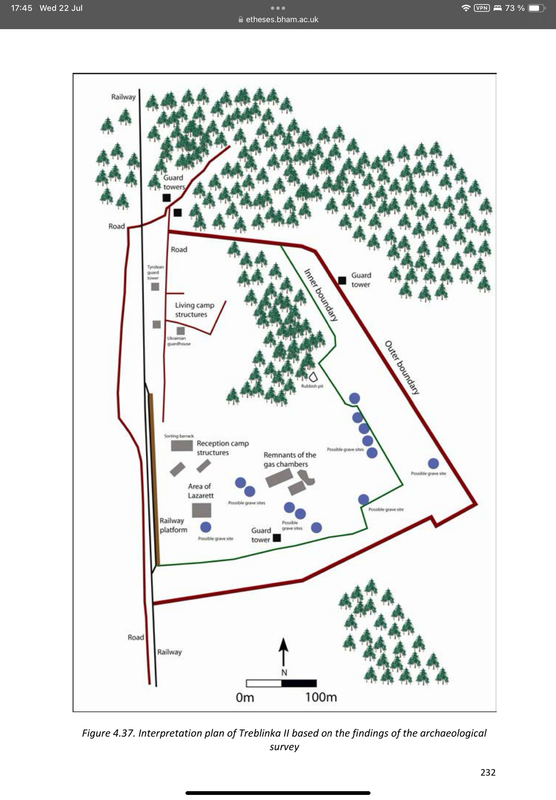
In her new book, Colls doesn't reproduce the "possible grave sites" map from p. 232 of her thesis. However, she does reproduce the similar maps from p. 231 with a different key: "Probable pits identified through geophysical survey."

So she's still a little ambiguous whether she believes Jankiel Wiernik probably lived in a pit, or possibly lived in a grave.

She's gullible to every atrocity story any Pole or Jew is willing to record. A history of T-I gets buried in a litany of atrocities, where the only thing that happened in the camp was:
  1. People were sent there
  2. They were killed
  3. More people were requested to be sent there
The gravel quarry operation was connected to DEST, the large SS company that operated in numerous camps, running stone quarries, brickworks, etc. Apparently in late 1942 or early 1943, the T-II personnel took over running the quarry, and van Eupen (of T-I but who was never there except to run people over with his horse) attempted to place Stangl (of T-II but who was never there) under his authority.

Bari the dog gets more mentions than DEST.

She incorrectly calls Zabecki the "stationmaster" twice (pp. 284, 316). In between, she also properly refers to Józef Kuźmiński as the stationmaster once (p. 296).

I was hoping it would be an integrated history of both camps considering the many overlaps, but she addresses each camp separately over the course of several chapters.

Re: Sturdy Colls - Finding Treblinka (2026) - comments by Skrbina, Rudolf

Posted: Mon Aug 03, 2026 1:50 am
by Wetzelrad
I have been curious about carbon monoxide testing for a while, so I'm glad the conversation has moved there. Knowing that AI is highly susceptible to new information, I decided to give Colls's theory of bound carbon monoxide to AI today, before perhaps it can become biased by exposure to Colls's book. Grok 4.5 responded in a way that strongly refutes Colls's theory. This is my short exchange with it:
Spoiler
Prompt wrote: Could carbon monoxide from repeated engine exhaust exposure become chemically bound to a clay brick? Also, could carbon monoxide in a clay brick still be detectable after being buried underground for 80 years?
No, carbon monoxide (CO) from engine exhaust is unlikely to become chemically bound (e.g., via strong covalent or stable coordination bonds) to a typical fired clay brick in any significant or permanent way. It can interact via weaker physical adsorption or surface processes, but these are reversible and limited.

Fired clay bricks are primarily aluminosilicates (silica, alumina, etc.) with a porous structure. CO is a small, relatively inert gas. Key points from materials science and adsorption studies:

- Adsorption, not strong chemisorption: Studies on earthen/clay materials show CO retention mainly through physisorption (weak van der Waals forces) or interactions with surface sites, influenced by humidity and temperature. Water reduces retention and slows uptake, but some CO can still be held (possibly with minor CO-water interactions or dissolution in pore water). These are not strong chemical bonds.
- Catalytic effects in specific cases: In high-iron fire-clay refractories at elevated temperatures (e.g., blast furnaces), CO can decompose catalytically (2CO → CO₂ + C), depositing carbon (graphite). This damages the material but does not bind CO molecules themselves. Zinc or iron can influence this, but it's irrelevant to ambient engine exhaust on ordinary bricks.
- Surface interactions: CO can probe Lewis acid sites on alumina/silica surfaces (vibrational shifts via electrostatic/Stark effects), but coverages are low and reversible. No stable carbonate or other fixed compounds form under normal conditions.

Engine exhaust exposure (repeated but ambient/low-temperature) would allow limited gas diffusion into pores, with mostly transient adsorption. Any binding is weak and not "chemically bound" in a durable sense.

No, CO (or residues from it) in a clay brick would almost certainly not be detectable after 80 years underground.

- Diffusion and desorption: Porous materials like bricks allow gas diffusion. CO would gradually desorb, diffuse out, or be displaced by moisture, soil gases, or microbes over decades. Studies show CO diffuses through porous walls relatively quickly.
- Environmental factors underground: Burial involves moisture, variable pH, oxygen (or anaerobic conditions), and temperature fluctuations. These promote desorption, oxidation (CO to CO₂), or dilution. Weakly adsorbed CO would not persist.
- Detection challenges: Even if trace carbon residues (e.g., from any decomposition) remained, distinguishing them from natural organic carbon, soot, or other sources in soil/clay would be extremely difficult after 80 years. No routine archaeological or forensic methods reliably detect original CO in such aged porous ceramics.

In summary, CO from exhaust would interact superficially and transiently with a brick, without stable chemical fixation. Long-term burial would eliminate any detectable traces due to physical/chemical processes over time. Specialized lab techniques (e.g., gas analysis on fresh samples) might show short-term adsorption, but not after decades.

https://x.com/i/grok/share/e7a85595d8d2 ... 19d872c2e1
However, Rudolf approached the problem in an entirely different way. I returned to Grok, and it agreed with Rudolf's conjecture. How annoying, that this is left unresolved.

Re: Sturdy Colls - Finding Treblinka (2026) - comments by Skrbina, Rudolf

Posted: Mon Aug 03, 2026 1:51 am
by Stubble
The articles are good. What Skrbina misses on being technical, Germar more than makes up for, and, his article remains approachable by most everybody. He is blunt and concise.

I may be misinformed, but, I was under the impression that Colls had been working at the site until late 2025, along with 2 separate Polish teams. I noticed by satellite images that the trees in-between the inner and outer perimeter fence were clear cut, and I am assuming that was done so these various archeologists could examine that area looking for the elusive 'huge mass graves'. I was looking forward to seeing that covered in the work. I did not.

Ultimately, reading the work felt like an exercise in futility, and, had I paid to do it, I'd want my money back. I can only imagine how her funders must feel.

Ultimately, apparently, the best evidence anyone can muster to prove that the population of Seattle was murdered there, buried, dug up, and then cremated on rail road rails, are the shoes that Wiernik's handler Adolf Berman showed the jury at the Eichmann Trial.

Sad for the orthodoxy if I'm asked.

That this is the state of affairs at Treblinka II and given what we know about Sobibor at this point, I'm genuinely surprised the myth of homicidal gas chambers disguised as shower rooms persists.

Re: Sturdy Colls - Finding Treblinka (2026) - comments by Skrbina, Rudolf

Posted: Mon Aug 03, 2026 3:12 am
by Eye of Zyclone
On pages 261 and 263 of her book, we read the following passage:
Although it seemed highly likely at this point that the discovered masonry belonged to the Old Gas Chambers, samples of them were sent to the Nicolaus Copernicus University in Toruń for further tests. Thermal Desorption Spectroscopy (TDS), which measures the absorption of molecules to a surface, revealed that the bricks and mortar had a higher emission rate of carbon monoxide compared to the reference samples tested, which ‘may indicate the presence of chemically bound CO [carbon monoxide],’ as opposed to carbon monoxide naturally absorbed from the environment.78 Therefore, it may indicate exposure to carbon monoxide, con­sistent with the descriptions provided by witnesses about how the gas chambers functioned.
I think we all know what it means about the immense weakness of a piece of evidence or an argument when some Holohoaxers say "may indicate"... :roll:

In any case, pumping and heating water from a well to supply and operate shower rooms in an isolated Polish forest (revisionist narrative) would also have required the use of a generator and would therefore have emitted exhaust fumes in the engineering room of such sanitary facilities.


Re: Sturdy Colls - Finding Treblinka (2026) - comments by Skrbina, Rudolf

Posted: Sat Aug 08, 2026 7:24 pm
by Archie
Pilgrim's review has been posted.
https://codoh.com/library/document/coll ... eper-hole/

I like "noninvasive treatment of sources." Critiquing the testimonies is probably a violation of Jewish law, ha.

It's curious to me that Colls's field is forensic archaeology yet it seems a lot of her book is more historical in nature (which is not really what she is trained for).

Re: Sturdy Colls - Finding Treblinka (2026) - comments by Skrbina, Rudolf

Posted: Sun Aug 09, 2026 12:48 pm
by pilgrimofdark
Skrbina's review was so long and comprehensive that I struggled to find much new to write about. That's why it's filled with silly puns.
Archie wrote: Sat Aug 08, 2026 7:24 pmIt's curious to me that Colls's field is forensic archaeology yet it seems a lot of her book is more historical in nature (which is not really what she is trained for).
Colls says she had a fellowship with the USHMM, and she references a lot of USHMM archival records.
Without the assistance of the United States Holocaust Memorial Museum (USHMM), this project would not have been realized. It is no exaggeration to say that my experience as part of my Fred and Maria Devinki Fellowship at the Jack, Joseph and Morton Mandel Center in 2016 was life changing. This exceptional experience ensured that I was able to utilize an extensive body of archive material that transformed my thinking on the site, that I had time to write about and reflect on my fieldwork results, and that I met so many incredible scholars who are too numerous to name.
There are a fair number of interesting bits scattered throughout the book.

Who was calling the Treblinka gas chambers "dushegubka"? That's the standard Russian euphemism for gas vans.
At Treblinka II (and at Bełżec and Sobibór), the gassing facilities were at the very heart of the Nazi extermination system. By the autumn of 1942, two such buildings had been built within Treblinka II’s “court of death,” which were variably described by guards and Jewish Sonderkommando who encountered them as “house of death nr. 1” and “house of death nr. 2,” “dushegubka” (“soul killer” in Russian), “bania” (“baths”), or as the “Alte Gaskammern” (Old Gas Chambers) and “Neue Gaskammern” (New Gas Chambers) (the latter two terms are used throughout this monograph).
The head of SMERSH, Viktor Abakumov, was pushing Soviet trials where the "dushegubka" played a role (Krasnodar and Kharkov).

Were Trawniki guards confessing to gas vans at Treblinka? How did they independently know of this Russian term for gas vans in order to confess to them being used at Treblinka?

Sometimes Colls isn't really clear on who is saying what and when and under what circumstances.

When I asked AI to help me polish sentences, it searched the internet and found Skrbina's article on CODOH. Then it gave me a stern lecture about Holocaust denial and refused to help me.

Re: Sturdy Colls - Finding Treblinka (2026) - comments by Skrbina, Rudolf

Posted: Sun Aug 09, 2026 7:24 pm
by Wetzelrad
I approve of the article and especially enjoyed the rapidfire takedown of witnesses.

All three of these articles are now on Unz Review. Skrbina's article was already featured on the front page a week ago and it attracted a lot of comments, as Holocaust articles always do. I encourage interested parties to participate in the comments sections.

https://www.unz.com/article/truth-lost- ... rdy-colls/
https://www.unz.com/article/the-chemistry-of-treblinka/
https://www.unz.com/article/colls-digs-a-deeper-hole/

Re: Sturdy Colls - Finding Treblinka (2026) - comments by Skrbina, Rudolf

Posted: Fri Aug 14, 2026 8:39 pm
by pilgrimofdark
Chad Gibbs's 2026 book Survival at Treblinka is also open access.

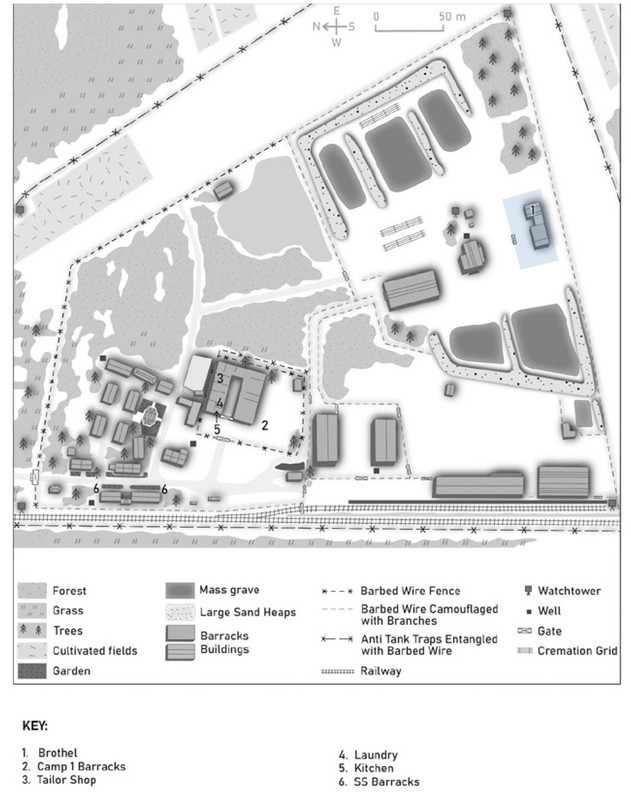
In it, he locates a little-known brothel in the "death camp" section of Treblinka.

This is in the same area where Jankiel Wiernik locates the worker barracks where he lived, and where Caroline Sturdy Colls locates "possible grave sites."

Mainstream historians and communist forgers conspiring to hoax documents have worked out to their satisfaction that Jewish women would have sex in mass graves, and that this was so common in eastern European Jewish culture that it was barely worth a mention for 80 years.

If you disagree, you will be labeled anti-semitic.

Gibbs's book is relatively short, so I might consider writing a review for IH.

Re: Sturdy Colls - Finding Treblinka (2026) - comments by Skrbina, Rudolf

Posted: Sat Aug 15, 2026 3:42 am
by Stubble
pilgrimofdark wrote: Fri Aug 14, 2026 8:39 pm Chad Gibbs's 2026 book Survival at Treblinka is also open access.

In it, he locates a little-known brothel in the "death camp" section of Treblinka.

This is in the same area where Jankiel Wiernik locates the worker barracks where he lived, and where Caroline Sturdy Colls locates "possible grave sites."

Mainstream historians and communist forgers conspiring to hoax documents have worked out to their satisfaction that Jewish women would have sex in mass graves, and that this was so common in eastern European Jewish culture that it was barely worth a mention for 80 years.

If you disagree, you will be labeled anti-semitic.

Gibbs's book is relatively short, so I might consider writing a review for IH.
Wait, can you repeat that, slowly? I'm pretty sure I didn't understand what you just said. A little-known, what? In the, where?

Oh, and thanks for the link. I ganked a copy.

Re: Sturdy Colls - Finding Treblinka (2026) - comments by Skrbina, Rudolf

Posted: Sat Aug 15, 2026 12:40 pm
by pilgrimofdark
Stubble wrote: Sat Aug 15, 2026 3:42 am Wait, can you repeat that, slowly? I'm pretty sure I didn't understand what you just said. A little-known, what? In the, where?
From page 74 of the book, Gibbs's brothel is listed as #1 in the map. I overlaid a blue highlight.

Image

Same area where Colls puts "possible grave sites."

Image

In the bibliography, Gibbs lists four books/articles by Colls, so he's aware of her archaeological work.

Re: Sturdy Colls - Finding Treblinka (2026) - comments by Skrbina, Rudolf

Posted: Sat Aug 15, 2026 1:09 pm
by Stubble
Which map is he using, it looks like the mass graves from the Wiernik map, but, it isn't square.

Re: Sturdy Colls - Finding Treblinka (2026) - comments by Skrbina, Rudolf

Posted: Sat Aug 15, 2026 8:47 pm
by pilgrimofdark
Stubble wrote: Sat Aug 15, 2026 1:09 pm Which map is he using, it looks like the mass graves from the Wiernik map, but, it isn't square.
He had several of his own made for the book, but they're based on the Laponder map -- copy on HEART. Gibbs has a maps for each of the early (Eberl era) and reorganized/expanded (Stangl era) layout of the camp.

He also references Moyshe Klaynman's "forest account" memoir of Treblinka written in the style of a four-act musical drama :!: It's on Yad Vashem in Yiddish.

Auerbach wrote a radio play and a movie screenplay outline based on Treblinka, and now we have a musical.

---

Edit / side note: all these little projects end up requiring delving into several deeper levels of Hell.

Gibbs's book is a slightly revised version of his dissertation, which is probably fine.

But his 2021 dissertation is also substantially identical to his 2016 master's thesis. The dissertation might just be edited with a couple new chapters.
Thesis
Belzec, Sobibor, and Treblinka occupied a distinctive position set apart from the wider ‘concentration camp universe.’ The Aktion Reinhard camps reported directly to Higher SS and Police Leader for the Lublin District Odilo Globocnik and through him to the Reichsführer-SS Heinrich Himmler personally. The standard chain of camp command through the SS Inspectorate of Concentration Camps was not involved. The Reinhard camps would contribute to Nazi German state finances by sending belongings stolen from their victims back to Germany, but they would not provide any labor income to the SS Main Economic and Administrative Department, as was the practice of concentration camps. The purpose of the Reinhard camps was simple. Inside their small wire walled spaces what Nazi ideologues termed Europe’s “Jewish Question” would receive its “Final Solution.”
Dissertation
Belzec, Sobibor, and Treblinka occupied a distinctive position set apart from the wider ‘concentration camp universe.’ The Aktion Reinhard camps reported directly to Higher SS and Police Leader for the Lublin District, Odilo Globocnik, and through him to the Reichsführer-SS Heinrich Himmler, personally. The standard chain of camp command through the SS Inspectorate of Concentration Camps was not involved. The Reinhard camps contributed to Nazi German state finances by sending belongings stolen from their victims back to Germany, but they did not provide any labor income to the SS Main Economic and Administrative Department, as was the practice of concentration camps. The purpose of the Reinhard camps was simple. Inside their small, wire-walled spaces, what Adolf Hitler and his fellow Nazi ideologues termed Europe’s “Jewish Question” would receive its “Final Solution.”
Book
Nazi authorities designed the Treblinka extermination camp and the other two Aktion Reinhard camps of Belzec and Sobibor to carry out the total annihilation of European Jewry and to leave no witnesses to tell the tale. These three camps held a distinctive position set apart from the wider “concentration camp universe,” reporting directly to Odilo Globocnik, Higher SS and Police Leader for the Lublin District, and, through him, to the Reichsführer-SS Heinrich Himmler personally. The standard chain of camp command through the SS Inspectorate of Concentration Camps was not followed. The Reinhard camps contributed to Nazi German state finances by sending belongings stolen from their victims back to Germany, but they did not provide any labor income to the SS Main Economic and Administrative Department, as was the practice of concentration camps elsewhere. The purpose of the Reinhard camps was simple. Inside their small, wire-walled spaces, what Adolf Hitler and his fellow Nazi ideologues termed Europe’s “Jewish Question” would receive its “Final Solution.”
Now I wonder if I can polish up some of my junior high papers and submit them for a PhD.