
Reminder that Archie constantly misrepresents my actual position. Those photos are not proof of 900,000 murders. They are a part of the evidence, from multiple corroborating sources, that prove mass murder. How many were killed, comes from witness estimations and transport documentation, since the Nazis cremated the majority of the corpses, preventing body counts.Archie wrote: ↑Fri Nov 21, 2025 12:58 amReminder that Nessie thinks that the photos below are proof of 900,000 murders.Nessie wrote: ↑Thu Nov 20, 2025 1:25 pmThe archaeological surveys prove you wrong. It is merely your opinion they contained the corpses of those who died from typhus. You offer no evidence to support that claim.HansHill wrote: ↑Thu Nov 20, 2025 12:35 pm
This is a lie, and you are a liar. You have not shown Keen, or anybody else for that matter, the remains of 800,000 bodies at Treblinka, and neither have you showed him or anybody else the grave space capacity for 800,000 corpses.
You are a liar, and your claims remain unsubstantiated.
Given that Nessie's judgment is clearly detached from reality, his opinions on archaeology can be safely discounted.
What Actually DID Happen at Treblinka?
Re: What Actually DID Happen at Treblinka?

Sanity Check - "Thus, currently revisionists can console themselves by affirming their incredulity..."
-
Callafangers

- Administrator
- Posts: 1290
- Joined: Tue Sep 24, 2024 6:25 am
Re: What Actually DID Happen at Treblinka?
This is some goofy stuff, Nessie.Nessie wrote: ↑Fri Nov 21, 2025 7:41 am You produce a series of alternate hypothesis and declare job done. You are wrong. You need to produce a chronologically evidence history of the camp;
- evidence pertaining to its origins, why it was set up, the department responsible, what documents and witnesses said
- when it opened, how long it ran for and when it closed
- when it took prisoners, how many it took, where they came from and what those prisoners said happened to them
- evidence about the staff and what they said about their work at the camp
- evidence of when it took prisoners with typhus, what happened to them and how many there were
- evidence of the border measures in operation and how they developed during the time the camp was open. Evidence an operational border in 1942-3, where the camp was, that also affected others, such as local Poles. Evidence the people who arrived at the camp, leaving and where they went to.
There is evidence of property theft and sorting, but you use eyewitnesses such as Bomba, you claim is a liar and you cannot evidence what happened to the people after everything including their hair, had been stolen from them.
You talk about the tradition of writing history, but you fail to write the history of the camp.
Your camp won the world and had infinite access to every archive and record, constructing trial after trial with coerced witnesses and fabricated claims. This is the only reason you can come up with a 'chronology of events' and, to no one's surprise, the verifiable evidence works firmly against you -- you can't find an extermination order, a gas chamber or gas van blueprint, a clear wartime admission of gassed Jews, nor a single mass grave in the same galaxy as your estimates.
You're forced to assume the key players in 'investigating the Holocaust' and 'preserving the memory', etc., were generally honest (as Jews and communists are), but the reality is shown to be the opposite.
Your position is so obviously delusional that it will not uphold itself; there is no path forward where this becomes the case. Anyone reading these threads will plainly see that you're forced to posture yourself a certain way rather than engaging sincerely and directly with the evidence that challenges you. You reiterate and restate the same slogans, like a politician, rather than showing good faith in your arguments.
Forensics lack both graves and chambers—the liar's ink stains history's page.

Re: What Actually DID Happen at Treblinka?
Nessie believes in the 900,000 death toll figure? Interesting. Seems I was being too charitable letting him away with defending "just" 800,000. I'll be sure to use this larger, stupider and even less realistic number when ragdolling him in future

Re: What Actually DID Happen at Treblinka?
Pointing out that you fail to do the most basic task of any historian or criminal investigator, is hardly "goofy"!Callafangers wrote: ↑Fri Nov 21, 2025 9:01 amThis is some goofy stuff, Nessie.Nessie wrote: ↑Fri Nov 21, 2025 7:41 am You produce a series of alternate hypothesis and declare job done. You are wrong. You need to produce a chronologically evidence history of the camp;
- evidence pertaining to its origins, why it was set up, the department responsible, what documents and witnesses said
- when it opened, how long it ran for and when it closed
- when it took prisoners, how many it took, where they came from and what those prisoners said happened to them
- evidence about the staff and what they said about their work at the camp
- evidence of when it took prisoners with typhus, what happened to them and how many there were
- evidence of the border measures in operation and how they developed during the time the camp was open. Evidence an operational border in 1942-3, where the camp was, that also affected others, such as local Poles. Evidence the people who arrived at the camp, leaving and where they went to.
There is evidence of property theft and sorting, but you use eyewitnesses such as Bomba, you claim is a liar and you cannot evidence what happened to the people after everything including their hair, had been stolen from them.
You talk about the tradition of writing history, but you fail to write the history of the camp.
There is no overarching extermination order. There is AR, its link to T4 and the circumstantial evidence of its operation to empty ghettos and take transports of Jews from all over Europe, stealing their property and those people then vanish from the documentary trail, leaving zero evidence they were still alive.Your camp won the world and had infinite access to every archive and record, constructing trial after trial with coerced witnesses and fabricated claims. This is the only reason you can come up with a 'chronology of events' and, to no one's surprise, the verifiable evidence works firmly against you -- you can't find an extermination order, a gas chamber or gas van blueprint, a clear wartime admission of gassed Jews, nor a single mass grave in the same galaxy as your estimates.
You're forced to assume the key players in 'investigating the Holocaust' and 'preserving the memory', etc., were generally honest (as Jews and communists are), but the reality is shown to be the opposite.
The gas chambers have been traced, or their ruins, as the Nazis destroyed as much evidence as they could. There are no gas van blueprints, but there are a series of documents recording their use. There are plenty of eyewitnesses, for which there is no evidence of coercion. There is a ton of archaeological evidence proving mass graves.
The delusional one, is you, as deny the existence of and lie and misrepresent the evidence.Your position is so obviously delusional that it will not uphold itself; there is no path forward where this becomes the case. Anyone reading these threads will plainly see that you're forced to posture yourself a certain way rather than engaging sincerely and directly with the evidence that challenges you. You reiterate and restate the same slogans, like a politician, rather than showing good faith in your arguments.
There is no evidence that challenges me. It all chronologically, logically and evidentially fits, to produce a history of TII and the other AR camps.
Sanity Check - "Thus, currently revisionists can console themselves by affirming their incredulity..."
Re: What Actually DID Happen at Treblinka?
I believe the death toll is in the range of 800-900,000.
How about you evidence how many died at TII?

Sanity Check - "Thus, currently revisionists can console themselves by affirming their incredulity..."
- pilgrimofdark
- Posts: 497
- Joined: Sat Aug 09, 2025 7:46 pm
Re: What Actually DID Happen at Treblinka?
Nessie, I apologize. When you posted this link with no attribution to "Das Prussian," I assumed it was your own independent work. I see I was incorrect and that is my mistake.Nessie wrote: ↑Thu Nov 20, 2025 1:30 pm My claim is in relation to the witnesses who worked at TII. List of witnesses to TII here;
https://codohforum.com/viewtopic.php?t=372
Instead, you plagiarized a list of inaccurate source references and spammed a portion of it at me here.
I'm going to stop derailing this thread on Treblinka.
I will take up your plagiarism in the appropriate forum.
Re: What Actually DID Happen at Treblinka?
The very sentence in the link "A list complied by Das Prussian, who wrote the introduction...". Learn what plagiarism is, before you accuse me of it!pilgrimofdark wrote: ↑Fri Nov 21, 2025 1:12 pmNessie, I apologize. When you posted this link with no attribution to "Das Prussian," I assumed it was your own independent work. I see I was incorrect and that is my mistake.Nessie wrote: ↑Thu Nov 20, 2025 1:30 pm My claim is in relation to the witnesses who worked at TII. List of witnesses to TII here;
https://codohforum.com/viewtopic.php?t=372
Instead, you plagiarized a list of inaccurate source references and spammed a portion of it at me here.
I'm going to stop derailing this thread on Treblinka.
I will take up your plagiarism in the appropriate forum.
Discussing the people who worked at TII, is not a derail. I have been on forums about denial for many years. I have NEVER seen any so-called revisionist, who accepts the evidence of any person on Das Prussian's list, for TII, as being truthful, when it comes to describing gassings, the gas chambers, mass graves or mass cremations.
Witness evidence is the best narrative evidence. Without it, so-called revisionists will never be able to construct a chronological narrative of events at the camp. They will never be able to prove what they variously think happened there.
Sanity Check - "Thus, currently revisionists can console themselves by affirming their incredulity..."
-
Wahrheitssucher

- Posts: 1000
- Joined: Mon May 19, 2025 2:51 pm
Re: What Actually DID Happen at Treblinka?
For anyone watching the 2026 World Cup final, the arena is filled to capacity!
And that capacity is 82,500 people.
So if there are any holyH believers reading this, they should consider the amount of people that was visible on their TV screen.
TEN TIMES that capacity-crowded arena, is the amount of people CLAIMED to be buried at a small area at the Treblinka 2 camp.
Hopefully anyone reading this who saw that packed arena and still believes the obviously bogus, holyH, mass-gassing, atrocity propaganda — will fnally understand that they've been duped.
As that many people could not possibly have been gassed, then cremated, then their burnt bones ground up, then buried at the tiny area claimed in Treblinka 2.

Ten times this amount of people is claimed by the holyH promoters to be buried yet untraceable at the T2 camp
A ‘holocaust’ believer’s problem is not technical, factual, empirical or archeological — their problem is psychological.
Re: What Actually DID Happen at Treblinka?
That does look impossible. Witnesses say there were only 3-6 mass graves at Treblinka*, with it most commonly depicted as 5 graves, but how would two stadiums' worth of people fit into one of these graves?

This is the Jankiel Wiernik model from the Ghetto Fighter's House museum. This is supposedly how Treblinka II looked. It's ludicrous. You can get a sense of the scale from the surrounding buildings.
* Jankiel Wiernik depicts 5 graves, Richard Glazar also 5, Samuel Willenberg 3, and the Franz Stangl trial map 6.
This is the Jankiel Wiernik model from the Ghetto Fighter's House museum. This is supposedly how Treblinka II looked. It's ludicrous. You can get a sense of the scale from the surrounding buildings.
* Jankiel Wiernik depicts 5 graves, Richard Glazar also 5, Samuel Willenberg 3, and the Franz Stangl trial map 6.

Re: What Actually DID Happen at Treblinka?
This seeming difficulty is solved easily utilizing the methods of Muehlenkamp Math.Wahrheitssucher wrote: ↑Sun Jul 19, 2026 8:26 pm TEN TIMES that capacity-crowded arena, is the amount of people CLAIMED to be buried at a small area at the Treblinka 2 camp.
https://www.codohforum.com/viewtopic.php?t=202
-Assume all the victims were toddlers
-Assume the bodies were ground up and compacted prior to burial
-Assume the graves were left open to decompose and were topped off with additional bodies in order to carefully consider every inch of grave space
-Assume all ground disruptions were, at one time, stuffed to the brim with bodies
Et voila, the bodies fit easily!
Incredulity Enthusiast
-
Callafangers
- Administrator
- Posts: 1290
- Joined: Tue Sep 24, 2024 6:25 am
Re: What Actually DID Happen at Treblinka?
I have gone through quite a few stadium photos with large crowds to make the same argument (one which comes even earlier from Hannover at the previous CODOH forum) but this image is my favorite thus far. Great find. It's a perfect illustration to compare:Wahrheitssucher wrote: ↑Sun Jul 19, 2026 8:26 pm For anyone watching the 2026 World Cup final, the arena is filled to capacity!
And that capacity is 82,500 people.
So if there are any holyH believers reading this, they should consider the amount of people that was visible on their TV screen.
TEN TIMES that capacity-crowded arena, is the amount of people CLAIMED to be buried at a small area at the Treblinka 2 camp.
Hopefully anyone reading this who saw that packed arena and still believes the obviously bogus, holyH, mass-gassing, atrocity propaganda — will fnally understand that they've been duped.
As that many people could not possibly have been gassed, then cremated, then their burnt bones ground up, then buried at the tiny area claimed in Treblinka 2.
- The sheer multitudes of people (and volume) which the number 82,500 represents (and by extension 800,000+)
- The size of the football field below the crowd is also useful. A quick Google search reveals that a FIFA World Cup football (soccer) field/pitch is around 105 meters long (and I am estimating about 63 meters wide). That comes to a surface area of about 6,600m2. If digging one meter deep across that surface, that's 6,600 cubic meters; two meters deep is 13,200 cubic meters, etc.
- Useful for visual estimations on theoretical grave capacity, comparing to 'Holocaust' excavations.
Forensics lack both graves and chambers—the liar's ink stains history's page.
- pilgrimofdark
- Posts: 497
- Joined: Sat Aug 09, 2025 7:46 pm
Re: What Actually DID Happen at Treblinka?
They removed some seats, so the capacity decreased to 80,760.
The MetLife Stadium field soccer field has about the same surface area as 5.7 Olympic-sized swimming pools.
So, 100% of the people in the arena are said to have been (some combination of) buried, dug up, burned, re-buried in that soccer field.
That's taking the most generous measurements plagiarists have been able to work out to their satisfaction:
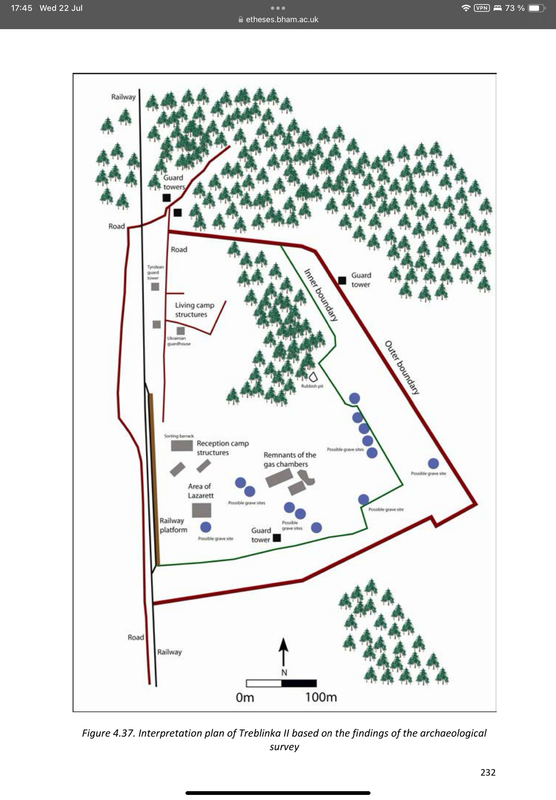
She has worked out to her satisfaction that Jews like Jankiel Wiernik were living in mass graves (thesis, p. 232). She believes he is a liar engaged in a conspiracy to hoax Treblinka architecture, when in reality he ate, slept, and conspired to revolt in a mass grave.
The MetLife Stadium field soccer field has about the same surface area as 5.7 Olympic-sized swimming pools.
So, 100% of the people in the arena are said to have been (some combination of) buried, dug up, burned, re-buried in that soccer field.
That's taking the most generous measurements plagiarists have been able to work out to their satisfaction:
- 5.7 Olympic-sized swimming pools <-> 80,760 corpses -- photo shown
- 57 (or 56) Olympic-sized swimming pools <-> 807,600 corpses -- ten times the photo shown
Sturdy Colls's map shows "possible grave sites" in the place where the alleged Camp 2 / Upper Camp barracks for workers were located based on Wiernik's model (two buildings closest to the camera).
She has worked out to her satisfaction that Jews like Jankiel Wiernik were living in mass graves (thesis, p. 232). She believes he is a liar engaged in a conspiracy to hoax Treblinka architecture, when in reality he ate, slept, and conspired to revolt in a mass grave.
-
Wahrheitssucher
- Posts: 1000
- Joined: Mon May 19, 2025 2:51 pm
Re: What Actually DID Happen at Treblinka?
.
There is an area of land out in the Polish countryside, halfway between the villages of Poniatowo and Wólka Okrąglik.
Both Wólka Okrąglik and Poniatowo are villages in the administrative district of Gmina Kosów Lacki, within Sokołów County, Masovian Voivodeship, in east-central Poland.
The town and railway-hub at Małkinia Górna is an 8 minute drive north of this area.
Locals use it for recreational walks, couples for courting and for picnics.
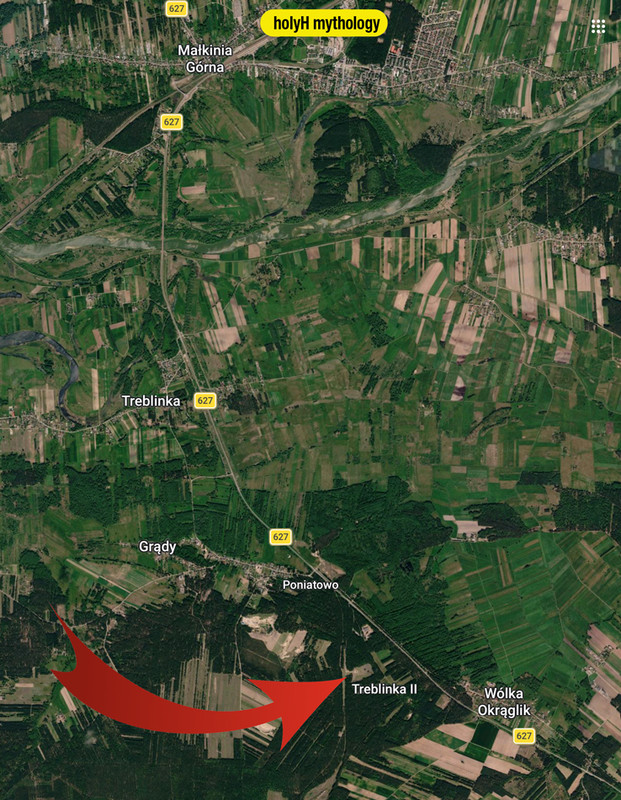
There is a memorial here that appears to be designed to prevent excavation work. It was put there by a collective that can loosely be described as ’international jewry’.
Why would jews who live far, far away from this area of countryside/farmland want to build a memorial here?
Who paid for that?
And when did they put it here?
Well, it is claimed that in 1955, the Central Board of Museums and Monuments within Poland's Ministry of Culture and Art announced a national design competition to create a memorial in the countryside of a remote part of Poland.
The winning design was supposedly created by three artists:
- Adam Haupt
- Franciszek Duszeńko
- Franciszek Strynkiewicz
Construction proceeded over several years. The project experienced delays because of funding and administrative issues. A public fundraising committee also raised additional money in Poland and abroad, supplementing state funding. The total cost was about 17 million Polish złoty (in the currency of the time).
The memorial was built between roughly 1960 and 1963 and officially unveiled on 10 May 1964.
The memorial consists of:
• approximately 17,000 rough-hewn stones spread across the former camp grounds,
• 225 inscribed stones naming towns and cities whose Jewish communities were deported to Treblinka,
• a central granite monument,
• boundary stones marking where the perimeter of the camp is thought to have been.
The village of Treblinka is in the district of Gmina Małkinia Górna, within Ostrów County in Masovian Voivodeship. The village lies close to the Bug River. It has only 350 inhabitants. It is considerably further from the area with the memorial, than both the much closer villages of Wólka Okrąglik and Poniatowo.
1. Anyone who believes this relatively tiny area ever contained a mass-grave of 600,000 human corpses and later the cremains of 850,000 is clearly extremely gullible and ignorant.
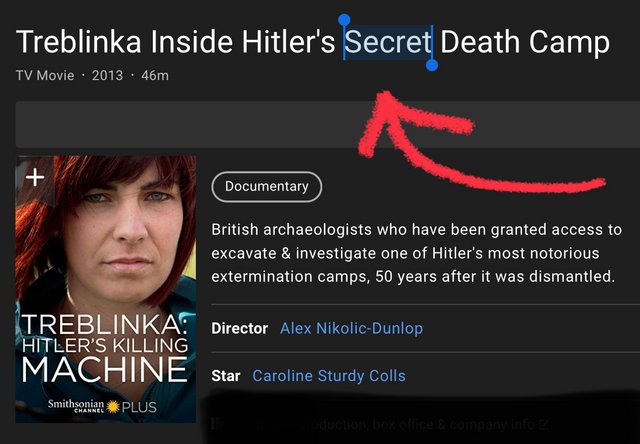
2. Anyone who believes and still maintains that the T2 camp — which was on the same spur line as the well-known T1 labour camp — was ever “secret” is more than a gullible ignoramus, they are an overly-emotional dimwit …and/or a paid deceiver:
There is an area of land out in the Polish countryside, halfway between the villages of Poniatowo and Wólka Okrąglik.
Both Wólka Okrąglik and Poniatowo are villages in the administrative district of Gmina Kosów Lacki, within Sokołów County, Masovian Voivodeship, in east-central Poland.
The town and railway-hub at Małkinia Górna is an 8 minute drive north of this area.
Locals use it for recreational walks, couples for courting and for picnics.
“… It would appear that [this area of Polish country-side has] largely been ignored
since the war . …[There is currently an] expression of territoriality for many in the Polish community, who do not wish for this site to define their region...
The area is often passed through as part of family walks and leisure activities as if it were any other part of the Polish countryside.
…the fact [is] that the site does in fact appear like a country park…
…During [my jooish-sponsored archelogical] fieldwork, young couples were [seen] picnicking at the site and despite having read the signage at the site… this appears to have caused little more than intrigue for many; how and why such a disregard for the events [claimed to have occurred here] has come about is unclear...”
~ Caroline Sturdy-Colls. Thesis. Pg. 224
There is a memorial here that appears to be designed to prevent excavation work. It was put there by a collective that can loosely be described as ’international jewry’.
Why would jews who live far, far away from this area of countryside/farmland want to build a memorial here?
Who paid for that?
And when did they put it here?
Well, it is claimed that in 1955, the Central Board of Museums and Monuments within Poland's Ministry of Culture and Art announced a national design competition to create a memorial in the countryside of a remote part of Poland.
The winning design was supposedly created by three artists:
- Adam Haupt
- Franciszek Duszeńko
- Franciszek Strynkiewicz
Construction proceeded over several years. The project experienced delays because of funding and administrative issues. A public fundraising committee also raised additional money in Poland and abroad, supplementing state funding. The total cost was about 17 million Polish złoty (in the currency of the time).
The memorial was built between roughly 1960 and 1963 and officially unveiled on 10 May 1964.
The memorial consists of:
• approximately 17,000 rough-hewn stones spread across the former camp grounds,
• 225 inscribed stones naming towns and cities whose Jewish communities were deported to Treblinka,
• a central granite monument,
• boundary stones marking where the perimeter of the camp is thought to have been.
The village of Treblinka is in the district of Gmina Małkinia Górna, within Ostrów County in Masovian Voivodeship. The village lies close to the Bug River. It has only 350 inhabitants. It is considerably further from the area with the memorial, than both the much closer villages of Wólka Okrąglik and Poniatowo.
1. Anyone who believes this relatively tiny area ever contained a mass-grave of 600,000 human corpses and later the cremains of 850,000 is clearly extremely gullible and ignorant.
2. Anyone who believes and still maintains that the T2 camp — which was on the same spur line as the well-known T1 labour camp — was ever “secret” is more than a gullible ignoramus, they are an overly-emotional dimwit …and/or a paid deceiver:
A ‘holocaust’ believer’s problem is not technical, factual, empirical or archeological — their problem is psychological.
-
Wahrheitssucher
- Posts: 1000
- Joined: Mon May 19, 2025 2:51 pm
Re: What Actually DID Happen at Treblinka?
Where does Caroline state she thinks Jankiel Wiernik is “a liar” ?pilgrimofdark wrote: ↑Wed Jul 22, 2026 1:14 pm She believes he [Jankiel Wiernik] is a liar engaged in a conspiracy to hoax Treblinka architecture…
A ‘holocaust’ believer’s problem is not technical, factual, empirical or archeological — their problem is psychological.
Re: What Actually DID Happen at Treblinka?
It is her assertion that the ground disturbances at 'Upper Camp' or 'Camp 2' are 'Huge Mass Graves'. That is an inference that all of the witnesses lied about the camp.Wahrheitssucher wrote: ↑Wed Jul 22, 2026 6:01 pmWhere does Caroline state she thinks Jankiel Wiernik is “a liar” ?pilgrimofdark wrote: ↑Wed Jul 22, 2026 1:14 pm She believes he [Jankiel Wiernik] is a liar engaged in a conspiracy to hoax Treblinka architecture…
The 'Huge Mass Graves' are not where they said they were, and, there is a hole in the ground where they said they laid their heads, so, obviously those are 'Huge Mass Graves' and the witnesses lied.
See how 'history' and 'corroboration' work? You just make it fit.
If I were to guess why no t4 personnel were chosen to perform gassing that had experience with gassing, it would be because THERE WERE NONE.